
For Eleven Years My Neighbor and I Went to War over One Mango Tree — When My Wife Died, Somebody Started Leaving Food at My Gate
PART 1: The Food at My Gate
For eleven years, I would not let my neighbor steal a single mango from my tree.
Then my wife died.
And somebody started feeding me with those same mangoes.
My name is Pilo. I am sixty-eight years old, a widower, and apparently a fool.
The tree stands exactly on the property line between my house and Aling Choleng's house.
This is the worst place God can put a mango tree.
Half its branches lean over my roof. Half lean over hers.
Its roots have lifted one corner of my path and cracked two of her flowerpots.
My father planted it.
Her father, according to Choleng, watered it.
“Water!” I once shouted. “Anybody can pour water!”
“Then why are all your plants dead?” she shouted back.
That woman had an answer for everything.
Our war appeared in the barangay blotter four times.
Twice because she complained about me. Twice because I complained about her.
Captain Boyet kept score by holding up four fingers whenever he saw us coming.
It began with harvesting.
Choleng picked mangoes at five in the morning. So I set my alarm for four-thirty.
She changed hers to four. I moved to three-forty-five and nearly fell off a monobloc chair in the dark.
There was also an incident involving two bamboo poles, one broken window, and Choleng's missing slipper.
We do not discuss that incident.
At the barangay fiesta, we entered competing desserts made from the same harvest.
I made mango float with my wife Marina. Choleng made mango sago with her niece.
We both lost to a leche flan made by a woman who had married into the barangay only six months earlier.
Choleng blamed my sour mangoes.
I blamed her cheap condensed milk.
For eleven years, Marina refused to take my side.
“Pabayaan mo na,” she would say while washing rice. “It is only a tree.”
Only a tree? A man needs principles. Also, after retirement, a man needs a hobby.
Marina would just shake her head. Sometimes I caught her hiding a smile when Choleng and I argued through the fence.
Then, in January, Marina put down a bowl in the kitchen and pressed one hand to her chest.
She looked more annoyed than frightened.
“Pilo,” she said. “Call Denise.”
Our daughter lives forty minutes away. I called her. I called an ambulance. I held Marina's hand on the way to the hospital and kept saying foolish things.
“You forgot to turn off the stove.”
“I will turn it off.”
“Your slippers are still under the table.”
“They will wait.”
“The laundry—”
“Marina, please.”
She squeezed my fingers once.
She died before sunrise.
Quickly. Quietly. Without making trouble for anybody, the way she had lived for forty-three years beside me.
During the wake, our house was never empty.
Relatives brought pancit, coffee, bread, rice, stories. Chairs scraped the floor all night.
People prayed, cried, laughed too loudly, then felt guilty for laughing.
Choleng came too.
She stood near Marina's coffin with her head bent for so long that I almost told her to sit down.
But we were enemies. So I only nodded.
She nodded back.
After the ninth night of prayers, everyone went home.
That was when I learned the truth about grief.
Grief is not the funeral. It is not the black ribbon or the flowers or the prayers.
Grief is an empty kitchen at seven in the morning.
It is reaching for two cups.
It is hearing the refrigerator hum and realizing that this is now the loudest sound in your house.
Denise called every day. She offered to stay with me, but she had children, work, and a husband who could burn boiled eggs. I told her I was fine.
I was not fine.
I ate crackers over the sink. I drank instant coffee for dinner.
Once I opened a can of sardines and stared at it until bedtime.
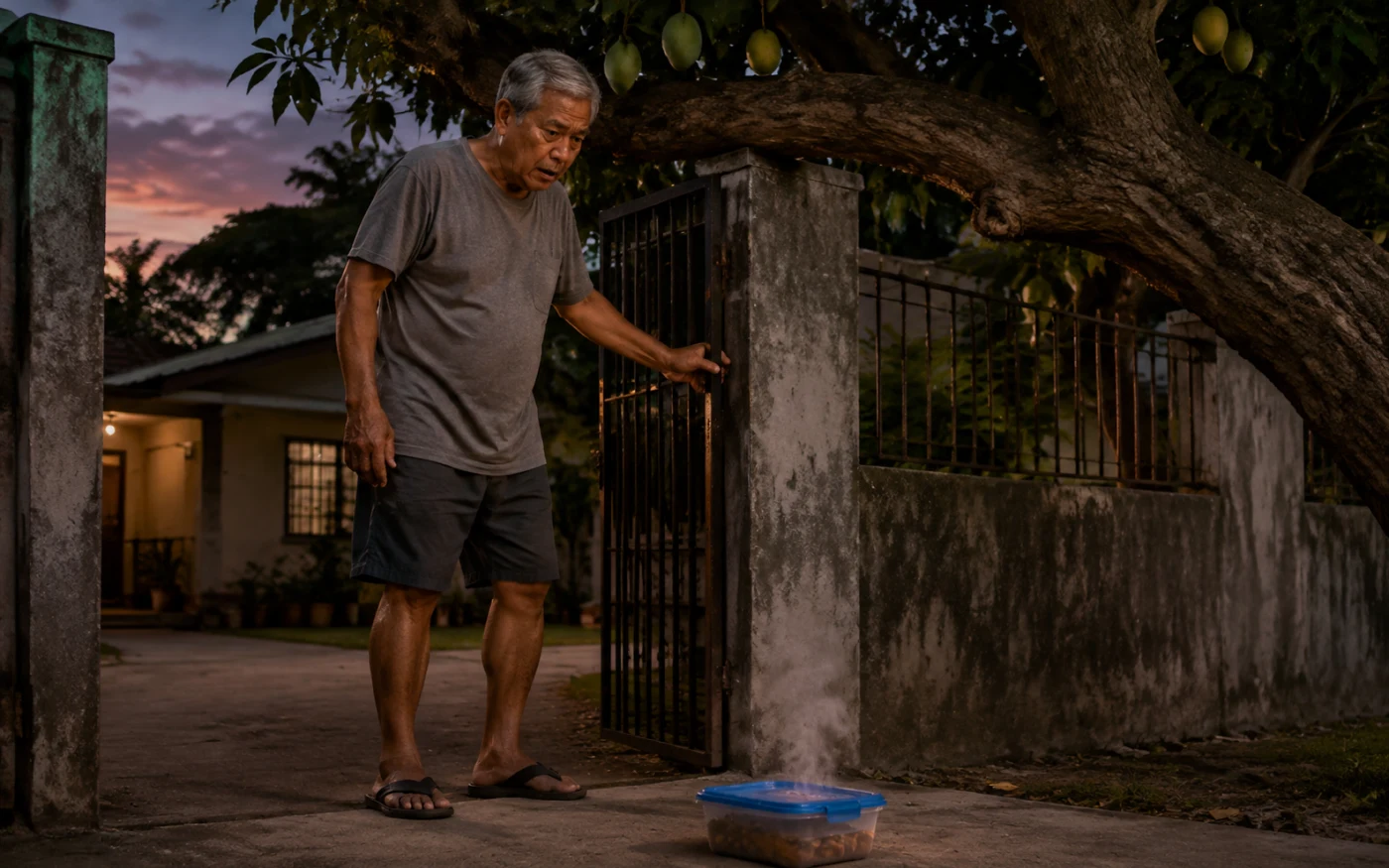
Then, one evening at exactly six, I heard a small plastic knock at the gate.
When I looked outside, nobody was there.
Only a blue-lidded tupperware sat on the concrete.
Inside was arroz caldo, still hot, with fried garlic and calamansi in a tiny plastic bag.
No note. No name.
I ate every spoonful.
The next evening, another container appeared. Ginisang munggo with malunggay leaves.
The day after that, chicken adobo with the sauce cooked down until it clung to the meat.
I called Denise.
“Are you leaving food at my gate?”
“Tay, I am at home.”
“Maybe you sent someone.”
“Why would I leave it like a kidnapper delivering ransom?”
I asked Marina's church friends.
Each one denied it, though three immediately offered to send more food.
I checked with my sister. I even asked Captain Boyet.
He said, “Maybe somebody is worried about you.”
“Then why hide?”
He shrugged. “Maybe they know your personality.”
I did not appreciate that.
The food continued through the forty days.
Then came the sinigang.
The broth was cloudy. The pork was soft.
Floating beside the kangkong were thin slices of green mango from the tree on the property line.
I knew because one slice still had the small brown scar our fruit gets where the branches rub against Choleng's roof.
I tasted the soup.
My knees nearly gave way.
It was too sour for anyone else.
Marina always added one extra handful of green mango because I complained the first time she made it.
After that, she kept doing it just to watch my face tighten.
I ate standing at the sink, crying into somebody else's tupperware.
Only a person who had stood beside Marina's stove could make it that way.
The next afternoon, I washed every empty container and lined them beside the door.
At five-fifty, I turned off the lights. Then I stood behind the curtain with my hand on the latch.
At exactly six, a shadow hurried toward my gate.
Small. Round. Carrying a red-lidded tupperware like a woman committing a crime.
I opened the door.
Aling Choleng froze.
We stared at each other across eleven years, four barangay complaints, one broken window, and one property line.
I should have thanked her.
Instead, because I am an idiot, I said, “The sinigang was too sour.”
PART 2: What Marina Had Hidden
Choleng narrowed her eyes.
“That is how Marina made it.”
“How would you know?”
“She taught me.”
I laughed once. Not because it was funny. Because the answer was impossible.
“When?”
“For years.”
“Where?”
She jerked her chin toward the back of our houses. “Sa likod ng bakod.”
I looked at the fence as if it had personally betrayed me.
Choleng pushed the tupperware against my chest. “Paksiw. Do not let it get cold.”
“Wait. You and Marina were friends?”
“Of course.”
“Of course?” My voice rose. “You fought with me every week!”
“I fought with you. Marina was pleasant.”
That was difficult to argue with.
She marched around the side of my house, and I followed her.
Near the mango tree, behind a curtain of hanging laundry, she stopped beside two loose boards in the fence.
She pulled one aside.
There was a small opening. Wide enough for a bowl. Wide enough for a hand.
On Choleng's side sat an upside-down biscuit tin that had been used as a stool.
On our side, hidden behind Marina's old pots, was a flat stone covered by a folded towel.
“She sat there?” I asked.
“Almost every afternoon.”
“For how long?”
“Maybe ten years.”
Ten years.
While I guarded the front yard like a soldier, my wife had opened a peace embassy behind the laundry.
Choleng reached through the gap and lifted a glass jar from behind the pots. Inside were folded scraps of paper.
“Recipes,” she said. “And sometimes messages.”
She handed me one.
In Marina's handwriting were the words: Pilo says your mango sago tastes like wallpaper paste. I told him he ate two bowls.
Below it, in Choleng's larger writing: He has no taste. Look at his shirts.
I was wearing one of those shirts.
Another paper said: Choleng, do you have ginger? Pilo has a cough but insists it is because the electric fan is jealous of him.
Another: Marina, your husband is stealing mangoes at 4:30. Tell him I changed my alarm to 4:00.
At the bottom, Marina had drawn a laughing face.
I sat on the flat stone.
For years, they had traded food, medicine, gossip, and jokes through that hole.
Choleng showed me the scratch on the fence where Marina tapped a spoon three times when coffee was ready.
She showed me the nail where they hung plastic bags of calamansi.
Once, when Choleng had the flu, Marina passed soup through the gap because Choleng was too proud to ask her niece for help.
“Why did she never tell me?” I asked.
Choleng snorted. “Because you would make a speech.”
She was right. This irritated me more.
“And you? Why hide it?”
“It was funny.”
I stared at her.
She tried to keep her face serious. She failed.
“You two were laughing at me.”
“Not every day.”
“Choleng.”
“Some days we discussed arthritis.”
For the first time since Marina died, a laugh escaped me before I could stop it.
It came out broken and wet. I covered my face.
Then Choleng sat on her biscuit tin, and neither of us spoke.
The leaves moved above us. A ripe mango dropped into her yard with a soft thud.
Normally, I would have shouted, “Mine!”
That afternoon, I let it lie there.
After a while, Choleng said, “She worried about you.”
I lowered my hands. “About what?”
“Being alone.”
My chest tightened.
“She knew something was wrong?”
“No. She had been getting tired more easily. She said if anything ever happened to her, you would pretend you were fine.”
Choleng picked at the edge of the old biscuit tin. “A week before she died, she made me promise something.”
“What?”
Choleng looked straight at me.
“Bantayan mo 'yang matigas ang ulo.”
I had to look away.
Marina had known me too well.
She knew I would tell Denise not to worry.
She knew I would live on crackers rather than admit I could not cook.
She knew I could turn loneliness into pride and call it independence.
So she had asked her secret friend—my sworn enemy—to feed me.
Choleng stood and brushed off her skirt. “Now return my containers.”
I pointed to the stack by my door. “They are clean.”
Her mouth fell open.
“Empty?”
“Yes.”
“You return tupperware empty?”
“You left it anonymously!”
“That does not cancel the law!”
The old Choleng had returned.
She collected the containers one by one, muttering about shameless men, bad manners, and the collapse of civilization.
Before she left, she shoved the red-lidded one back at me.
“Tomorrow,” she said. “You return this with something inside.”
“Like what?”
She looked toward Marina's quiet kitchen.
“That is your problem.”
PART 3: What I Put Inside
The next morning, I decided to cook.
This was my first mistake.
I found Marina's recipe notebook in a drawer.
Her handwriting was neat at the beginning and impatient near the bottom of every page.
I chose ginataang bilo-bilo because the picture online looked harmless.
Nothing round and sweet should be dangerous.
Two hours later, purple yam stained my hands, coconut milk was bubbling across the stove, and several rice balls had joined together into one large creature.
Denise called while I was fighting it with a wooden spoon.
“Tay, what is that sound?”
“Cooking.”
There was a long silence.
“Do I call the fire department or an ambulance?”
“Your mother wrote one cup of water. Which cup?”
“A measuring cup.”
I looked at the large coffee mug I had used three times.
“Ah,” I said.
At six, I carried the red-lidded tupperware to Choleng's gate.
She tasted one spoonful.
Her eyebrows climbed.
“Well?” I asked.
“It has no category.”
“Is it too sweet?”
“Pilo, I do not know if it is food.”
I waited for the insult. Instead, she took another spoonful.
“Why are you still eating?”
“Marina told me to watch over you. She did not say it would be easy.”
The following day, she returned the container with chicken afritada. I sent it back with burnt banana cue.
She returned it with pancit. I tried tortang talong and somehow left half the skin on.
Her reviews came through the hole in the fence.
“Too salty!”
“You ate all of it!”
“I was checking if the bottom improved!”
Soon I began waiting for the three taps of her spoon.
I repaired Marina's flat stone and replaced Choleng's rusted biscuit tin with a small stool.
Then I found an old square table in our storage room. One leg was shorter, so I wedged a piece of wood beneath it.
I placed it under the mango tree, exactly over the property line.
Half the table stood in my yard. Half stood in hers.
When Choleng saw it, she crossed her arms.
“Your half is bigger.”
“It is a square.”
“Your eyes are old.”
“So are yours.”
She went inside and returned with two plates of bibingka.
That was how two enemies began taking merienda together.
We still argued.
We argued about coffee, politics, television, and whether Captain Boyet wore hair dye.
We argued about my cooking most of all.
But never about the harvest.
When the mangoes ripened in May, Choleng appeared at four in the morning carrying the old bamboo pole.
I was already beneath the tree.
For a moment, we stood in our old battle positions.
Then I held out the basket to her.
“You pick,” I said.
She blinked. “Why?”
“Your arms are shorter. You need more practice.”
She called me an old goat, but she took the pole.
I steadied the basket while she pulled down the fruit.
We divided the harvest on the little table.
One mango for her pile. One for mine.
When she was not looking, I moved three of my best mangoes to her side.
She caught me moving the fourth.
“What are you doing?”
“Your eyes are old, remember?”
Her face changed.
Just for a second, the fight went out of it. She touched one golden mango with her fingertips.
“Marina always gave me the sweetest ones,” she said.
“I know.”
That was a lie. I had only learned it from the notes in the jar.
But I understood now why Marina had done it.
The sweetest things were never the ones worth fighting over.
Last week, near dusk, I went outside to bring in the laundry.
I heard Choleng's voice beneath the tree.
I stopped behind the curtain.
She was standing alone with one palm pressed against the trunk.
“Your Pilo can make adobo now,” she whispered. “Still too much vinegar, but edible. Denise visits every Sunday. Captain Boyet's hair is definitely blacker. And he gave me the best mangoes, though he pretended it was an accident.”
She looked up into the branches.
“He misses you. We both do.”
I could have stepped out.
I could have teased her for talking to a tree.
I could have announced that it was my tree, since my father planted it.
Instead, I quietly went back inside.
I made coffee the way Marina liked it—strong, with a little condensed milk.
Then I carried two cups to the small table on the property line.
Choleng sat across from me. Her eyes were red, but she said nothing.
Neither did I.
Above us, the branches belonged to both yards.
Between us, the two cups sent up one warm ribbon of steam.