
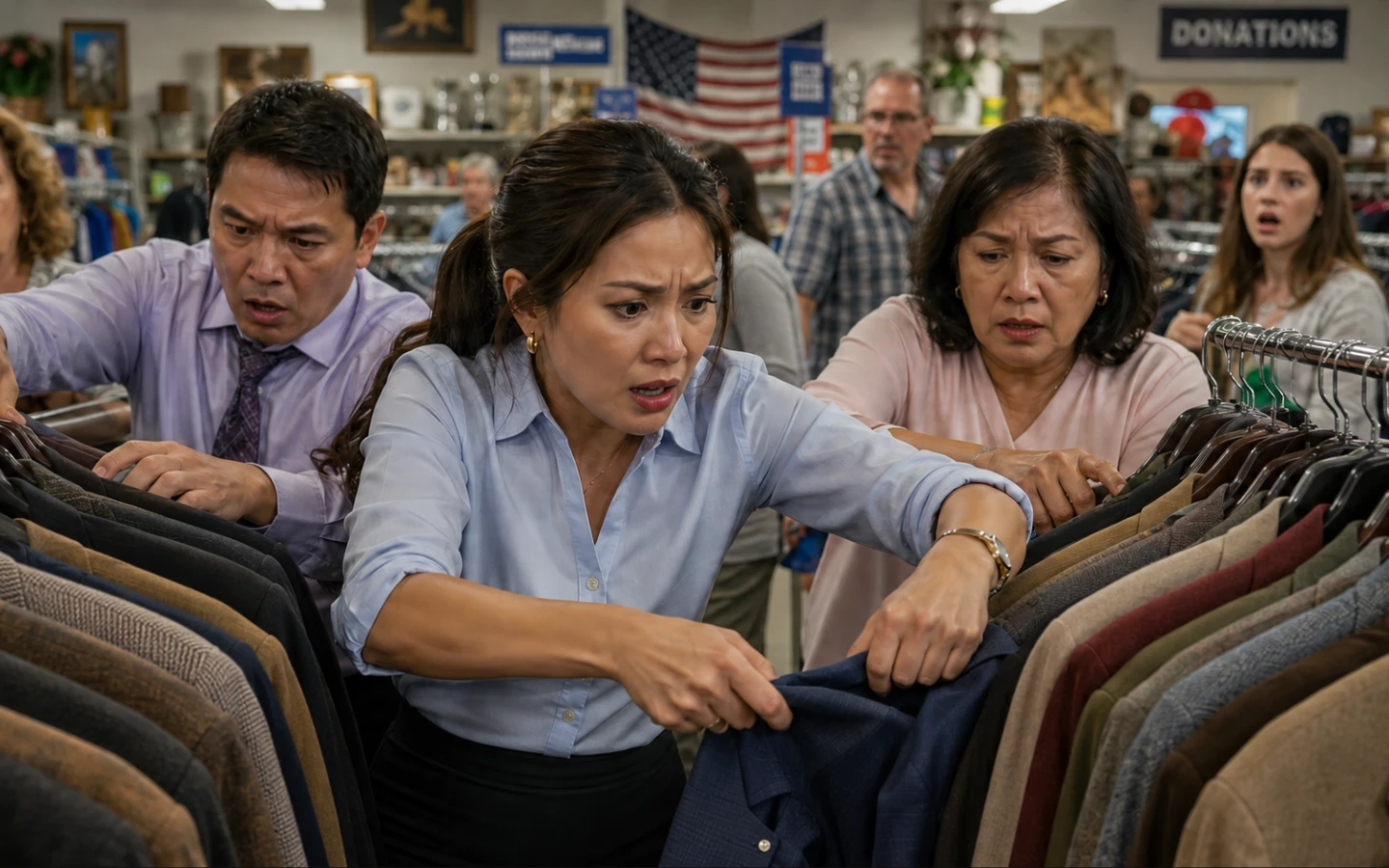
Our Office Pool Won $300 Million. The Ticket Was in the Blazer I Donated to Charity That Morning...
PART 1: Where Did the Blazer Go
I lost three hundred million dollars in a church parking lot.
Not gambling. Not crypto. Not because I trusted some cousin named Junjun with an “investment opportunity.”
I put the winning lottery ticket in a navy blazer, stuffed the blazer into a garbage bag, and donated it to charity.
The day before we won.
Diyos ko.
I work in accounting at Brightway Insurance. For six years, twelve of us had an office lottery pool. Ten dollars each every Friday. Same people. Same numbers. Same ridiculous hope.
In six years, we won four dollars.
We bought one donut and cut it into twelve pieces.
I was the ticket keeper because I was the accountant and apparently everybody trusted me with money. Cute, considering what happened next.
Every Friday I bought the tickets at the gas station on Third, folded the ticket inside our signed numbers sheet, and tucked both into the inside pocket of my navy blazer.
Same pocket. Same blazer. Six years.
We always played my numbers: 7, 17, 23, 31, 46, 57.
One weird thing: when I write a seven, I put a tiny flame on top, like a birthday candle. I’d done it since I was five. I barely remembered why.
That mattered later.
Tuesday morning, I woke up with the dangerous confidence of a woman who had watched three closet-cleaning videos before bed.
“New quarter, new life,” I told myself.
By seven-thirty I had three black garbage bags of clothes, including the navy blazer. It had a coffee stain on one cuff. I had already replaced it.
I remember holding it up and thinking, Mari, be ruthless.
So I was ruthless.
Very inspiring.
I drove the bags to St. Agnes, where a charity truck was collecting donations.
A silver-haired volunteer took the bag from me.
“Salamat, hija. Ang dami ah.”
“I’m becoming a minimalist,” I said.
She laughed. “Sige. Until Target has a sale.”
Then she tossed my bag into the truck.
I drove to work feeling spiritually superior.
The universe must have been choking.
Wednesday at exactly 8:47 a.m., Freddie from claims ran through the office holding his phone over his head.
“OUR NUMBERS! MARI! ALL SIX!”
Three hundred million dollars.
Twelve shares.
Twenty-five million each before taxes.
Nobody cared about taxes. Taxes were a problem for Future Rich Us.
Freddie started crying. Ben called his wife and shouted, “BABE!” six times. Trish from claims began practicing her resignation speech.
Then she turned to me.
“Mari. Ticket.”
My stomach dropped.
I saw the gas station. The fold. The inside pocket. The coffee stain. The black garbage bag.
“Ay, nako.”
Rosa grabbed my arm. “What?”
“The ticket is in my blazer.”
“So get the blazer.”
“I donated it yesterday.”
Nobody moved.
Freddie finally whispered, “To who?”
“Charity.”
I pulled up the donation page with shaking hands. The St. Agnes truck fed a central warehouse. The warehouse sent clothes to nineteen thrift stores around the city.
Nineteen.
Then Ben said, “Isn’t a lottery ticket a bearer ticket?”
I closed my eyes.
“Yes.”
“So if somebody finds it—”
“They can claim it.”
Trish snatched up her purse.
“Which store?”
“I don’t know.”
“Then find out.”
She was already running.
Freddie yelled, “PARKING LOT! NOW!”
And suddenly twelve insurance employees who normally complained about walking to the printer were sprinting for their cars.
Somewhere in this city, my stained six-year-old blazer was hanging over three hundred million dollars.
And anybody could put a hand in that pocket first.
PART 2: Who Got There First
You have never seen office workers move like people who might lose twenty-five million dollars.
Freddie hurdled a hedge.
The man once complained that his desk chair “felt aggressive.”
Our boss canceled every meeting and turned the conference-room whiteboard into a war map.
Nineteen stores. Teams of two.
Freddie borrowed his uncle’s church van with SANTO NIÑO PARISH painted on the side. Ben brought his minivan with three car seats still in it. Rosa got in my car carrying water, chargers, and the expression of a woman prepared to fight a coat rack.
“Every navy blazer,” she said.
“Every pocket.”
Do you know how many navy blazers exist in thrift stores?
All of them.
For two days, I checked pockets until my fingers hurt.
I found tissues, receipts, forty cents, a cough drop welded to a lining, and one grocery list that said, “eggs, eggs, ask about eggs.”
Every time my hand touched paper, my heart jumped.
Every time it was garbage, I wanted to lie on the floor.
We got shameless.
Freddie brought donuts to a stockroom and said, “Mga boss, please. Anything navy from St. Agnes.”
Rosa charmed a teenage sorting clerk into letting us see incoming racks.
Ben paid a manager twenty dollars to “check the back for blue jackets,” which was useless but emotionally necessary.
Then Trish decided the real emergency was making sure I suffered correctly.
She wrote in the group chat:
Given Mari’s negligence, I think her share should be under review.
Rosa read it over my shoulder.
“Oh, kapal.”
“Don’t.”
“I’m just saying. Kapal.”
The next morning, Trish said it to my face.
“If I find it first, sweetie, we’re renegotiating. Finders keepers.”
Freddie said, “Trish, shut up.”
She shrugged. “I’m being practical.”
Then she stopped telling us which stores she had searched.
That was when I realized she wasn’t looking with us anymore.
She was looking against us.
I barely slept Thursday night.
Freddie’s mother needed both knees replaced. Rosa was buried in her mother’s hospital bills. Ben had three kids and a mortgage with teeth.
And I had folded the answer to all of that into a coffee-stained blazer because I wanted my closet to “breathe.”
I hated my closet.
By Thursday evening, we had searched eighteen stores.
Nothing.
That was when my Tita Baby joined the war.
Tita Baby believes there is no locked door in America that cannot be opened by food.
Friday morning she arrived carrying two foil trays.
“What is that?” I asked.
“Lumpia.”
“For breakfast?”
“For information. Anak, you people have been asking questions with empty hands. Amateur.”
An hour later, she walked into the central warehouse with two hundred hot lumpia and the confidence of a woman entering a barangay meeting she intended to control.
“Good morning! Kain muna. Who is in charge?”
Doors opened.
A sorting manager named Luis ate several lumpia while flipping through route manifests.
Then his finger stopped.
“St. Agnes. Tuesday morning.”
“That’s us.”
He turned the page.
“Those bags went out Thursday.”
“Where?”
He tapped one line.
“St. Vincent’s. Alvarado.”
Store nineteen.
The only one left.
Tita Baby slapped the table. “Salamat, Lord. Luis, take more lumpia.”
We ran.
Rosa rode shotgun. Tita Baby sat in back praying the rosary at competition speed.
Then we pulled into St. Vincent’s.
And I saw Trish’s white Lexus parked sideways across two spaces.
“No,” Rosa said.
I was already out of the car.
Through the front window, Trish was at the register waving her phone at an older clerk.
“Pull the receipt,” she snapped. “Give me the customer’s name. I’ll pay you.”
The clerk crossed his arms.
“Ma’am, I told you already.”
I stopped behind her.
Then he said the words that killed me.
“The navy blazer sold about an hour ago.”
PART 3: Who Bought My Blazer
Sold.
An hour ago.
Three hundred million dollars had walked out of the store for six dollars and tax.
Trish made a noise like a kettle discovering betrayal.
“Then tell me who bought it!”
“No.”
“I’ll give you a thousand dollars.”
“No.”
The clerk’s voice was calm.
And suddenly every hair on my arms stood up.
I knew that voice.
Birthday parties. Sunday markets. Old songs in the kitchen.
And the bad years.
Phone calls I stopped answering. Birthday cards I sent back unopened.
The clerk looked past Trish.
Straight at me.
“Anak?”
I forgot about the money.
“Papa.”
I had not spoken to my father in eleven years.
Mama died twelve years earlier. Papa started drinking after the funeral and just kept falling.
He pawned Mama’s wedding ring. He missed my college graduation because he was drunk in a parking lot two cities away.
Then, on the first anniversary of Mama’s death, he knocked her framed photo off our home altar reaching for a glass.
I snapped.
“You want to destroy everything she touched? Fine. Start with me. Wala ka nang anak.”
You don’t have a daughter anymore.
For eleven years, he sent me a birthday card.
For eleven years, I wrote RETURN TO SENDER.
My handwriting got angrier.
His got shakier.
Now he stood behind a thrift-store counter wearing an apron and a volunteer badge that said DOMINGO.
Gray at the temples.
Clear-eyed.
Sober.
“You work here?” I asked.
“Six years. Since I got sober.”
Then, softly, “You look like your mama.”
Of course Trish could not survive a reunion that was not about her.
“Beautiful,” she said. “Who bought the blazer?”
Papa bent down behind the counter.
And lifted up my navy blazer.
Coffee stain and all.
“I did,” he said.
Trish froze.
“Employee price. Six dollars.”
“Why?” I whispered.
Papa looked almost embarrassed. “I liked it.”
Then he reached into the inside pocket.
Out came our folded numbers sheet.
Twelve signatures.
And the lottery ticket.
Crisp.
Unsigned.
Three hundred million dollars between his fingers.
“I was steaming the blazer when this fell out,” Papa said. “Then I saw the numbers.”
He unfolded the sheet.
“Seven. Seventeen. Fifty-seven.” His voice cracked. “Your mama’s birthday. July seventeenth, nineteen fifty-seven.”
Then he touched my seven.
The tiny flame on top.
“You still do this.”
And suddenly I remembered being five years old at the kitchen table, crying because I kept writing my sevens backward.
Papa had taken my pencil.
“Put a little flame here, anak. Now it’s a candle. You won’t forget.”
I had done it ever since.
For thirty years.
“I forgot,” I whispered.
Papa smiled through wet eyes.
“I didn’t.”
Then Trish lunged.
I am not exaggerating. She launched herself across the counter like a hawk after a sandwich.
“That belongs to the pool!”
Papa lifted the ticket out of reach.
Then the same man I had spent eleven years remembering at his worst looked at her with perfect calm.
“I bought the blazer. Ticket was inside. So right now, this is mine.”
Trish went white.
Papa turned to me.
He held the ticket flat on his palm.
“And I know who I want to give it to.”
That was the moment.
Because Papa had once pawned Mama’s wedding ring for drinking money.
Now he had three hundred million dollars in his hand.
Nobody would have known if he walked away.
And he was giving it to me.
No speech.
No excuse.
Just his open hand.
I took the ticket.
“Papa. Pen.”
He pulled one from his apron.
Right there on the thrift-store counter, with Trish staring like her soul had been audited, I signed my full legal name across the back.
Then I wrote the date.
On the seven, I drew a tiny flame.
Papa saw it.
His face crumpled.
“Anak.”
I went around the counter and hugged him.
Eleven years of anger, silence, Mama, all of it hit me at once.
He smelled like fabric steam and Old Spice.
I cried into his apron. He cried into my hair.
Tita Baby marched over, tapped Papa on the shoulder, and said, “Hoy, Domingo. Don’t make me regret bringing lumpia.”
Papa laughed through tears.
“Pasensya na, Baby.”
“Not me. Her.”
He looked at me.
“Pasensya na, anak.”
It did not fix eleven years.
But it opened the door.
This time, I walked through it.
Everyone got their share.
Yes, even Trish. Twenty-five million dollars, plus the lifelong knowledge that we all heard her say “finders keepers.”
Freddie got his mother both new knees. Rosa paid off the hospital bills. Ben paid off the mortgage and kept the minivan.
I tried to give Papa money.
He pushed the check back across my kitchen table.
“No.”
“Papa, please.”
He smiled. “I don’t need twenty-five million. I got the blazer.”
He kept it too.
Coffee stain and all.
Now he wears it to Sunday dinner at my house, where he has his own chair again.
On Mama’s birthday, we put candles on the cake.
Papa lit them.
I looked at the little flames and started laughing.
He knew exactly why.
Some things get donated.
Some things get returned to sender.
And sometimes the thing you thought was gone for good is waiting behind the counter of the very last store.