
I Wrote “No Karaoke, No Loud Aunts” on the Mayor’s Gala Memo. Then the Fancy Sound System Died and Tita Chit Smiled...
PART 1: The Machine I Banned
At four-thirty in the afternoon, with the mayor arriving in ninety minutes, the most expensive sound system ever brought to San Isidro made one soft beep.
Then it died.
Every speaker.
Every wireless microphone.
The giant LED wall.
Gone.
I stared at the black control rack.
Celeste Villareal stared at me.
Behind us, three hundred gold chairs waited under white draping I had spent two weeks calling “elevated.”
Then Tita Chit’s text arrived.
How is the elegant silence?
I wanted to throw my phone into the fountain.
Three weeks earlier, I had written the sentence that caused all of this.
ELEGANT ATTIRE. NO KARAOKE. NO LOUD AUNTS BACKSTAGE.
I meant it as a joke.
Mostly.
My seven titas did not laugh.
Tita Chit replied:
Noted.
That should have frightened me.
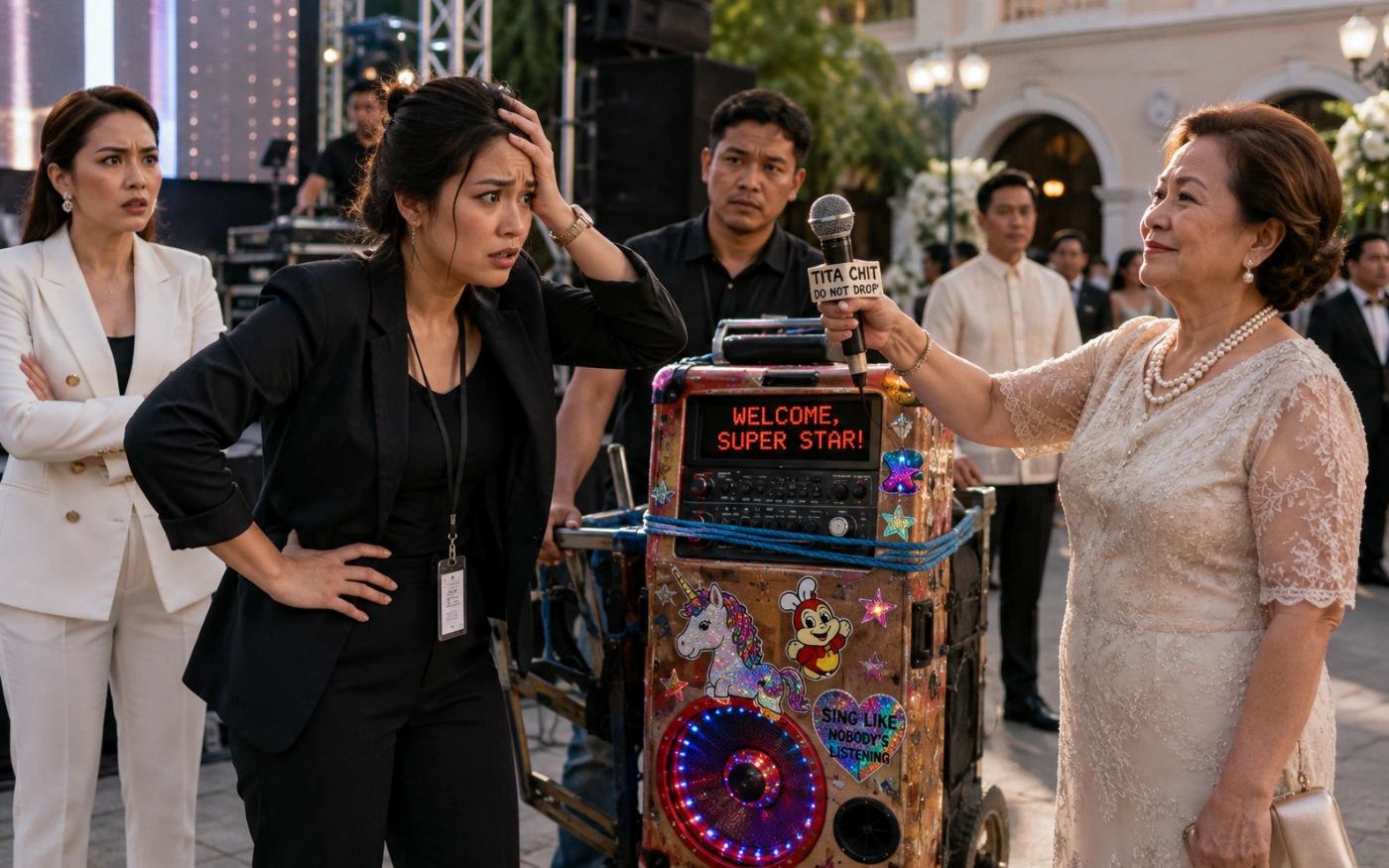
Chit owned the ugliest karaoke machine in Laguna.
It was the size of a washing machine and rolled on three good wheels and one that squeaked like a trapped mouse.
The front flashed red, blue, and green lights whether you wanted them or not.
One microphone had masking tape around the handle that said:
TITA CHIT — DO NOT DROP
The side was covered in stickers added by grandchildren over the years.
A glitter unicorn.
A faded Jollibee bee.
A holographic heart that said SING LIKE NOBODY’S LISTENING, which was impossible because Chit always turned the volume to eleven.
That machine had survived typhoons, brownouts, two debuts, one wake, and my cousin Leo sitting on it during “My Way.”
I hated it.
Not because it was bad.
Because it worked.
For six years I had organized birthdays, baptisms, fiestas, retirement parties, school programs, and one wedding where the groom disappeared for twenty minutes because nobody told him the photos had started.
Everybody said I was talented.
Then they paid me in leftover cake.
I wanted a real career.
Then Celeste came from Manila.
She was a senior producer for Veranda Events.
Their website had white flowers, black suits, mirrored tables, and no visible aunties anywhere.
The mayor had hired them for San Isidro’s Centennial Gala, and Celeste needed a local coordinator.
She looked through my event photos on her tablet.
Then she stopped at one picture.
My seven titas were dancing beside Chit’s karaoke machine while a lechon entered behind them.
Celeste zoomed in.
“You’re good,” she said.
My heart jumped.
“But this is your problem.”
She tapped the screen.
“What?”
“You still think like a hometown girl.”
That hurt.
Which is why I believed her.
Veranda had an opening for a junior producer in Manila.
If the gala went well, Celeste said she would recommend me.
Salary.
Benefits.
Real clients.
My own apartment someday.
No more relatives saying, “Mara, simple lang,” before asking for six floral arches and fireworks.
So I became unbearable.
I replaced bright flowers with white roses.
I rented sleek black speakers from Manila.
I replaced aluminum trays with ceramic serving dishes.
I told Mang Ruben there would be no lechon parade.
He stared at me.
“Then how will the lechon arrive?”
“Normally.”
“It is a pig.”
I told Ate Nita not to bring her usual emergency trays.
“We have exact guest counts.”
She narrowed her eyes.
“Exact?”
“Yes.”
“Guests are not exact.”
“Professional tayo, Ate.”
She smiled.
That smile should also have frightened me.
Then I called my titas.
“Please just come as guests.”
Chit said, “Guests?”
“Yes.”
“As in sit down?”
“Yes.”
“And no helping?”
“Yes.”
“What if you need something?”
“I have professionals.”
Silence.
Then:
“Okay.”
I felt powerful.
For about seventeen days.
At four-thirty on gala day, the Veranda sound rack beeped and died.
The technician opened the back.
Then he said the sentence every event planner dreams of hearing.
“I’ve never seen this before.”
Celeste turned toward me.
“Fix it.”
“You brought the system.”
“You’re the local coordinator.”
“The mayor speaks in ninety minutes.”
She glanced at her watch.
“Then you have eighty-nine.”
I looked at the dead speakers.
Then at my phone.
Another text from Chit.
Still no loud aunts?
I typed:
Tita. Where is the machine?
Three dots appeared.
Then disappeared.
Then appeared again.
Finally:
At home. You banned it.
PART 2: What Came Down the Road
I called her.
She answered sweetly.
“Hello. Guest speaking.”
“Tita.”
“Backstage relatives prohibited.”
“Tita, please.”
“What happened?”
“The sound system died.”
A pause.
Then a small inhale.
I could hear her trying not to laugh.
“Do not enjoy this.”
“I am fighting for my life.”
“Can you bring the machine?”
“No.”
My stomach dropped.
“Why?”
“I came as a guest. I am wearing pearls.”
“TITA.”
Another pause.
Then she sighed.
“I will call your cousin Paolo.”
At five-ten, I heard a horn outside the plaza.
Not a car horn.
A tricycle horn.
I turned.
And there it was.
Tita Chit’s karaoke machine was strapped upright to the back of Paolo’s tricycle with blue rope, flashing red and green lights in broad daylight.
The glitter unicorn caught the sun.
People on the sidewalk were taking pictures.
Celeste closed her eyes.
“No.”
“Yes,” I whispered.
Paolo pulled up beside the stage.
“Tita Chit said rush delivery.”
Chit herself walked behind him in pearls, carrying the taped microphone.
She held it out.
“Professional.”
I took it.
“Please don’t speak.”
“I am a guest.”
The technician connected the machine to the stage power.
It turned on immediately.
A woman’s recorded voice announced:
“WELCOME, SUPER STAR!”
Three barangay workers applauded.
I wanted the ground to open.
We tested the microphone.
Clear.
Loud.
Perfect.
Celeste looked horrified.
“You cannot use that for the mayor.”
“Do you have another microphone?”
She did not answer.
At five-forty, the imported white roses began collapsing in the heat.
Tita Vangie arrived carrying armfuls of bougainvillea from her yard.
“I am only a guest,” she said, while rebuilding twelve centerpieces.
At five-fifty, Ate Nita called.
“The congressman is coming.”
“With how many?”
“Thirty-two.”
I looked at my exact food count.
Then at her.
She smiled through the kitchen tent.
“Guests are not exact.”
Behind her sat six foil-covered trays.
I could have kissed her.
At six, the mayor arrived.
He climbed onto the stage, saw the flashing karaoke machine, and laughed.
“Chit! Buhay pa ’yan?”
Chit shouted from the front table.
“Mas matibay pa sa atin!”
The mayor took the taped microphone.
“Testing.”
His voice boomed across the plaza.
The crowd cheered.
He gave his speech.
The sound never cut once.
Then the LED wall behind him suddenly flickered back to life.
For three glorious seconds, I thought the Manila system had recovered.
Instead it displayed a frozen Veranda logo.
Then turned purple.
Then showed the technician’s laptop desktop.
Three hundred people watched him frantically close a folder labeled FINAL FINAL USE THIS.
Tita Chit leaned toward me.
“Very elegant.”
I elbowed her.
The mayor finished his speech.
He handed me the microphone.
“Music.”
I froze.
Celeste said quickly, “Use the playlist.”
The playlist was inside the dead sound rack.
The mayor looked at Chit’s machine.
Chit looked at me.
“No,” I whispered.
The mayor saw my face.
“What?”
“Nothing, Mayor.”
He pointed at the machine.
“That has music.”
Chit smiled.
“It has eight thousand songs.”
Celeste stepped between us.
“This is a formal gala.”
The mayor looked around at the tables.
Then at the lechon waiting quietly near the kitchen because I had forbidden its entrance.
“Formal enough.”
He tapped the microphone.
“Who knows ‘Dahil Sa’yo’?”
The plaza exploded.
My mother raised both hands.
Mang Ruben shouted, “Bring the pig!”
I turned.
Four boys lifted the lechon onto bamboo poles.
“No,” I said.
Nobody listened.
The lechon entered to applause while Tita Chit punched song numbers into the machine.
The mayor started singing.
The congressman joined him.
The vice mayor was worse than both.
By seven-thirty, my elegant gala had become the loudest event I had ever planned.
And everybody was having the time of their lives.
Then Celeste grabbed my arm.
“Turn it off.”
PART 3: What I Chose Instead
“What?”
Celeste pointed at the stage.
The mayor was singing with two barangay captains.
My mother was dancing beside the lechon.
One of the white tablecloths had already acquired a soy sauce stain shaped like Palawan.
“This is embarrassing,” Celeste said.
I looked around.
People were laughing.
The buffet line was moving.
The microphone worked.
The extra guests were eating from Ate Nita’s emergency trays.
Vangie’s bougainvillea looked better than the dead white roses ever had.
Chit’s ridiculous machine flashed beneath the stage like a tiny casino.
“What part?”
“All of it.”
She leaned closer.
“You want the Manila job?”
My stomach tightened.
“Yes.”
“Then shut this down.”
There it was.
The thing I had wanted for months.
Maybe years.
A real job.
A real salary.
A chance to stop being the girl relatives paid with leftover cake.
I looked at my titas.
The women I had told to sit down.
The women who had quietly brought microphones, flowers, food, cables, tape, scissors, extension cords, and enough common sense to rescue me from my own professionalism.
Chit caught my eye.
She did not smile.
She did not tell me what to do.
That mattered.
Celeste crossed her arms.
“Mara.”
The mayor grabbed the microphone.
“One more!”
The crowd cheered.
Celeste said, “Turn it off.”
I looked at the karaoke machine.
Then at her.
“Sorry.”
Her face relaxed.
She thought I meant sorry to the mayor.
I picked up Chit’s second microphone.
“The machine is booked.”
For one second, Celeste just stared at me.
“You’re throwing away your recommendation.”
“Probably.”
“You’ll regret this.”
Maybe.
That was the annoying part.
I probably would regret it tomorrow.
But tonight I was done apologizing for the exact things that made the event work.
Celeste left before dessert.
I cried behind the stage for five minutes.
Not because I wanted her back.
Because I wanted the job.
Both things could be true.
Chit found me sitting on an overturned crate.
“Sayang?” she asked.
“Very.”
She sat beside me.
“You were also very annoying.”
“I know.”
“Your flowers looked like a funeral.”
“I KNOW.”
She handed me a tissue.
Then the mayor shouted from the stage.
“Mara! Ikaw naman!”
I shook my head.
“No.”
Chit stood.
“You banned karaoke.”
“So?”
“So punishment.”
“That is not how punishment works.”
“In this family, yes.”
Five minutes later, I was singing badly enough to threaten the centennial.
My seven titas stood in front of the stage screaming like I had sold out Araneta Coliseum.
The next morning, Chit came to my house to collect her machine.
It sat in my garage, still flashing because nobody knew which switch controlled the lights.
She reached for the handle.
“Thank you,” I said.
“I know.”
“And I’m sorry.”
“I know.”
I held up one finger.
“Wait.”
I took a new sticker from my pocket.
Chit narrowed her eyes.
“What is that?”
I peeled the backing off and stuck it beneath the glitter unicorn.
MARA EVENTS — SOUND SYSTEM #1
Chit gasped.
“You are stealing my machine?”
“I’m elevating it.”
She stared at me.
Then started laughing so hard she had to sit on a cooler.
I opened my laptop on the workbench.
The Veranda application was still there.
I closed it.
Then I opened a blank invoice.
Chit wiped her eyes.
“First client?”
“The mayor.”
“For what?”
“Christmas party.”
She pointed at the machine.
“Karaoke?”
I looked at the blinking lights.
The taped microphone.
The stupid unicorn.
“Mandatory.”