
They Finally Let Me Bring the Lechon — Then Forty Relatives Filmed Me Chasing It Into a Duck Pond
PART 1: The Lechon Promotion
I have a confession.
For twenty-two years, I was jealous of a roasted pig.
Not of my sister Carmen.
Carmen is lovely. Carmen once drove forty minutes back to my house because I thought I had left the iron on. She found it unplugged, made coffee, and never mentioned the panic sweat on my upper lip.
No. My enemy was the applause.
Every third Saturday in July, our family held its picnic at Quarry Bend, Group Site 4. And every year, Carmen arrived carrying the lechon.
The whole pig.
Brown, shining, crisp-skinned, with an apple in its mouth and the confidence of a beauty queen who knew the crown was already hers.
Everybody stood up.
Everybody.
Uncles who needed help getting out of lawn chairs rose for that pig like the national anthem had started.
Phones came out. Children clapped. Somebody always shouted, “Ayan na!”
Then Carmen smiled and accepted praise for making one telephone call and driving to Union City.
Meanwhile, I had been awake since four in the morning cooking rice.
Not some rice.
The rice.
Three rice cookers, one borrowed from Tita Lita, running in shifts until I had three hundred cups packed hot into coolers.
Nobody photographed the rice.
Nobody whispered, “Look at that steam.”
Rice does not enter like a celebrity. Rice waits quietly on the table while everybody loses their mind over pork, then saves the meal when the pork runs out.
I knew this.
I respected this.
I was also tired of being beige.
Then, in April, Carmen had her hip replaced.
She called me six weeks before the picnic.
“Nen,” she said, “you bring the lechon this year.”
I sat down so fast I missed the edge of the bed.
“Me?”
“You. I can’t lift it.”
“Ate, are you sure?”
“It is a pig, not the nuclear codes.”
She said it kindly. That matters. Nobody in this story is evil.
Overconfident? Yes.
Unsupervised? Absolutely.
But evil? No.
I planned my lechon entrance like a royal wedding.
I called Rico’s Lechon on May eleventh and ordered the sixty-five-pound pig.
The woman asked, “Forty-five or sixty-five?”
I said, “Sixty-five,” in the voice of a person making history.
Then I bought the cart.
My daughter still cannot discuss the cart without folding over like a lawn chair.
I found it online for eighty dollars. Stainless steel. Two shelves. Professional-looking. The seller was closing his taco truck in Hayward.
I drove there, looked at the shiny metal, paid cash, and failed to inspect a single wheel.
Three wheels turned normally.
The fourth wheel had personal goals.
There was also a foot brake on the front left.
I know that now.
At the time, I treated the brake the way people treat the instructions for a fire extinguisher: comforting to see, unnecessary to understand.
Then I made a sign.
LECHON NI NENITA.
Underneath, in smaller letters:
EST. 2026.
I had it laminated for four dollars and eleven cents.
My husband Rey watched me carry it into the kitchen.
“Nen,” he said.
“What?”
He looked at the sign. Then at me. Then toward the garage, where the cart was parked crooked because the bad wheel refused to face north.
“Nothing,” he said.
That man had been married to me for thirty-one years. He knew a parade float built by pride when he saw one.
The morning of the picnic, I arrived at Quarry Bend at nine.
Alone.
On purpose.
I wanted the pig in place before the family arrived. I wanted them to walk toward the pavilion and see my sign shining in the sun.
I opened the van.
There it was.
Sixty-five pounds. Golden brown. Still warm under the foil. Apple polished. Ears crisp. A pig with better skin than anyone in my family.
I got emotional.
“Today,” I whispered, “we are not rice.”
I put on gloves. I slid the lechon onto the cart. I attached the sign. I straightened it twice.
Then I began pushing across the lawn.
The cart was heavy, but it moved.
The pig stayed centered.
The sign fluttered.
I could already hear the applause in my head.
Then came a soft click behind me.
Another click answered from the left.
Then another.
Then forty more, all around the field.
I stopped.
The grass hissed.
And every sprinkler in Quarry Bend came alive at once.
PART 2: The Cart Starts Rolling
The first blast hit the back of my knees.
I screamed like the park had fired a warning shot.
Then I performed the frantic, slapping movement a fifty-three-year-old woman in wet slides believes is running.
I grabbed the cart with both hands and pushed.
The grass turned to soup.
The bad wheel spun sideways, reconsidered its duties, and resigned.
The cart stopped.
I did not.
My chest hit the handle. The pig slid eight inches toward me. The apple popped out of its mouth and rolled into the grass.
I watched it go.
I did not chase it.
A woman must keep one scrap of dignity, even while being attacked by municipal irrigation.
I threw the blue tarp over the lechon. Then I dragged that eighty-dollar cart across sixty feet of sprinklers with one wheel behaving like a shopping cart possessed by a minor demon.
By the time I reached the pavilion, I was soaked from the waist down.
My piña-sleeved blouse clung to my back.
My hair had escaped its clip.
My slides made a wet kissing sound with every step.
But the tarp had held.
The pig was dry.
I leaned over the cart, breathing like a horse after a bank robbery, and started laughing.
I had won.
That is the dangerous thought.
I fixed my hair with the rubber band from my wrist. I wiped the cart. I rescued the sign. I even found another apple in the van because, unlike the wheel, I had planned for emergencies.
At ten-thirty, my family arrived all at once.
Four cars in a row, like a funeral procession where someone had strapped a folding table to the second vehicle.
My nephews unloaded the videoke machine before the chairs.
Of course they did.
The first song started while three aunties were still carrying aluminum trays across the grass.
Carmen arrived last, moving carefully with the cane she claimed was “only for balance,” as though balance were a hobby.
She looked at me, then at the covered cart.
“You did all this?”
I tried to sound casual.
“It is just food.”
She looked at the laminated sign.
“Est. 2026?”
“For recordkeeping.”
“Nenita.”
“What?”
She started laughing.
At eleven, my brother-in-law Boy banged a serving spoon against a cooler.
“Okay!” he shouted. “Everybody look. Nenita has something.”
Forty-two relatives turned toward me.
My face heated from my collar to my ears.
This was it.
Twenty-two years of invisible rice.
Twenty-two years of watching Carmen receive the standing ovation.
I put both hands on the tarp.
“Ready?” I called.
The children cheered.
I pulled.
The lechon appeared.
And they stood up.
They actually stood up.
Uncle Danny stood up, and Uncle Danny had spent the previous hour explaining that his knees were now decorative.
Someone whistled.
My daughter filmed with one hand while holding her baby with the other.
Carmen covered her mouth.
For four shining seconds, I was Nenita, Queen of Pork, Founder of 2026, Mistress of the Laminated Sign.
Then I heard a small grinding sound.
The cart moved one inch.
I looked down.
The pavilion floor sloped for drainage.
The low side pointed toward the pond.
The brake was untouched.
The cart moved another inch.
I grabbed the handle.
“Why is it moving?” my daughter asked from behind her phone.
“It is not moving,” I said, while moving.
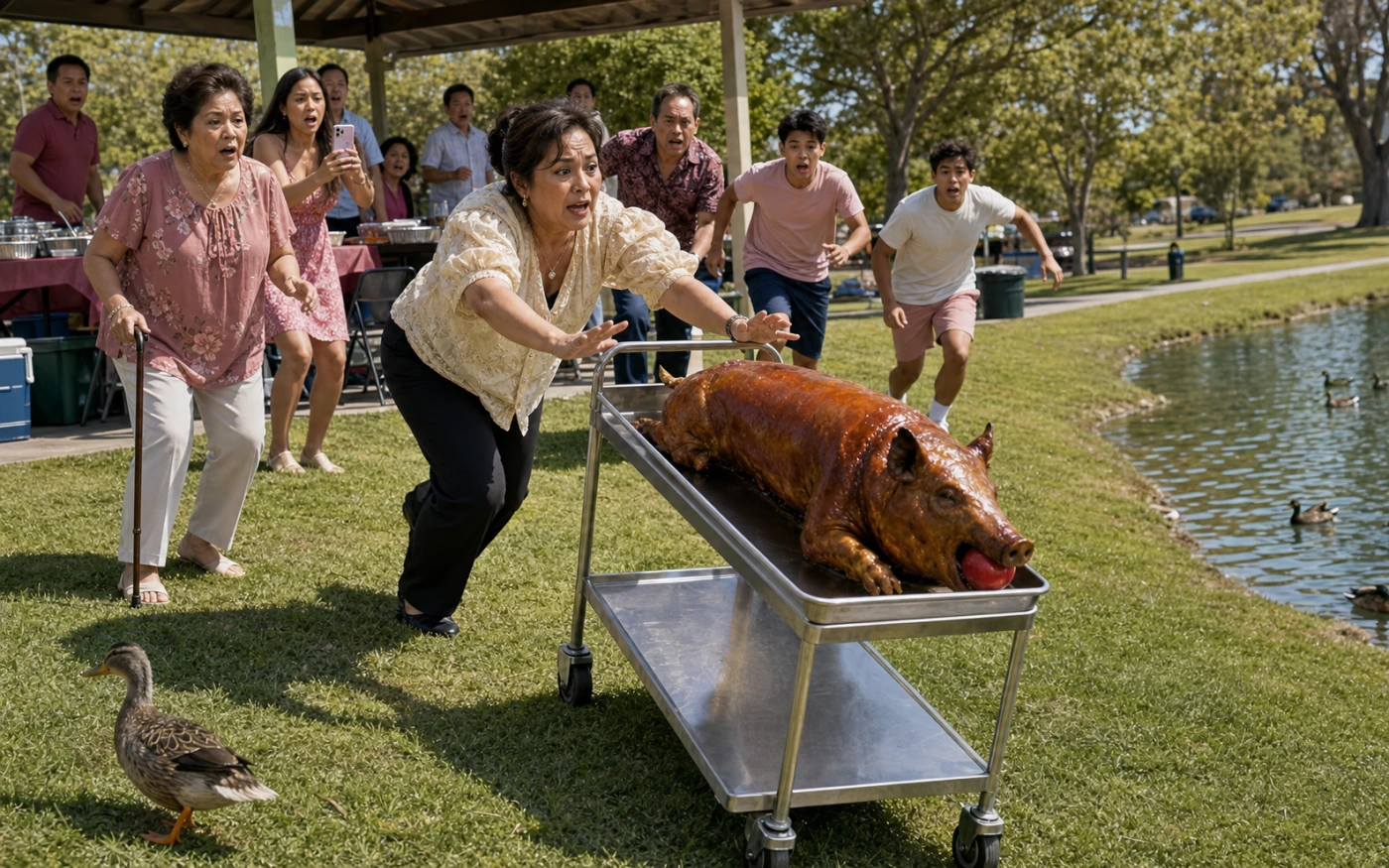
The cart rolled off the concrete.
Someone shouted, “Brake!”
“What brake?” I shouted back, which was not the answer anyone wanted.
The cart gathered speed on the grass.
I held on.
A nephew yelled, “LET GO, TITA!”
Excellent advice.
I rejected it completely.
I ran behind sixty-five pounds of roasted pig while my whole family chased us and the videoke machine continued playing a love song to an empty pavilion.
We passed the horseshoe pit.
We passed the trash cans.
We passed a duck who stepped aside with the exhausted expression of a park employee nearing retirement.
Ten feet from the water, the bad wheel hit a tree root.
The cart stopped.
The lechon did not.
The pig rose like a parade balloon, then landed in the duck pond.
I went in after it.
Of course I did.
The water reached my waist. My blouse floated around me. One slide disappeared.
I grabbed the pig under its front legs and lifted it against my chest like a giant, crispy baby.
Forty-two relatives lined the bank.
Every phone was pointed at me.
A feather stuck to the lechon’s shoulder.
A duck stared at us from four feet away, furious that catering had entered its home.
Then I saw Carmen throw down her cane.
Six weeks after hip surgery, my sister started running toward the pond.
PART 3: What Saved the Feast
“CARMEN, NO!” I screamed. “YOUR HIP!”
She kept coming.
Her white pants hit the water first.
She waded in up to her knees, grabbed the pig’s back end, and yelled, “GET THE HEAD!”
“I HAVE THE HEAD!”
“THEN LIFT!”
Boy came in next.
Then my daughter handed her baby to an auntie and came in.
Then four teenage boys entered, because the event had moved to the pond and they feared missing content.
Uncle Danny tried to follow.
Six people stopped him.
The videoke machine kept singing.
Nobody turned it off. Somewhere behind us, a recorded man begged his lover not to leave while eleven members of my family wrestled a ruined pig through green water.
We dragged it onto the grass.
Everyone gathered around. The skin had gone soft, mud streaked the foil, and the feather remained attached like an insult.
Four hundred and twenty dollars. Six weeks of planning. Twenty-two years of waiting for applause.
All of it smelled faintly of pond.
I sat in the mud and cried.
Not movie crying.
Real crying. Wet face, open mouth, no useful breathing.
Carmen lowered herself beside me, white pants brown to the knees.
“Nen,” she said.
“I ruined lunch.”
“You gave lunch a better entrance than I ever did.”
“I ruined the lechon.”
“Yes.”
That made me cry harder.
My daughter was still holding her phone.
“Anak,” I said, “please stop filming your mother’s collapse.”
“Mom, I stopped.”
“You are pointing it at me.”
“I’m checking something. What is in the van?”
“The cart came from the van.”
“No. The coolers.”
I blinked at her.
“What coolers?”
She ran to the parking lot.
A minute later, she shouted, “MOM!”
She stood at the open van with both hands on two giant insulated coolers.
And suddenly I remembered four o’clock that morning.
The alarm.
The dark kitchen.
Two cookers steaming the windows, with Tita Lita’s borrowed one balanced on a chair.
Three hundred cups of rice.
I had cooked all of it.
I had packed it hot and loaded it into the van, then become so busy imagining my lechon entrance that I forgot it existed.
My hands had done the work without asking for applause.
Twenty-two years of habit had saved lunch while one afternoon of vanity was floating beside a duck.
We ate at one o’clock.
No lechon.
But there were six trays of adobo, four trays of pancit, three trays of lumpia, two trays of menudo, one untouched pinakbet, Tita Lita’s leche flan, and enough hot rice to feed every relative plus several passing joggers.
Everybody was wet.
My blouse was ruined.
Carmen sat with her leg propped on a cooler, her cane across the table like a war trophy.
Boy stood and tapped the serving spoon against a tray.
I pointed at him.
“No speech.”
He nodded.
“Kain na,” he said.
That was the whole speech.
It was perfect.
By two o’clock, the video was in the family group chat.
By Sunday morning, it had reached Pampanga.
My ninety-one-year-old auntie, who had not messaged me in four years, sent a voice note containing forty seconds of laughter, the words “Ang galing mo, Nen,” and then more laughter.
Rey watched the video nine times in bed.
“You knew,” I said.
“Knew what?”
“The wheel.”
He lowered his phone.
“I saw it wobbling in the driveway.”
“And you said nothing?”
“You were so happy.”
“That is not a defense.”
“It is the defense I have.”
Carmen’s hip was fine. Her surgeon called her a menace and told her never to sprint into a duck pond again.
On Monday, she called me.
“I brought lechon for twenty-two years,” she said. “Nobody remembers any of them. You brought one pig, and now relatives who have been dead since 1998 probably know about it.”
“Thank you for this comfort.”
“Next year, you bring it again.”
“No.”
“I will do the rice.”
“No.”
“You already have the sign.”
I said no for eleven days.
Then I called Rico’s.
Sixty-five pounds. Third Saturday in July. Deposit paid.
I also bought a new cart.
It has four obedient wheels and two brakes. I practice stepping on them in the driveway while Rey watches from a safe distance.
The old sign hangs in my kitchen above the rice cooker.
One corner is warped from the pond. A brown waterline crosses the bottom. My daughter offered to replace it.
I told her absolutely not.
That sign reminds me that applause is loud, but usefulness is what feeds people.
It also reminds me to test the brakes.