
My Strict Auntie Evicted Me from Her House for "Lacking Discipline." Ten Years Later, I Found Her Journal at a Yard Sale.
PART 1: The Locked Door
Ten years after my aunt threw me out like garbage, I found the journal where she admitted she'd broken my heart on purpose.
But at twenty-two, all I knew was that I had failed one midterm.
I came home to Auntie Jocelyn's Daly City house that afternoon carrying a box of grocery-store ensaymada as a peace offering.
She had raised me since my father died.
She packed rice and adobo into old plastic containers for my lunches.
She waited awake when my evening classes ran late.
Once, she crossed three bus stops in the rain because I had forgotten my inhaler.
But discipline was her religion.
Shoes aligned by the door. Rice cooker wiped after every use.
Studying from seven until ten, no excuses.
I had already rehearsed my confession on the bus.
“Auntie, bumagsak ako sa midterm. Pero babawi ako.”
She stood in the living room, perfectly still. Two black garbage bags sat beside her feet.
“Your clothes,” she said.
I laughed because the other choice was to be afraid. “Why are they there?”
“You have two hours to leave.”
The ensaymada slipped in my hands, denting the box. “It was one exam.”
“One exam becomes one class. One class becomes one wasted life.”
Her voice was sharp, but she would not look directly at me. “You are lazy, undisciplined, and a complete disappointment.”
Those words landed harder than any slap.
I begged. I promised summer classes, extra tutoring, no weekends out.
She kept checking the front window as if my tears bored her.
“Saan ako pupunta?”
“The campus dormitory still has emergency rooms.”
“I can't afford the deposit.”
She placed an envelope on top of one bag. Inside was exactly enough cash.
“So you planned this?” I whispered.
For one second, her face broke. Her lips trembled. Then she became stone again.
“Go, Maya.”
I dragged the bags down the steps while one split open, spilling my underwear and review notes onto the sidewalk.
She did not help me.
When I turned around, she was standing behind the screen door with one hand pressed to her chest.
“If I leave,” I said, crying so hard I could barely breathe, “I will never come back.”
“Then learn to survive.”
The deadbolt clicked.
That sound lived inside me for ten years.
The dorm took me for one semester.
After that came couches, shared rooms, instant noodles, and night shifts at a twenty-four-hour pharmacy.
I taped my failed midterm above every desk I used.
Whenever I wanted sleep, I heard Auntie Jocelyn call me lazy.
I finished my degree.
I became a junior developer, then a software engineer, then a senior engineer in Silicon Valley.
I worked eighty-hour weeks and answered emails at 2:00 a.m.
When managers praised my discipline, I smiled and imagined setting the compliment down on Auntie's spotless kitchen table.
I never called her.
She sent one Christmas card the first year.
It said only, “I hope you are eating.” I returned it unopened, though I had held it to the light first.
After that, silence.
At thirty-two, I flew to Laguna for my cousin Aaron's wedding.
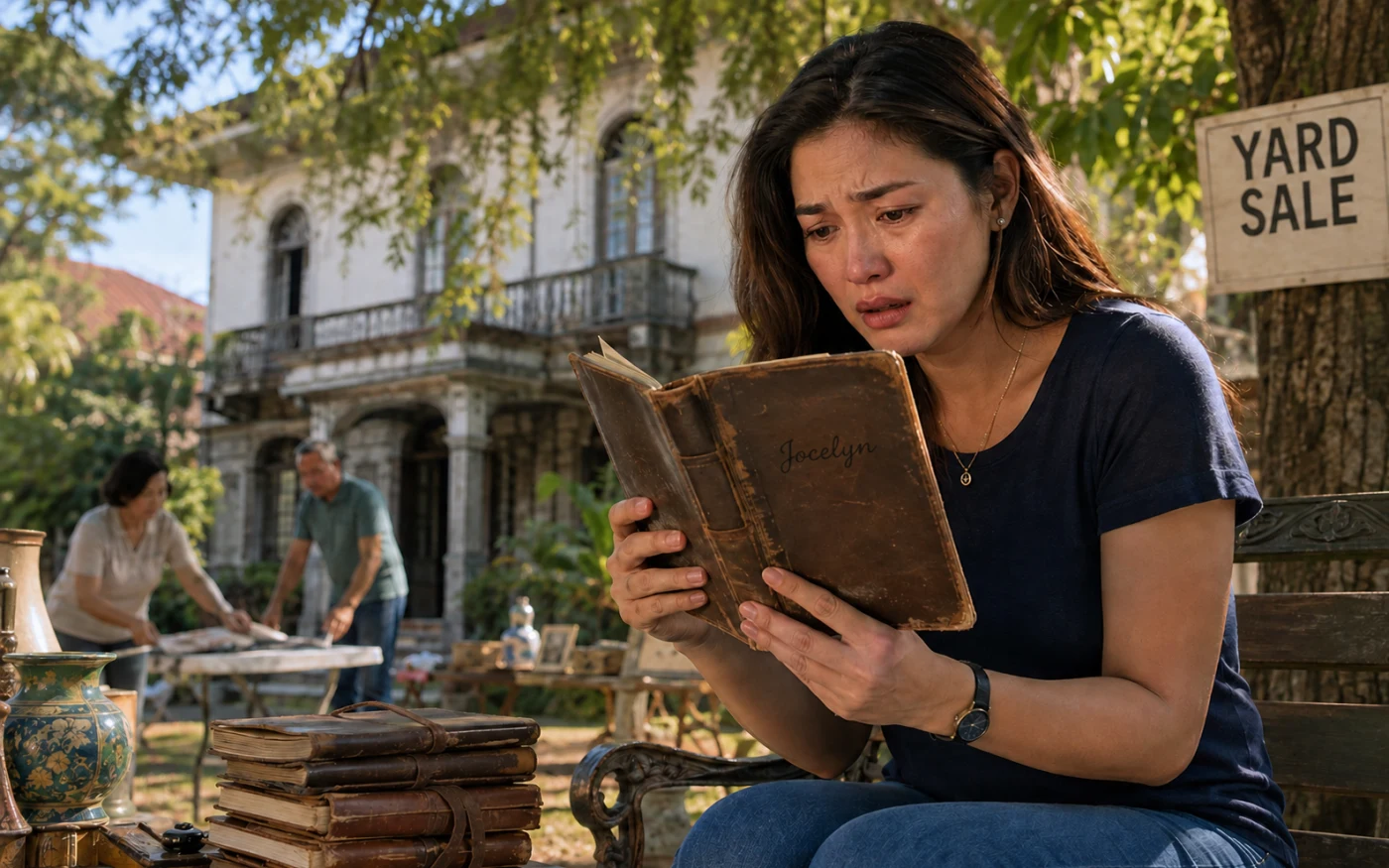
In Liliw, between fittings and family errands, I passed a yard sale outside an old ancestral house.
A hand-painted sign said everything had to go before the property changed owners.
I almost kept walking.
Then I saw a stack of leather notebooks beneath a chipped Santo Niño statue.
On the top cover, written in sharp, elegant cursive, was one name.
Jocelyn.
My hands went cold.
The seller, an elderly woman, said a relative had stayed there after returning from America and left some belongings in a cabinet when she moved to a smaller place.
I bought all eleven for three hundred pesos, carried them to a bench under an acacia tree, and opened the volume marked 2014.
At first, it was ordinary Auntie: grocery lists, work schedules, reminders to pay the water bill.
Then I found May 12.
The handwriting slanted wildly across the page.
Men came to the house today asking for my late brother's money. I told them Ernesto is dead. They said his debt is not. Ninety thousand dollars. They know Maya lives with me. One said accidents happen to young women who walk home alone.
My father's name seemed to rise off the paper.
Below it, Auntie had written one final sentence so hard the pen had torn the page.
I have two days to make my child disappear.
PART 2: Why She Made Me Leave
I turned the page with shaking fingers.
May 13: The campus dormitory has guards and key-card doors. I paid the deposit under Maya's student number. She must believe leaving is her idea—or hate me enough not to return.
My throat closed.
The envelope. The exact amount. The way she kept watching the window.
Then came the entry from May 14.
I made Maya hate me today. I called her lazy. God forgive me, I called her a disappointment. She looked at me as if I had killed something inside her. Perhaps I did. But she is behind guarded doors tonight, and they cannot reach her.
I covered my mouth, but a sound escaped anyway.
People at the yard sale glanced toward me.
I bent over the notebook, tears dropping onto ten-year-old ink.
Page after page dismantled the story I had told myself.
Auntie had worked her office job during the day, then cleaned floors at Seton Medical Center at night.
She sold her jewelry, including the tiny gold cross my grandmother gave her.
Every month, she recorded another payment against my father's debt.
December 24: My hands are cracked from bleach. Maya returned my card. Good. Anger keeps a door closed better than fear.
June 3: Saw her graduation photo through Aaron. Magna cum laude. I cried in the supply closet where nobody could see.
August 19: They reduced the balance. I wanted to tell Maya, but what if she comes home? Konti na lang. Let her hate me longer.
There were no complaints about the double shifts.
No self-pity. Only numbers, prayers, and small scraps of news about me collected from relatives.
She knew about my first engineering job. My promotion. Even the company photo in which I was standing in the back row.
Beside my face, she had drawn a tiny star.
The final debt entry was dated five years after she evicted me.
Paid in full. Maya is safe. I thought this day would make me brave enough to call her. Instead, I hear my own words and feel ashamed. Maybe her life is peaceful without me. I will not ask her to reopen a wound just so I can close mine.
I sat there until the afternoon light shifted and vendors began folding their tables.
My resentment had built my whole adult life.
It had gotten me out of bed, carried me through exams, and kept me awake through impossible projects.
Now it vanished in a few pages, and underneath it was a grief so raw I felt twenty-two again.
I called Aaron.
“Nasaan si Auntie Jocelyn?”
He went quiet. “You really want to know?”
“Please.”
She had returned to Liliw two years earlier, he said.
The night work had damaged her knees.
She lived alone in a small cottage at the edge of town and earned a little money repairing school uniforms.
Then Aaron told me something else: the cottage was mortgaged.
Auntie had fallen behind after a hospital stay, and the bank's final deadline was Monday.
Monday was three days away.
I opened my laptop in the rental car.
My hands moved faster than my thoughts.
Calls to the bank.
A transfer from the savings account I had spent years growing because being homeless once had made security feel sacred.
A frantic favor from Aaron's lawyer friend.
By noon the next day, I held a stamped release showing that every peso on the cottage had been paid.
On the drive there, the journals rode in the passenger seat.
So did one empty black garbage bag.
I did not know whether I had brought it out of anger, memory, or a need to show her exactly what she had done.
Her cottage stood behind a low fence crowded with gumamela.
I saw her through the window, silver-haired and bent over a child's blue uniform.
I knocked.
The sewing machine stopped.
When Auntie Jocelyn opened the door and saw me holding that black bag, all the color left her face.
PART 3: What Was in the Bag
“Maya,” she breathed.
She looked smaller than the woman in my memory. Her shoulders tensed as if she had spent ten years preparing to receive every cruel word back.
“I found your journals,” I said.
Her eyes closed.
“You had no right to read those.” The old steel entered her voice, but weakly.
“You had no right to let me believe I was unwanted.”
She flinched. “Tama ka.”
I wanted to stay furious. It would have been easier.
But then I noticed her fingers gripping the doorframe—the same fingers that had scrubbed hospital floors after working all day.
“Why didn't you call me after you paid them?”
“And say what? That your father left danger behind? That I used your worst fear to drive you away?” She looked down. “You were doing well. Ayokong guluhin ka.”
“I wasn't doing well. I was proving you wrong every day.”
Her voice cracked. “I know.”
“I worked until I got sick.”
“I know.”
“I missed you.”
That broke her.
Auntie covered her face. “I know,” she sobbed. “I missed you, anak.”
I dropped the black bag between us.
She stared at it.
“Open it,” I said.
Her hands trembled as she pulled the plastic apart.
Inside was the paid mortgage release, tucked on top of the ensaymada box I had bought that morning from a bakery in town.
She read the first page twice.
“What did you do?”
“I paid the cottage.”
“No.” She pushed the paper toward me. “Hindi ko ito matatanggap.”
I pushed it back. “You worked two jobs for five years to pay a debt that wasn't yours.”
“That was different.”
“Because you love me?”
She fell silent.
“Then this is different too,” I said. “Because I love you.”
Her knees seemed to give way.
I caught her before she hit the floor, and suddenly I was holding the woman I had refused to touch for a decade.
“Bakit ka umiiyak, Maya?” she whispered against my shoulder.
I laughed through my tears. “Pinoprotektahan mo lang pala ako.”
She pulled back and held my face in both hands. “I should have trusted you with the truth.”
“I should have opened your Christmas card.”
“It was a terrible card.”
“It really was.”
For the first time since I was twenty-two, we laughed together.
Then Auntie did something I will remember longer than the deadbolt.
She reached behind the door, removed the cottage key from its hook, and placed it in my palm.
“No more locked doors,” she said.
I closed her fingers around it and guided her hand back toward her heart.
“Your house,” I told her. “Your key. But save me a place at the table.”
She opened the screen door wide.
“Ang tagal mong umuwi,” she said.
Inside, I set the journals beside her sewing machine while she made garlic rice and fried eggs, scolding me for being too thin even though I wasn't.
We ate the ensaymada straight from the crushed box.
She kept adding food to my plate when she thought I wasn't looking.
When I stood to wash the dishes, she tapped the chair with her spoon.
“Sit. Bisita ka.”
“No,” I said, taking her empty plate. “Pamilya ako.”
Auntie smiled, reached across the little kitchen table, and held my hand.