
My Older Sister Told Us She Failed the Entrance Exam and Went to Work Instead — Twenty Years Later, We Found the Letter in a Tin Box under Her Bed...
PART 1: The Lie We Loved
My older sister lied to us for twenty years, and every birthday, every Christmas, every family reunion, we thanked her for that lie without knowing it.
There were four of us Manalo children.
Nilda was the eldest. Then me, Ruel. Then Bong. Then Baby.
But Ate Nilda was never simply the oldest.
She was the one who checked whether the rice could survive one more meal.
She knew which sari-sari store would still let Nanay write our sardines in a notebook.
She was the one who said, “Busog na ako,” then pushed the last piece of fish toward Baby.
In 2000, Ate was seventeen and brilliant.
Not the kind who announced it.
She studied on the floor after we slept, her notebooks spread beside an old kerosene lamp whenever our electricity was cut.
She wanted to become a teacher.
Once, when I was fourteen, she caught me pretending I did not understand fractions because I wanted her to finish my homework.
“When I become a teacher,” she said, flicking my forehead, “students like you will be my punishment.”
“What if you don’t pass?”
She flicked me again.
“I’ll teach you anyway.”
The state university was several hours away. To us, it might as well have been another country.
Nanay saved coins for Ate’s bus fare. Tatay sold a pig to pay for her application.
The morning of her entrance exam, he tied his old watch around her wrist.
“So you won’t be late when you become somebody,” he said.
Ate rolled her eyes.
“I’m already somebody.”
Tatay laughed so loudly the neighbor’s dog started barking.
Three weeks later, he collapsed in the field.
He was forty-three.
I remember neighbors filling our yard. I remember Nanay’s cry. I remember Ate standing beside the coffin with Baby against one hip while Bong held the back of her blouse.
She did not cry until everyone was asleep.
After the funeral, sacks of donated rice came.
Then they stopped.
Nanay washed clothes for other families, but some mornings her hands were so swollen she could barely close them.
Two weeks later, Ate walked into the kitchen holding an envelope.
Nanay was stretching one cup of rice into lugaw for five people.
“The university wrote,” Ate said.
We all looked up.
She folded the envelope once.
Then again.
“Bagsak ako.”
Nanay stopped stirring.
“Ay, sayang.”
That was all.
We had funeral debts. Market debts. Pharmacy debts.
One failed entrance exam could not compete with the terror already sitting at our table.
Ate shrugged.
“Okay lang. It was far anyway.”
The next Monday, she started working at the rice mill.
She came home powdered white with dust. Her palms cracked. She coughed at night.
Every Friday, she put her wages into Nanay’s hand and kept only enough for transportation.
Later she found work at a pharmacy.
The air was cleaner. The hours were longer.
She learned medicines, bookkeeping, inventory. Eventually she became the manager.
Meanwhile, the rest of us moved forward as if Ate were pulling us by a rope.
When I needed accounting textbooks, she bought them.
When Bong entered the police academy and needed shoes, Ate found the money.
When Baby finished nursing school but could not afford her board review, Ate placed an envelope beside her breakfast.
“Where did this come from?” Baby asked.
“Mayaman ako.”
She said this while wearing slippers repaired with glue.
We laughed.
We even told the entrance-exam story at parties.
“Our genius Ate failed once,” I would say, raising my glass, “then made sure none of us did.”
Everyone would cheer.
Ate would swat my arm.
“Hoy. Stop advertising my failures.”
Then she would laugh too.
We never noticed she always found something to do in the kitchen afterward.
Twenty years passed.
I became an accountant.
Bong became a police officer.
Baby became a nurse, then a clinical instructor.
Ate remained at the pharmacy.
She never complained.
That should have worried us more than it did.
When Nanay died after a long illness, Ate was thirty-seven.
For months, none of us touched the old house.
Then the rainy season came and water began dripping through the bedroom ceiling.
Ate finally said, “Clear it before the whole bahay falls down.”
She had work that Saturday, so the rest of us went.
Baby cried over Nanay’s dresses.
Bong found Tatay’s old cap and suddenly became very interested in looking out the window.
I made lists because lists are what accountants do when we do not want to cry.
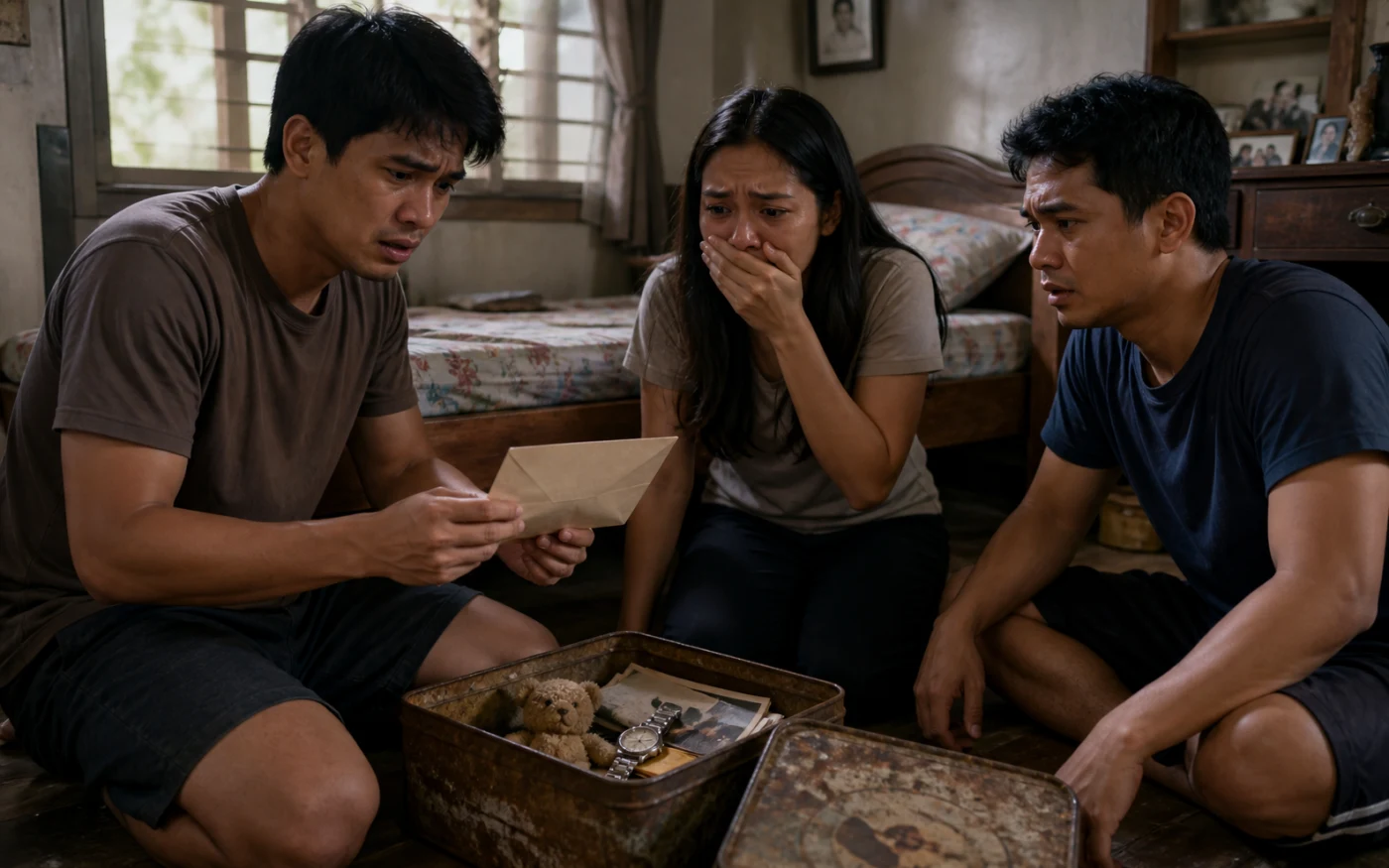
Under Ate’s childhood bed, Bong found a rusty biscuit tin.
Inside was Tatay’s watch.
My first report card.
Bong’s academy photograph.
Baby’s nursing pin.
A pressed yellow flower.
And beneath them was an envelope bearing the seal of the state university.
The date was August 2000.
I stared at Baby.
Baby stared at me.
Bong unfolded the letter.
His lips moved over the first line.
Then he whispered one word.
“Congratulations.”
PART 2: The Choice She Lost
Ate had passed.
Not barely.
She had earned one of the highest entrance scores in the district.
The university offered her full tuition, board, lodging, and a monthly stipend.
All she had to do was confirm her place.
She never answered.
Baby sat down on the floor.
“No.”
Bong read the letter again.
I did what I always do.
I calculated.
One widow.
Four children.
No income.
Almost no food.
A scholarship could feed Nilda once she reached the university.
It could not feed the rest of us that Monday.
“She knew,” I said.
Baby covered her mouth.
“We kept saying she failed.”
At every reunion.
Every birthday.
For twenty years.
I called her.
She answered from the pharmacy.
“Ate, we found the tin.”
Silence.
“We found the university letter.”
More silence.
Finally she sighed.
“Ay. That.”
“That?”
“I forgot I kept it.”
“You passed.”
“Apparently.”
“You had a full scholarship.”
“Ruel, may customer ako.”
“Ate.”
Her voice changed.
“What did you expect me to do?”
“Go.”
“And leave Nanay with four children?”
“You were seventeen.”
“And you were fourteen. Bong was eleven. Baby was nine.”
Nobody in the room spoke.
I stared at the watery stain on the ceiling.
“You wanted to teach.”
Ate inhaled.
Just once.
Then she said, “Tapos na ’yan.”
And hung up.
That evening, we waited outside the pharmacy.
When she pulled down the metal shutter, she found all three of us beside my car.
She stopped.
“No.”
Baby blinked. “We haven’t said anything.”
“I know your faces.”
Bong held up the letter.
“You should have gone.”
Ate snatched it from him.
“And you should have eaten what?”
“We could have managed.”
She laughed.
“You cried when the rice had ants.”
“I was eleven!”
“Exactly.”
Baby stepped closer.
“Ate, what if you went now?”
Nilda stared at her.
Then she laughed so hard she had to lean against the shutter.
“At thirty-seven?”
“You’re acting like you’re ninety.”
“I have a job.”
“We know.”
“I have responsibilities.”
“We know.”
“I haven’t been inside a classroom in twenty years.”
Baby folded her arms.
“And?”
Ate stopped laughing.
“I don’t need you to repay me.”
“This isn’t repayment.”
“Yes, it is.”
“No.” Baby’s voice softened. “Maybe we don’t return the years. Maybe we return the choice.”
Ate looked away.
“No.”
So we stopped pushing.
That was important.
For the first time in our lives, Ate had said no to something for herself.
We decided to respect it.
Three months later, I found her at my kitchen table helping my daughter Mara with an essay.
Ate leaned over the notebook, asking questions.
Not giving answers.
Mara erased a sentence.
Wrote another.
Then suddenly smiled.
“Oh.”
Ate smiled too.
“There.”
I stood in the doorway.
“You should have been a teacher.”
Ate kept looking at the notebook.
“I know.”
That was all she said.
But it was the first time she had ever admitted it.
A week later, Baby brought her information about an evening Education program at a college near us.
She did not leave an application.
She did not make a speech.
She simply placed the brochure beside Ate’s coffee.
“This exists,” Baby said.
Then she walked away.
Two weeks later, the brochure disappeared.
A month after that, Ate called me.
“Ruel.”
“Yes?”
“If somebody wanted to apply…”
I sat down.
“Yes?”
“…would somebody need help with the online form?”
I smiled so hard my face hurt.
“Possibly.”
“Don’t be dramatic.”
“I said one word.”
“You were smiling loudly.”
The four of us handled the practical things because, for once, we could.
I paid tuition.
Bong handled rides when Ate had evening classes.
Baby helped her understand admissions paperwork.
The pharmacy promoted the assistant manager and reduced Ate’s hours.
Nobody sold anything.
Nobody skipped meals.
Nobody worked through the night to make it happen.
That mattered.
On her first evening of class, Ate wore a new white blouse.
On her wrist was Tatay’s repaired watch.
We promised not to follow her.
We lied.
Bong, Baby, and I stood outside the classroom window like criminals.
Inside, twenty students sat in rows.
Most were younger than Ate.
The instructor asked everyone to introduce themselves.
When it was Nilda’s turn, she stood.
She touched Tatay’s watch.
“My name is Nilda Manalo,” she said.
Then she smiled nervously.
“I am late.”
A young woman beside her moved her backpack from the empty chair.
“Okay lang, Ate. Sit with me.”
Ate looked toward the window.
She saw us.
Her eyes narrowed.
Then she pointed.
“Those are my noisy children.”
The class laughed.
Ate sat down.
And opened her notebook.
PART 3: Teacher Nilda
School was not easy.
But this time, hard did not mean lonely.
Ate studied at the pharmacy counter during quiet afternoons.
Her younger classmates saved her a seat.
They started calling her Ate Nilda by the second week.
By the second semester, half of them were coming to her for help.
“Ate, can you check my lesson plan?”
“Ate, does this explanation make sense?”
“Ate, how do you make children listen?”
She would sigh dramatically.
Then pull out a chair.
Of course she would.
I helped her with math.
One night I stared at her worksheet and said, “This fraction is wrong.”
She flicked my forehead.
“You were bad at fractions.”
“I became an accountant.”
“Miracles happen.”
Baby supervised one of her practice-teaching requirements.
That caused the worst fight of the entire degree.
“Your lesson has no clear objective,” Baby said.
“My objective is that they learn.”
“That is not how you write it.”
Nilda folded her arms.
“I changed your diapers.”
“And now I am grading you, po.”
They did not speak through dinner.
At midnight, Baby found a revised lesson plan outside her bedroom door.
Across the top, Ate had written:
Check again, Ma’am.
Four years after Ate walked into that first evening class, another university letter arrived.
This time she opened it immediately.
She had qualified for graduation.
With honors.
Ate cried before any of us did.
That was how we knew something had changed.
She no longer pretended that wanting something made her selfish.
On graduation morning, she wore Tatay’s watch over the sleeve of her toga.
“Too much?” she asked me.
“No.”
“Be honest.”
“I am.”
She touched the cracked leather strap.
“He should see it.”
At the auditorium, Bong cried during the processional and denied it.
I shouted when they announced Ate’s honors.
Then Baby disappeared from the seat beside me.
I looked at Bong.
“Where did she go?”
He smiled.
“May surprise.”
When Nilda’s row stood, the dean walked toward the microphone.
“Nilda Manalo, Bachelor of Secondary Education.”
Ate climbed the steps.
Then she saw who was holding her diploma.
Baby.
Our youngest sister had joined the college faculty that year.
The little girl Ate once fed from her own plate now stood in academic robes holding the diploma Ate had given up to keep her fed.
Ate stopped walking.
Baby was already crying.
When Ate reached her, Baby leaned toward the microphone.
“Ate,” she said, “twenty-four years late.”
Ate glanced at Tatay’s watch.
Baby smiled.
“Sorry po for the wait.”
The auditorium stood.
Ate pressed one hand over her mouth.
Then Baby gave her the diploma.
For once, Ate did not wave away the applause.
She did not say it was too much.
She raised the diploma over her head.
We screamed.
But that was not the ending.
The ending came two months later.
On a Monday morning, Bong picked me up before seven.
Baby was already in the back seat.
“Are we really doing this?” I asked.
“Yes.”
“She told us not to come.”
“That has never stopped us.”
We drove to a public high school fifteen minutes from Ate’s house.
Her first teaching job.
Through the classroom window, we saw her standing at the board in a simple blouse and black skirt.
Tatay’s watch was on her wrist.
She wrote:
MS. NILDA MANALO
Thirty-two students watched her.
A boy in the second row raised his hand.
“Ma’am?”
“Yes?”
“I’m bad at fractions.”
Ate froze.
Outside the window, I covered my mouth.
Then she smiled.
“So was my brother.”
The boy looked worried.
Ate picked up a piece of chalk.
“He became an accountant.”
The class laughed.
She began writing numbers on the board.
Then she stopped and looked toward the window.
She had seen us.
Of course she had.
Ate shook her head.
“Those are my noisy children,” she told the class.
Baby started crying.
Bong saluted.
I lifted both hands.
Ate laughed.
Then the school bell rang.
She glanced once at Tatay’s watch.
This time, she was not late.
She turned back to her students.
“Okay,” she said. “Let’s begin.”