
For Thirty-Two Years I Ran a Boarding House. At 78 I Finally Had to Sell. I Never Expected Who Showed Up to Buy...
PART 1: The Last Room
The woman who came to buy my boarding house knew exactly which stair creaked—and when she called me “Tita Lourdes” from behind, I nearly dropped the keys.
But that happened on the last day.
Three weeks earlier, I had been standing in Room Eight, trying to decide which memories could fit inside one suitcase.
At seventy-eight, my knees had become unreliable employees. Some mornings they reported for duty. Some mornings they did not. My doctor had already warned me twice about the stairs, and the second warning came after I slipped while carrying a basin of laundry.
“Hindi ka na bata,” he said gently.
As if I had forgotten.
For thirty-two years, I ran an eight-room boarding house near a nursing college in Quezon City. The paint was always peeling somewhere. The water pressure had moods. The front gate made such a loud clang that nobody could sneak home after curfew, though many tried.
My rate was still almost the same as it had been in 2000.
Every year, someone told me to raise it.
“Tita, lugi ka na,” the girls would say.
“Then stop using all my shampoo,” I would answer.
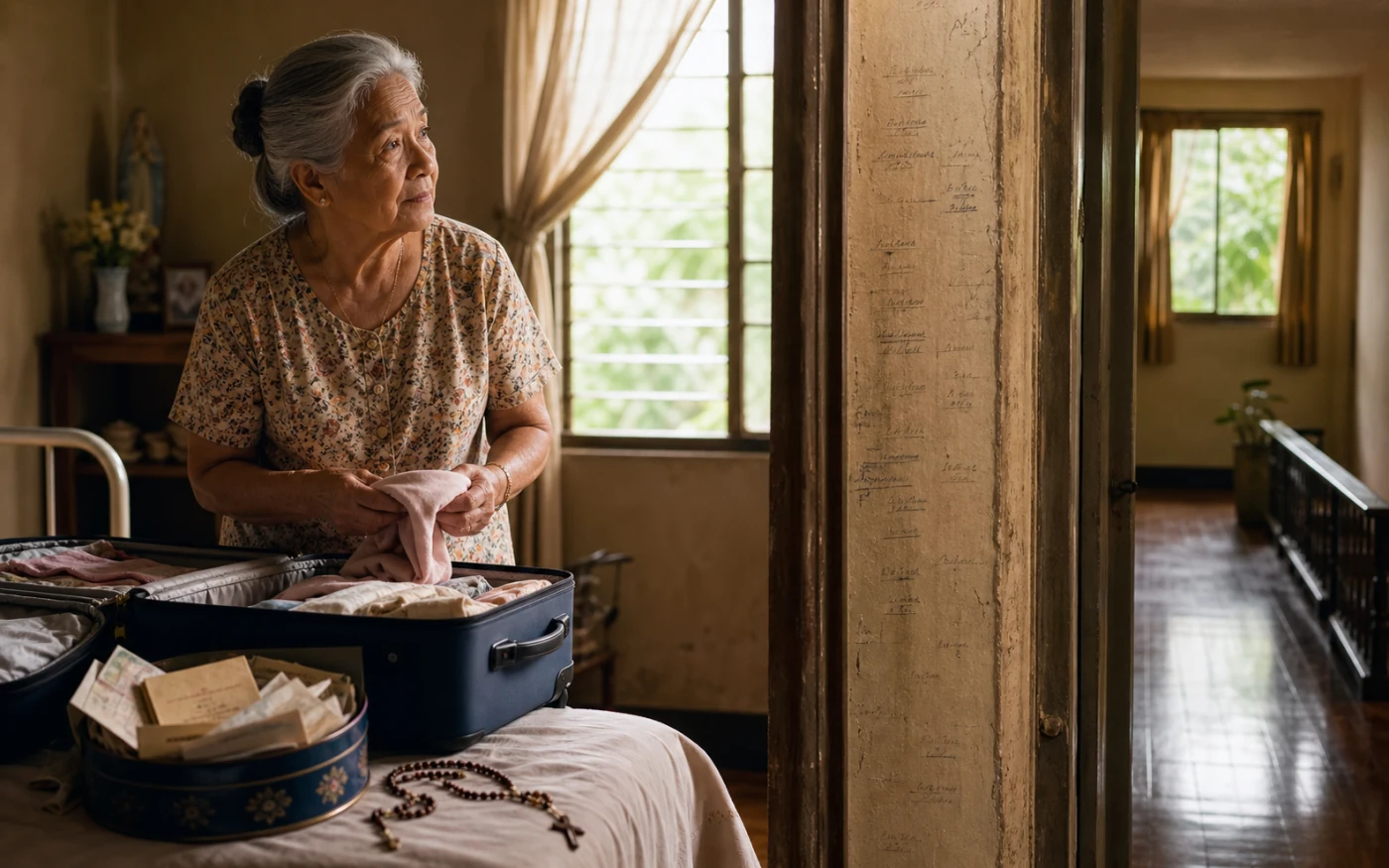
Forty-one young women finished nursing school while living under my roof. I knew because every one of them had written her name and graduation year in pencil on the hallway doorframe.
There was Maribel, 2004, whose father sold his tricycle to pay her final semester. Joy, 2007, who fainted at the sight of blood during her first hospital duty. Katrina, 2011, who cried so loudly over a boyfriend that the girls in Room Three thought someone had died.
There were marks beside some names. A heart. A flower. One tiny drawing of my angry face beside the words CURFEW QUEEN.
I never erased any of it.
I never married. I had no children. People sometimes said that last part softly, as if it were an illness.
But my house was never quiet enough for me to feel pitied.
During board exams, I cooked arroz caldo before sunrise and left boiled eggs beside their reviewers. I wrote to mothers when a daughter was too ashamed to admit she had failed a subject. At two in the morning, I took taxis to hospitals for girls who had nobody nearby.
Twice, brides came down my narrow staircase in white dresses because they wanted to be married from my sala.
For years, I complained about wet towels, unpaid electricity shares, noisy visitors, and shoes blocking the hallway.
Then the girls graduated one by one.
They became nurses in Manila, Cebu, Dubai, London, Toronto. They sent Christmas cards. They brought babies to visit. They promised, “Tita, babalik kami.”
Some did.
Life carried the others farther than promises could reach.
By November, only two boarders remained. Both were leaving after their exams. The broker, Mr. Salazar, had found an interested buyer who wanted a walkthrough before making an offer.
I had already chosen a residential home in Marikina.
The brochure showed smiling old women doing crafts. The staff seemed kind. The hallways were clean. My room would have a private bathroom and one narrow window facing a concrete wall.
“Safe po kayo doon,” the administrator told me.
Safe.
It was a good word. A sensible word.
I hated it.
On my final Sunday in the house, I packed my dresses, my rosary, and a biscuit tin filled with letters. I labeled boxes for donation. Then I sat on the edge of my old bed and listened.
No slippers slapping against the floor.
No one calling, “Tita, may pagkain pa?”
No laughter exploding from the bathroom.
What hurt was not selling the house. Wood rots. Roofs leak. Owners eventually hand their keys to someone else.
What hurt was the thought that, in December, I would become a woman who used to have people.
The walkthrough was scheduled for ten the next morning.
At nine fifty-five, I polished the dining table one last time. At ten, a white van stopped outside. Mr. Salazar stepped through the gate, followed by three women carrying folders.
I could not see their faces clearly through the screen door.
One of them stepped on the third stair.
It creaked.
“Ay, buhay pa pala ’yan,” she laughed.
My hand froze around the keys.
I knew that laugh.
Then she came up behind me and said, “Tita Lourdes, hindi ka naghintay sa’min?”
PART 2: Who Came to Buy
I turned and found Maribel Santos standing in my hallway.
Not the frightened nineteen-year-old who had once counted coins at my dining table, but a forty-two-year-old hospital supervisor in a navy blouse. Beside her were Joy Villanueva, now a head nurse, and Katrina Ramos, the former champion of heartbreak, wiping tears before she had even said hello.
For a moment, none of us moved.
Then all three rushed at me.
“Dahan-dahan!” I protested as six arms wrapped around my shoulders. “Matanda na ang buto ko!”
“You didn’t tell us,” Maribel said.
“Tell you what?”
“That you were selling.”
I looked at Mr. Salazar. He suddenly became very interested in the ceiling.
“You are the buyers?” I asked.
Katrina sniffed. “Part of them.”
“How many parts does one buyer have?”
Joy grinned. “Eleven.”
I thought they were teasing me. Surely the three of them had come to say goodbye. Maybe they planned to take photographs, touch their old names on the doorframe, and promise to keep in touch.
Instead, Maribel opened her folder on my dining table.
Inside were bank papers, building plans, and a list of eleven names I knew better by their maiden names.
Maribel. Joy. Katrina. Liza. Beth. Aileen. Grace. Rowena. Cel. Mia. Noreen.
Graduation years from 2004 to 2018.
“We’ve been organizing for a month,” Joy said. “Some are abroad, but they’re part of it. We formed a corporation and pooled the down payment.”
“A corporation?” I stared at them. “You girls used to hide rice cookers in your rooms.”
“Successful nurses na kami,” Katrina said.
“You still owe me for one broken rice cooker.”
Mr. Salazar coughed into his fist.
Maribel slid the building plan toward me. The eight bedrooms would remain, though two downstairs rooms would be widened. There would be handrails, accessible bathrooms, a small nurses’ station, and a ramp from the gate.
Across the top, someone had written: CONVALESCENT HOME.
“A place for patients who are well enough to leave the hospital but still need care,” Maribel explained. “After surgery, stroke, injury. Families need somewhere warm, not just clinical.”
I looked around my sala. In my mind, the scratched floor disappeared beneath wheelchairs. The dining room filled with medicine trays. Strangers slept in the rooms where my girls had once whispered about exams and love.
“Why here?” I asked.
Joy touched the wall beside her old pencil signature.
“Because we learned care here before the hospital taught us the word for it.”
My throat tightened, but I would not cry in front of Mr. Salazar.
“The plumbing is terrible,” I said.
“We know.”
“The roof leaks above Room Six.”
“We know.”
“And that gate will wake every patient.”
Katrina smiled. “We know, Tita.”
They toured every room. Maribel measured doorways. Joy checked the downstairs bathroom. Katrina stood in Room Four, where she had lived for three years, and laughed when she found a faded sticker behind the cabinet.
I followed them slowly, one hand on the railing.
Their idea was beautiful. The house would keep caring for people after I was gone. I was grateful they wanted to give it another life, but somehow that made leaving hurt even more.
At the end of the tour, we returned to the sala.
“The offer is fair,” Mr. Salazar said quietly. “And financing is ready.”
I looked at the papers. The amount would cover the residential home for the rest of my life. I should have felt relieved.
Instead, I pictured my little window facing a wall.
“I accept,” I said.
Katrina began crying again. Joy hugged her. Maribel took out a pen.
“There’s one condition,” she said.
I stiffened. “The old cabinets are included, but not my sewing machine.”
“Not your condition. Ours.”
She placed another page in front of me.
At that exact moment, the front gate clanged.
Voices filled the yard—many voices, talking over one another.
“Nandiyan ba si Tita?”
“Huwag muna kayong pumasok!”
“Who brought the pancit?”
I stood so quickly that my chair scraped backward.
Through the window, I saw women climbing out of the van, some older, some younger, one carrying a baby and another holding a cake crookedly against her chest.
Maribel pushed the page closer and tapped one sentence near the bottom.
“Read that first, Tita.”
PART 3: What Was Their Condition
I put on my reading glasses.
The sentence blurred anyway.
The seller’s bedroom shall remain the permanent private residence of Lourdes de Vera, with lifetime care provided on-site at no cost.
I read it twice.
Then I removed my glasses. “No.”
The room went silent.
Maribel blinked. “No?”
“You are buying a business, not adopting an old woman.”
“Too late,” Joy said softly. “You adopted us first.”
The front door opened, and eight more women crowded into my sala. Liza still had the same dimples. Beth had flown from Davao that morning. Grace was video-calling Mia in Canada, whose face bounced around the phone screen as everyone tried to talk at once.
They filled the room in seconds.
Shoes blocked my hallway again.
Someone set pancit on my polished table without a mat.
“Hoy! Mainit ’yan!” I cried.
Eleven women burst out laughing.
Maribel took my hand. “Your bedroom stays yours. We’ll add rails, an emergency button, and a door to the garden.”
“I can pay.”
“You already did,” she said.
Then she reached into her folder and took out eleven old envelopes.
I recognized my own handwriting before she even put them down.
One was addressed to Maribel’s mother: Please let her stay through finals. We will settle the rent later.
One contained the hospital note I had written when Joy suffered dengue and I slept upright beside her bed.
Katrina held a stained index card with my arroz caldo recipe in one hand.
“You kept these?” I whispered.
“Lahat,” she said.
I sat down because my knees finally stopped pretending to be dependable.
Around me were women I had once worried would not pass anatomy, wake up for duty, recover from heartbreak, or find enough money for tuition. Now they were buying my house—not to preserve it like a museum, but to make it useful again.
And apparently, whether I approved or not, they had decided I belonged in the house too.
I signed the page.
Then I pointed at the pancit.
“Put something under that bowl. New owners, pero walang manners.”
Renovation began in January.
For three months, the house became louder than it had been in years. Workers removed walls, fitted rails, and built the garden door. I supervised from a plastic chair despite repeated instructions to rest.
“That handrail is too low.”
“Tita, standard height po.”
“Standard for whom? Ants?”
The girls gave me a yellow hard hat labeled BOSSY BOARDER.
I wore it every day.
They also preserved the hallway doorframe. The carpenter carefully lifted it out, sealed every pencil name beneath clear varnish, and installed it beside the nurses’ station.
On opening morning, I woke before everyone else.
My bedroom was still mine, but the old window no longer faced the neighbor’s fence. French doors opened to a small garden with sampaguita, two chairs, and a ramp leading back to the hallway.
Outside, the house waited—fresh paint, clean sheets, sunlight across the sala.
At nine, the front gate clanged.
Our first patient arrived in a wheelchair.
Her name was Teresita. She was seventy-four, recovering from hip surgery, and gripping her daughter’s hand so tightly their knuckles had turned white.
“Ma, three weeks lang,” her daughter murmured. “I’ll visit every day.”
Teresita stared at the ramp. Her chin trembled.
I knew that look.
It was the look of someone being taken to a safe place she had not chosen.
So I walked outside before Maribel could stop me.
“Mrs. Teresita,” I said, “I am Lourdes. I live here.”
She looked up. “Patient din kayo?”
“Supposedly.” I leaned closer. “But nobody can run this place properly, so I am forced to work.”
Behind me, eleven nurses groaned.
Teresita laughed.
Her grip on her daughter loosened.
“Come,” I said. “I saved you the room nearest the garden. But if you ring the bell after midnight, make sure it is important. Some of us need beauty sleep.”
By lunch, all six first patients had arrived. A radio played in the kitchen. Wheelchairs rolled along the hall. Someone complained that the soup lacked salt. Someone else called for an extra pillow. Joy hurried past with a blood-pressure cuff while Katrina argued with a delivery man at the gate.
The house was full again.
I stood beside the old doorframe, listening to every wonderful noise.
Then Maribel appeared with my lunch tray.
“Your room, Tita. Doctor’s orders.”
“I am checking the patients.”
“You checked them twice.”
Joy came from the other side and took my elbow. “Rest muna.”
“This is harassment,” I announced as they escorted me toward my bedroom.
Teresita called from the garden, “Lourdes, save me a chair!”
I pulled free, grabbed a second pillow from Joy’s arms, and marched toward her.
“See?” I said. “May kailangan sa akin.”
Eleven women followed with my lunch, my medicine, and helpless laughter as the front gate clanged once more.