
I Was a University Janitor for 22 Years — At Graduation, the Dean Called My Name. When I Saw My Disciplinary File on the Podium, I Was Certain They Were Firing Me.
PART 1: The Name I Feared
When the dean called my full name in front of three hundred graduates, I was certain they had finally discovered what I had been doing inside the engineering building before sunrise.
I gripped the plastic chair and whispered, “Patay.”
My wife, Celia, slapped my knee. “Ano ba, Dolfo? Stand up.”
But I could not move.
Nobody at the university called me Rodolfo Miranda Salazar.
To the faculty, I was Mang Dolfo. To the students, I was Kuya, Manong, Sir Janitor, or sometimes just a hand waving from the end of a hallway.
Only an angry administrator would use all three of my names.
For twenty-two years, I had cleaned the College of Engineering.
I arrived while the sky was still black, unlocked the side entrance, and pushed my cart through halls that smelled of chalk, floor wax, and last night’s panic.
At six in the morning, that grand building belonged to me.
I knew every loose tile. I knew which classroom window leaked during habagat. I knew that the light outside Room 304 flickered twice before staying on.
I also knew which students cried in the stairwell where the security camera could not see them.
When you clean around people long enough, they stop hiding from you. They argue beside your mop bucket. They count coins on your newly wiped tables. They fall asleep over equations and wake with the marks of notebook spirals on their cheeks.
I never went to college. My father got sick when I was seventeen, so I worked at a rice mill, then a warehouse, then the university.
But if a professor left a problem on the board, I sometimes stood there after everyone had gone.
I would hold my rag and study the numbers.
“Hindi ka titigil?” Celia once asked when she brought me dinner during overtime.
“Sandali lang,” I said. “Parang kaya ko.”
Usually, hindi kaya.
Still, I tried.
That was how I began recognizing the look of a student who was one problem away from giving up.
The first was a skinny boy named Ramon Castillo. In 2019, I found him asleep on the floor outside the laboratory at four forty in the morning. His notes were under his face, and his calculator was still in his hand.
“Hijo,” I said. “Buhay ka pa?”
He opened one eye. “Hindi ko na po alam.”
I gave him half my coffee and one of the pandesal Celia had packed.
“Kumain ka muna,” I told him. “Tapos, ulit.”
He stared at the bread as if it were a gold medal.
“I’m failing, Mang Dolfo.”
“Not yet. You still have the exam.”
“But—”
“Malapit ka na.”
That became my line.
I said it to Cheska, who hid in the women’s restroom because her mother had called to say there was no money for next semester.
I said it to Arman, who lived two hours away and sometimes chose bus fare over lunch.
I said it to twins Joel and Jon, though one of them had already graduated and still came at dawn to help the other study.
I had no money to solve anything. Celia and I had four children, and every peso already had somewhere to go.
Our youngest, Mariel, wanted to study engineering more than anybody I had ever seen.
As a child, she took apart our electric fan and put it back together with only one screw left over.
“Improvement,” she said when I found it.
I kept that screw in my wallet.
By senior high school, Mariel could solve some of the equations I copied from the classroom boards. She would sit at our kitchen table, tap the paper, and say, “Pa, mali itong sign mo.”
Then she would explain it while I nodded as if I understood everything.
She qualified for the university entrance exam.
She did not enroll.
“Sa state college na lang ako,” she told us. “Okay naman doon.”
But I saw the university brochure folded under her mattress.
The building I kept beautiful for other people’s children was too expensive for mine.
Masakit, pero ganoon.
So I continued arriving before dawn with my old red thermos. I began packing extra pandesal. Sometimes a banana. Sometimes two boiled eggs, if payday had just come.
Then a new assistant administrator, Mr. Villareal, saw three students drinking my coffee inside a locked study room.
“Mang Dolfo,” he said, “you cannot let students in before operating hours.”
“May exam po sila.”
“That is not your concern.”
He wrote my name in a small black notebook.
After that, I became careful. I did not stop. I simply left the room unlocked while I cleaned nearby.
If anyone asked, makakalimutin na ako.
Then, one week before graduation, the dean’s secretary came looking for me.
“Mang Dolfo, the dean wants you at commencement.”
My stomach dropped.
“Bakit po?”
“Wear a barong. Not your uniform.”
That frightened me more.
At home, Celia ironed her brother’s old barong while I paced barefoot around our sala.
“They will retire me,” I said.
“You are fifty-nine.”
“Then they will fire me politely.”
“Tumigil ka nga.”
I did not sleep.
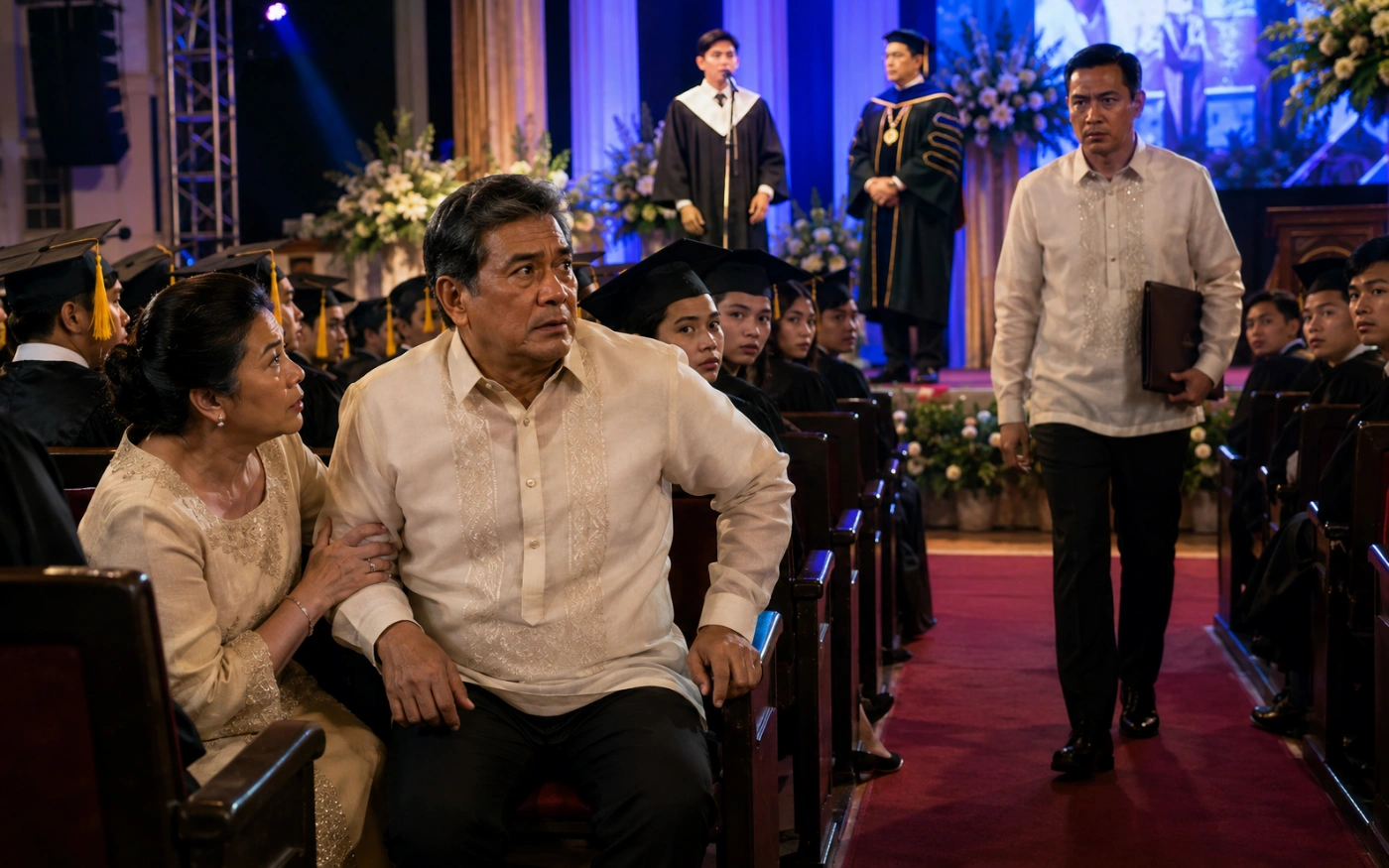
At commencement, they seated us in the last row. Mr. Villareal stood near the stage holding a folder. When he looked toward me, I lowered my eyes.
The speeches felt four hours long.
Then the dean stepped to the microphone.
“Before we present the diplomas,” she said, “the graduating class has requested a special moment.”
A young engineer walked onto the stage.
I recognized Ramon Castillo immediately, though now he wore a medal around his neck and no drool on his notes.
He unfolded a piece of paper.
“Would Mr. Rodolfo Miranda Salazar please come forward?”
Three hundred heads began turning toward me.
And Mr. Villareal started walking down the aisle with that folder in his hand.
PART 2: Why Did They Turn?
I leaned close to Celia and whispered, “If they dismiss me, get my lunch box from the janitor’s room.”
She stared at me. “Your name was called and you are worried about Tupperware?”
Mr. Villareal reached our row.
I braced myself.
He held out his hand.
“Mang Dolfo,” he said quietly, “the stage is waiting.”
Then he smiled.
That confused me so badly that I stood.
The instant I did, all three hundred graduates rose together.
The sound of their chairs scraping the floor hit me first. Then came the applause.
Every graduate had turned away from the stage to face me.
Some were clapping over their heads. Some were crying. One shouted, “Mabuhay ka, Mang Dolfo!”
I saw faces from years ago sitting among the families—former students, already engineers, already parents, already wearing company IDs and wedding rings.
Cheska was there.
Arman was there.
Joel and Jon stood on two chairs, both waving.
“Lakad,” Celia said behind me, but her voice was breaking.
I took one step.
Then another.
I had walked that aisle thousands of times with a broom, collecting candy wrappers and muddy footprints. That day, for the first time, I had nothing in my hands.
Ramon waited at the microphone.
“Most of us met Mang Dolfo on our worst day,” he said. “Usually before sunrise. Usually when we had not eaten.”
The graduates laughed softly.
“He never gave us exam answers. Believe me, we asked.”
I looked at him sharply. He lifted both hands.
“He gave us coffee. He gave us pandesal. And he kept saying, ‘Malapit ka na,’ even when we were sure we were nowhere near.”
Someone behind me sobbed loudly.
Ramon looked straight at me.
“Some of us stayed because you noticed we were disappearing.”
My knees weakened.
He named a student who had returned home after failing two subjects. Mang Dolfo called his boarding house, Ramon said, because the boy had left his notebook behind.
He named a scholar who had eaten my lunch for three days while waiting for her allowance.
He named a graduate whose father died during finals. I had sat beside that boy on the loading dock without speaking until sunrise.
I had forgotten half those moments.
They had not.
The dean placed a plaque in my hands. It said I had given “extraordinary service to generations of learners.”
The letters blurred.
“Hindi ito sa akin,” I whispered.
Ramon covered the microphone, but everybody still heard him say, “Sa iyo ’yan, Mang.”
Then he handed me a steel thermos stamped with the university seal.
It was heavy.
“Open it,” the graduates called.
I twisted the lid.
Inside were hundreds of tightly rolled pieces of paper, each tied with blue thread.
I pulled out one.
It was from Cheska.
You gave me your breakfast the morning I planned to leave. I stayed.
Another was from Arman.
You pretended not to notice when I slept in Room 204. Salamat po.
Another came from a student whose face I could not remember.
My mother still knows your name.
I pressed the note to my chest.
“Enough,” I told Ramon. “I cannot breathe.”
He hugged me.
That was when I noticed Mr. Villareal’s folder lying open on the podium.
Across the top was my name.
Below it, in large letters, I saw DISCIPLINARY INCIDENT REPORTS.
My joy vanished so quickly I nearly dropped the thermos.
The dean followed my eyes.
“Ah,” she said. “We should explain that.”
She lifted the folder.
“Over the years, Mang Dolfo accumulated eleven reports for opening rooms early, sharing staff supplies, allowing exhausted students to rest, and exceeding his scheduled hours without authorization.”
The hall went silent.
I looked at Mr. Villareal.
He looked ashamed.
The dean continued, “This graduating class requested those reports.”
Ramon stepped back to the microphone.
“We needed proof,” he said.
“Proof of what?” I asked.
“That you kept choosing us, even when you could get in trouble.”
The graduates began clapping again, but Ramon raised one finger.
“Sandali. We are not finished.”
The curtains at the side of the stage opened.
My daughter Mariel walked out wearing a white dress, clutching a sealed envelope.
I had left her at home that morning.
Now she was crying so hard she had to stop halfway across the stage.
“Pa,” she said, “may tinago rin ako.”
PART 3: What Was in the Envelope?
Mariel held the envelope toward me, but I did not take it.
“Ano ’to?” I asked.
“Open it, Pa.”
My fingers were shaking. Celia had reached the front row, one hand covering her mouth.
Inside was an admission letter from the College of Engineering.
Behind it was a second page stamped FULL SCHOLARSHIP.
I read Mariel’s name three times.
“Hindi maaari,” I said. “We did not apply.”
“I applied again,” Mariel whispered. “Hindi ko sinabi. Ayokong umasa kayo.”
Ramon turned to the audience.
“Graduates and alumni created the Mang Dolfo Scholarship Fund,” he said. “For students who are almost there and need somebody to help them stay.”
The hall erupted.
I stared at the paper, then at all those young people in black togas. My first foolish thought was that I had no proper shoes for Mariel’s first day.
My second was that this could not be real.
“Why her?” I asked.
The dean answered me.
“Because she earned admission. Because her scores placed her near the top of the incoming class. The fund did not give her ability, Mang Dolfo. It opened the door.”
Mariel shook her head and pushed the letter against my chest.
“Ikaw nagbukas, Pa.”
That broke whatever was left holding me together.
I bent forward, and my daughter caught me.
For several seconds, the whole graduation ceremony disappeared. There was only Mariel’s hair against my cheek, Celia’s arms around both of us, and the steel thermos trapped between our bodies.
Then Mariel pulled back.
“Pa, may kailangan pa.”
“Ano na naman?”
The dean carried a small tray toward us. On it rested a silver university pin, the same pin every new engineering student received at orientation.
“The scholars asked if you would do the honor,” she said.
Mariel stood straight in front of me.
I had cleaned around thousands of those pins. I had found them under seats and returned them to offices. I had polished display cases filled with them.
But I had never held one meant for my own child.
I picked it up.
My hands were rough, and the clasp was tiny. I fumbled once. Then twice.
The graduates waited without making a sound.
“Pa,” Mariel whispered, smiling through tears. “Kaya mo ’yan.”
I fastened the pin over her heart.
The applause came down around us like hard rain on a metal roof.
Mariel touched the pin, then took my old university ID from where it hung beneath my barong. The picture showed me in a faded maintenance uniform, younger and trying not to smile.
She held my ID beside her new pin.
“Pareho na tayo,” she said.
I shook my head.
“Mas mataas ka.”
“Hindi, Pa.” She looked toward the endless rows of graduates. “Marami lang kaming inangat mo.”
Ramon handed me the microphone.
I did not want it. Three hundred engineers were staring at me, waiting for a speech, and every prepared word had left my head.
So I said the only thing I knew.
“Kumain muna kayo.”
The hall burst into laughter and tears at the same time.
I lifted the thermos.
“Tapos, ulit. Malapit na kayo.”
Three months later, before Mariel’s first class, we rode to the university together in the dark.
She wore a fresh white blouse and carried a secondhand backpack Ramon had given her. I wore my blue maintenance uniform.
At six, I unlocked the side entrance.
Mariel hesitated on the threshold of the building she had only ever visited to bring me lunch.
“Pasok,” I told her.
She stepped inside.
The halls were silent. Morning light touched the windows. For two hours, the most beautiful building in the province belonged to us.
In Room 204, I opened my new steel thermos and poured coffee into its lid. Then I gave Mariel the pandesal Celia had packed.
“Pa, hindi pa ako pagod,” she said.
“Practice.”
She took the bread and leaned her head on my shoulder.
My daughter looked at the clean board waiting for its first equation.
Then she reached for my hand.
“Tara, Pa,” she whispered. “Malapit na tayo.”