
For Eight Years I Was Cold to the Woman My Son Married — Then I Had a Stroke, and She Was the Only Person on Earth Who Could Understand Me
PART 1: The Words I Lost
The first person who understood me after my stroke was the woman I had spent eight years pretending not to understand.
I need to tell you the ugly truth before I tell you what she did.
My name is Aurora de la Cruz. I am seventy-two years old, a retired teacher, widow of a school principal, and mother of two children I once believed proved I had done everything correctly.
Then my son Miguel married Lisa.
She was polite. Hardworking. Pretty in a quiet way. She was a dental assistant from Pampanga, and her father had driven a delivery truck until his knees gave out.
There was nothing wrong with her.
That did not stop me from treating her as if there were.
You see, before Lisa, Miguel had dated Patricia, the daughter of a lawyer from Quezon City.
Patricia wore pearls to lunch. She called me Tita Aurora. She knew which fork to use without looking at anybody else.
I had already imagined the wedding before Miguel ended the relationship.
Then he brought Lisa home.
“Ma,” he said, smiling in a way that should have warned me, “ito si Lisa. I’m going to marry her.”
Lisa reached for my hand with both of hers.
“Good evening po, Ma.”
Ma.
Right away.
I smiled and pulled my hand back to fix the serving spoon.
“Aurora is fine,” I said.
Miguel’s smile disappeared.
That should have shamed me. It did not.
For eight years, I never shouted at Lisa. I never called her names. No, I was more careful than that.
At family lunches, I served her last.
When she entered my kitchen, I said, “Ay, Lisa, you don’t have to help,” while moving my body between her and the counter.
When she brought leche flan, I praised the container.
When someone admired her blouse, I mentioned that Patricia used to have her clothes tailored.
And at every birthday, baptism, and Christmas party, I found some reason to tell the story of the lawyer’s daughter my son almost married.
Never directly to Lisa.
Always close enough for her to hear.
My daughter Celeste cornered me once beside the sink.
“Ma, tama na. She knows what you’re doing.”
I dried a plate that was already dry.
“What am I doing?”
“You make her feel maliit every time she comes here.”
“Naku. You young people are too sensitive.”
Miguel spoke to me twice.
The second time, his face was pale with anger.
“If you keep disrespecting my wife, we will stop coming.”
I looked at Lisa, who stood behind him holding a bowl of ginataang bilo-bilo she had made because she knew it was my favorite.
“Did she tell you to say that?” I asked.
Lisa’s face changed.
Only for one second.
Then she lowered her eyes and said, “Hindi, Ma.”
She still called me Ma.
That annoyed me most of all.
I decided her patience was performance. Her gentleness was strategy. Her eight years of remembering my birthday, bringing me medicine, and driving from Marikina through terrible traffic were all part of some campaign to win.
Win what, I could never have said.
Then one Sunday afternoon in March, Celeste and I came home from Mass. I sat in my sala with coffee while rain darkened the road outside.
I remember reaching for the cup.
My fingers missed it.
The cup fell and broke.
“Sayang,” I tried to say.
What came out was a wet sound.
Celeste looked up from her phone.
“Ma?”
I stood because I was embarrassed.
The room tilted.
My right leg disappeared beneath me, and the floor rushed toward my face.
I heard Celeste screaming my name from very far away.
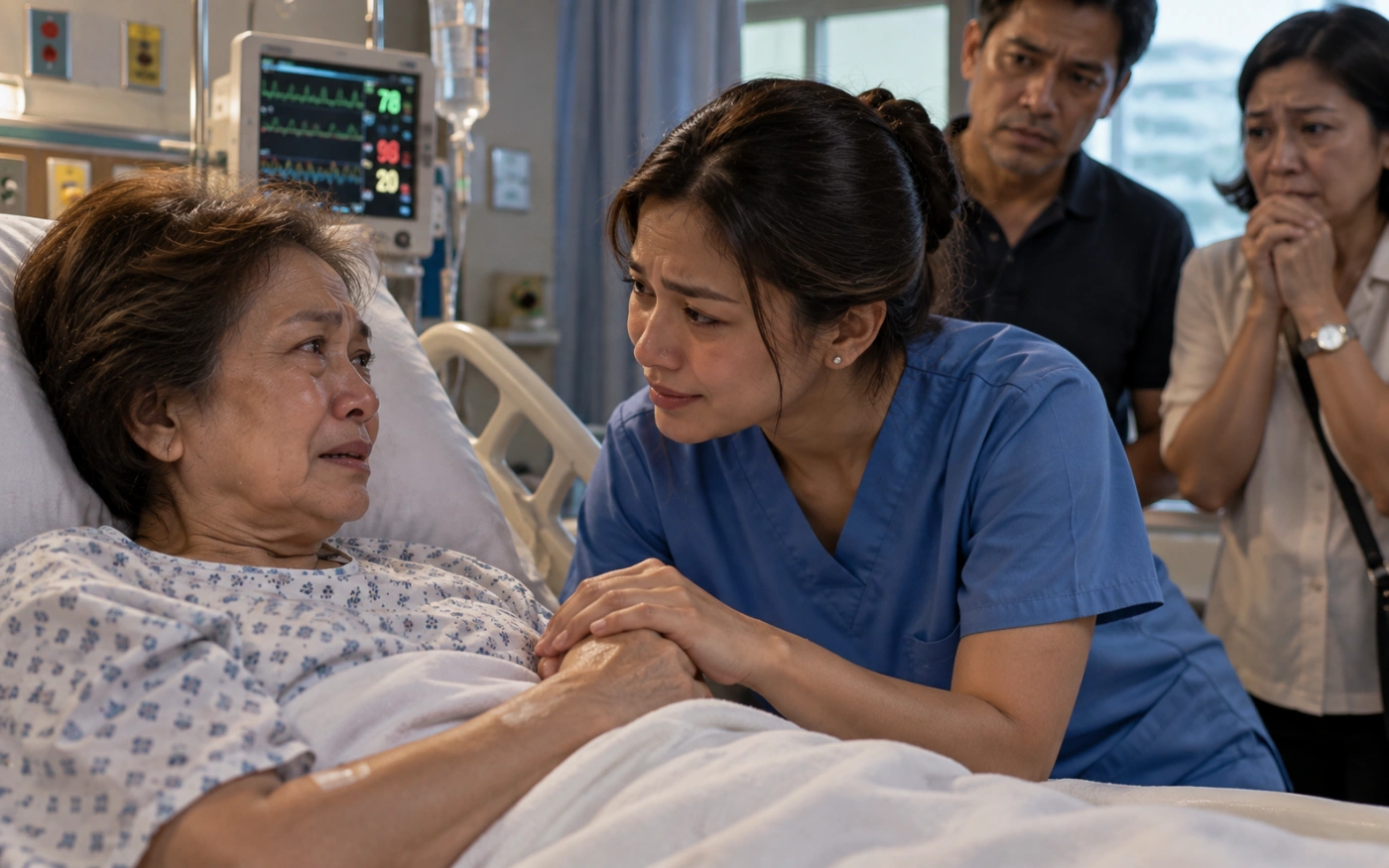
At the hospital, I understood almost everything.
That was the cruelty.
The doctor said stroke. Miguel asked whether I would walk again. Celeste cried into a tissue. A nurse asked me to squeeze her fingers, but my right hand lay on the bed like it belonged to a dead woman.
“Mrs. de la Cruz, can you tell me your name?”
Aurora, I screamed inside my head.
My name is Aurora.
“Ha,” I said.
Miguel bent over me.
“Ma, ako ito. Miguel.”
I know who you are, anak.
“Ha.”
My son’s face crumpled.
For the next three days, my family loved me loudly and understood me not at all.
“Are you hungry?”
“Ha.”
“Do you need the bathroom?”
“Ha!”
“Masakit ba?”
“No.”
No was one of the few words that survived, but even that came out when I did not want it.
I tried to ask them to turn off the fluorescent light. I tried to say my left hip ached from lying in one position. I tried to tell Miguel that his car keys were slipping from his pocket.
Every thought reached my mouth and shattered there.
On the fourth morning, I was cold.
Not ordinary cold. My bones were shaking. The hospital blanket scratched my chin, and the air conditioner blew straight across my bed.
Miguel tucked the blanket tighter.
“Better, Ma?”
“Ha! Ha!”
He thought I was upset and called the nurse.
The nurse checked my blood pressure. Celeste raised the bed. Miguel lowered it again. I wanted my yellow blanket from home, the soft old one I kept at the bottom of my aparador.
“Tu—” I fought to say. “Tu—bi.”
They brought water.
I knocked the plastic cup away with my left hand.
It hit the floor.
Everyone went silent.
I began to cry from rage.
Then the door opened.
Lisa stood there, still wearing her pale blue clinic uniform, breathing hard as if she had run from the parking lot.
She looked at the spilled water.
She looked at my face.
Then she came straight to my bed.
“Ma,” she said softly. “Ang lamig ba?”
My whole body stopped.
Lisa turned to Miguel.
“Nasaan ang yellow blanket niya?”
And nobody in that room knew what she was talking about.
PART 2: How Did She Know
Lisa drove to my house herself.
Celeste gave her the keys, and I heard Miguel say, “There are blankets here.”
“Ayaw niya niyan,” Lisa answered. “She wants hers.”
Forty minutes later, she returned carrying the old yellow blanket against her chest.
Not just any yellow blanket.
The right one.
It had faded sunflowers along the edge and one corner I had repaired by hand after my husband died. I had slept with it every night for eleven years. I had never told anybody I needed it.
Lisa shook it open and laid it over me.
I closed my eyes.
“Ayan,” she whispered.
For the first time since the stroke, somebody had answered the sentence trapped inside me.
After that, Lisa began coming every day.
She still worked mornings at the dental clinic. Then she came to the hospital with her hair escaping its clip and a paper bag of food she usually forgot to eat.
She never rushed my sounds.
She sat beside me and watched.
When I snapped “ha” and stared upward, she switched off the light.
When I turned my face left, she placed a pillow beneath my hip.
When I said “tubi” but pressed my lips together, she knew I was not asking for water. She checked the room until she found the television remote beneath Celeste’s bag.
Even the nurses started calling her.
“Lisa, ano kaya?”
She would study my eyes, my hand, the direction of my chin.
“She wants the curtain open.”
She was right.
“She doesn’t like the soup.”
She was right.
“Her sock is twisted.”
Right again.
Miguel tried to laugh one afternoon.
“Parang may secret language kayo.”
But his eyes were wet.
Mine were too.
At night, shame lay heavier than my useless arm.
I remembered every plate I had served her last.
I remembered one Christmas when she arrived with a fever because I had complained that they were late.
She spent two hours washing dishes while I told three cousins that Patricia was now working at a law firm.
I remembered Lisa standing alone on my porch after everyone left, rubbing her wrists beneath the Christmas lights.
I had seen her.
I had simply chosen not to ask.
Now she noticed if one seam in my sock bothered me.
During therapy, my anger became worse before it became better.
The therapist held up picture cards.
“What is this?”
Apple, I thought.
“A—ah—ha.”
“Take your time.”
I slapped the card away.
Lisa picked it up.
“Sige lang, Ma.”
I glared at her.
She did not say kaya mo. She did not tell me to be positive. She placed the card back and waited.
“Ap—ple,” I finally said.
It was crooked and ugly.
Lisa smiled as if I had delivered a speech at Malacañang.
“Oo,” she said. “Apple.”
Two weeks later, I went home in a wheelchair.
Celeste moved into my spare room. Miguel arranged schedules. But it was Lisa who knew where I wanted the chair positioned in the sala, away from the afternoon glare but facing the gate.
It was Lisa who stopped Miguel from replacing my drinking glasses with plastic cups.
“Baka mabasag,” he said.
“Then I’ll hold it,” she replied.
She filled my old glass and held it to my lips.
Water ran down my chin and soaked my blouse.
I wanted to disappear.
Lisa wiped me gently and kept talking about the price of tomatoes in the Antipolo market. She did not look sorry for me. She did not mention the mess.
By June, words were returning one at a time.
Some days I could make a short sentence. Other days my mouth locked around the simplest name.
One rainy afternoon, Lisa sat beside the window peeling a green mango. She sliced it thin because she knew that was how I liked it, with bagoong on the side, never poured over.
I had been carrying one question for weeks.
I tapped the arm of my chair.
“Li—sa.”
She put down the knife at once.
“Yes, Ma?”
“How…”
My throat tightened.
She waited.
“How…do…”
My mouth refused the next word. I struck my thigh with my left fist.
Lisa did not supply it. She did not rescue me.
She only moved the plate aside and gave me her full face.
I tried again.
“How…do you…know?”
The question took nearly two minutes.
When it finally came out, Lisa looked surprised.
Then she gave me the answer that broke something open inside me.
PART 3: What She Had Seen
“Ma,” Lisa said, “I’ve been watching you for eight years.”
She picked up the mango knife, then put it down again.
“You never talked to me. So I learned you by watching.”
I stared at her.
She spoke without drama, as if she were explaining where she kept the rice.
“I saw you take the yellow blanket out every time we slept here after a party. I saw you move away from bright lights. I saw how you rub your hip when masakit. I know you hate cups with lids because once Miguel bought you one and you hid it behind the kaldero.”
My face burned.
“Why?” I managed.
Lisa’s eyes lowered.
For one terrible second, I expected her to say she had done it for Miguel. Or because she pitied an old woman. Or because a good daughter-in-law had duties even when her mother-in-law had no heart.
Instead she said, “Because you were his mother.”
Then, after a pause, “And because I wanted you to like me.”
There it was.
Not a strategy. Not a performance.
A young woman had entered my house wanting a mother, and I had made her study me from doorways.
I began to cry.
Since the stroke, tears came without permission. That day they poured down my face so hard I could not even form her name.
Lisa reached for a towel.
I caught her wrist with my left hand.
“Sorry,” I said.
One small word.
It was not enough for eight years, but it was the word I had.
Lisa knelt beside my chair.
“Ma, huwag muna.”
I shook my head.
“No. Listen.”
She waited, as she always did.
“I was…proud. Cruel.”
Her mouth trembled.
“I made you…feel small.”
“Ma—”
“You are not small.”
That sentence exhausted me. I leaned back, breathing hard.
Lisa covered her mouth and cried.
For a while, we sat there with the rain tapping the window and the mango turning brown between us.
Then she wiped her face.
“Kain muna tayo,” she said.
So we ate.
That was how she accepted my first apology: with green mango, bagoong, and no speech that made me feel forgiven before I had earned it.
My recovery continued.
The right leg grew stronger. The right hand remained stubborn, but I learned to walk with a cane. My words came back unevenly, like relatives arriving late to a reunion.
Lisa kept coming.
Now I watched her too.
I learned that she went quiet when tired. That she drank coffee after it was cold. That she always gave Miguel the crispest piece of fried tilapia, then claimed she preferred the tail.
The first time she entered my kitchen after my stroke, she stopped at the doorway.
“Ma, saan ko ilalagay ito?” she asked, holding vegetables.
I knew why she stopped.
For eight years, my body had been the locked door.
“Dito,” I said. “Beside me.”
She came in slowly.
We cooked sinigang together. I sat on a stool and ordered her around because some habits deserved to survive. She added too much kangkong. I told her so. She laughed with her whole face.
Four months later, we celebrated my granddaughter Mara’s seventh birthday at my house.
There were balloons tied to the gate, trays of pancit and lumpia, cousins from Baras, an auntie from Pililla, and children running through the sala in socks.
I stood with my cane near the buffet, tired but happy.
Lisa carried out the pancit wearing the yellow dress Miguel loved.
Then Tita Mercy arrived.
She was not truly my tita. She was the cousin of a cousin who collected old stories and returned them at the worst possible moment.
She kissed my cheek, inspected my cane, and praised my recovery.
Then she looked across the room at Lisa.
“Aurora,” she said brightly, “is it true Miguel almost married that lawyer’s daughter? Sayang naman, di ba?”
The room went silent.
Not gradually.
Completely.
Miguel froze beside the birthday cake. Celeste closed her eyes. Even the children seemed to feel something dangerous moving through the room.
Lisa stood four feet away, holding a heavy tray of pancit.
For eight years, I had trained everyone to expect the story.
I could have blamed my memory. I could have laughed. I could have changed the subject and remained the same woman with better speech.
Instead I planted my cane and looked at Mercy.
“I don’t know who told you that.”
Her smile slipped.
I pointed toward Lisa.
My hand shook, but my voice did not.
“My son married a woman named Lisa.”
Lisa’s eyes widened.
“She is the reason I can stand here and talk to you today.”
Nobody moved.
So I said the part that mattered.
“When I had no words, she listened to me. When I could not lift a glass, she held it. She knew me after I spent eight years refusing to know her.”
Mercy stared at the floor.
I turned away from her.
“Lisa, anak,” I said, loudly enough for every person there to hear. “Will you please help me in the kitchen?”
The tray trembled in Lisa’s hands.
Miguel took it before she dropped it.
Lisa crossed the room and came to me. She put one arm around my waist, careful of my weak side.
Together, we walked into the kitchen.
On the counter waited the birthday candles I had forgotten.
Lisa reached for them, but I touched her hand.
“Anak,” I said again, just for her.
She looked at me, and the tears came.
“Yes, Ma?”
I kissed her forehead.
Outside, Mara called for her mother, and Lisa wiped her cheeks.
Then my daughter-in-law took my arm, and we carried the candles out together.