
I Bought My Childhood Home and Found Mom's Diary in the Wall. The "Deadbeat" Father Who Abandoned Us Paid Our Mortgage for Eighteen Years...
PART 1: My Mother Lied
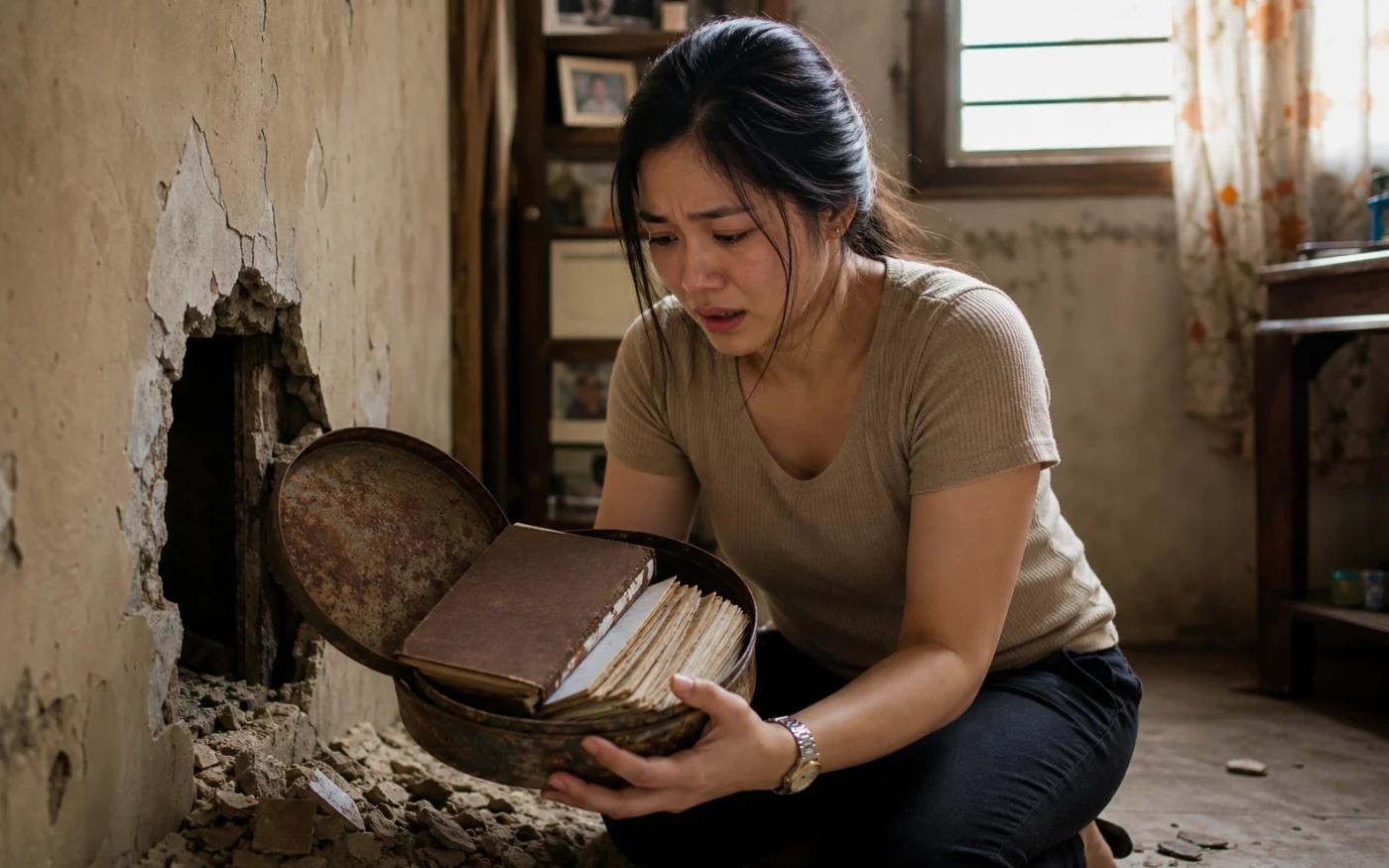
I was thirty-four years old, standing inside the childhood home I had just spent my life savings buying back, when a wall cracked open and informed me that the “deadbeat” father I had hated since I was twelve had been paying for our house almost the entire time he was gone.
Inside the wall was a rusted biscuit tin containing my mother’s diary and 216 remittance receipts, one for every month of eighteen years, all bearing the same sender:
RODEL G. OCAMPO.
My father.
The man Mama said ran off with another woman. The man our barangay had insulted since 2007. The man I trained myself not to miss.
And if that was already bad, the first sentence in Mama’s diary was worse.
But I’m getting ahead of myself.
My name is Divina Ocampo—Divine at work. I do collections for a bank in Ortigas, and for nine years I used the same line whenever a borrower started begging:
“Sir, may pamilya po. You left them in debt.”
My supervisor loved it. “Pakinggan n’yo si Divine. Walang awa.”
I thought I knew exactly what happened when a man left his family carrying bills.
Papa was a carpenter in San Ildefonso, Bulacan, with sandpaper hands, a pencil behind one ear, and an obsession with buying five pieces of pan de sal before sunrise.
One warm piece always waited for me on top of the rice cooker.
When I was eight, he started building a room at the back of our house because I was sick of sharing with my brother. He framed the doorway himself and wrote on one stud in crooked pencil:
R.O. 1999 — PARA KAY DIVINA.
He also showed me a loose plank behind the old aparador.
“Secret post office natin,” he whispered.
If one of us left a note inside, we knocked three times on the wall.
Tok-tok-tok.
That meant: Check the post office.
I thought this was the greatest technology ever invented.
Then, in 2007, Nonoy’s appendix ruptured.
He went septic. He spent nineteen days in a private ICU in Malolos because the public hospital had no bed. I remember tubes. I remember Mama praying into a towel. I remember Papa sitting outside the billing office with his elbows on his knees, staring at a piece of paper like it had personally threatened to kill his son.
Then one Tuesday, Papa disappeared.
No goodbye.
No note.
Just Mama at the kitchen table at six in the morning, both hands flat on the wood, while I kept asking where he was.
Finally she said, “He has another family sa Bacolod. Wala na siya. Tapos na ’yun.”
That story spread faster than dengue.
By lunchtime, Aling Charing at the sari-sari store had “always suspected.” By Friday, she was telling customers she had personally seen Papa at a terminal with a younger woman.
Papa became the villain, Mama the abandoned wife, and Nonoy and me the poor abandoned children.
And the room Papa had promised to finish stayed unfinished for eighteen years.
Mama kept us alive through rice cakes, laundry, borrowed money, and stubbornness. Every month, when the housing payment came due, she would disappear and come home saying, “Ayos na.”
I never asked how. Children accept miracles when adults look tired enough.
Mama died late last year after kidney failure. Near the end, she sold the house for dialysis, and we moved her into a leaky rental in Marilao.
At the hospital I promised, “Ma, bibilhin ko ulit.”
I meant the house. I did not know I was promising to buy back a lie.
It took me less than a year and ₱850,000—every centavo I had, plus twelve thousand from Nonoy, who was working at sea and sent it with one message:
KUHANIN MO. UWI NATIN ’YAN.
The agent said the owner lived far away and wanted a quick sale. I made an embarrassingly low offer.
Accepted in four minutes.
I thought I was the luckiest woman in Bulacan.
Then the santol tree betrayed everybody.
Papa had planted it the year I was born. By 2026, its roots had shoved the back wall hard enough to crack the plaster from floor to ceiling. On my first Saturday in the house, I attacked it with a sledgehammer and the confidence of a woman who had watched exactly two renovation videos.
Three swings. The plaster collapsed.
Behind it was the old hollow beside Papa’s unfinished room.
Our secret post office.
And inside, wrapped twice in yellowing plastic, was the biscuit tin.
I opened Mama’s diary first.
The entry was dated eleven days after Papa disappeared.
It began:
Divina, anak. If you are reading this, then you found our post office. Your father did not abandon us.
Then came the next line.
I made him leave.
PART 2: The Price of His Name
I sat on the dusty floor and read until the sun moved from one window to the other.
The hospital bill for Nonoy had reached ₱180,000.
We had almost nothing.
Papa worked for Sy Hardware & Construction, and every Friday his boss, Mr. Alfredo Sy, trusted him to carry the crew payroll in a canvas bag.
On the fifteenth day Nonoy was in the ICU, the doctors told my parents they needed another deposit.
Papa took the payroll money.
He stole it—and because my father apparently could not even commit a crime normally, he left a handwritten receipt inside the empty bag:
Utang ko po. Babayaran ko lahat. Rodel Ocampo.
Mr. Sy could have sent him to jail. Instead he offered one brutal deal: Papa would leave Bulacan, work for a relative’s construction crew in Zamboanga del Norte, and surrender part of every salary until the payroll was repaid. No police case if every peso came back.
Papa agreed before Mr. Sy finished speaking because Nonoy was still alive.
Papa wanted to tell everyone why he had done it. He wanted to stand outside our house and admit the theft himself.
Mama stopped him.
My scholarship papers needed a barangay clearance and good-moral certificate. Nonoy, if he survived, would return to school as a thief’s son. The label would stick to all of us.
Meanwhile, Aling Charing had already started telling people she saw Papa with another woman.
Mama looked at the choice in front of her and picked the uglier story that hurt only one person.
She told Papa:
Better they think you’re a traitor than a thief. I’ll take care of the kids. Umalis ka na, Rodel.
So Papa left.
I understood why Mama lied when I was twelve. I did not understand all the years after.
Ma, ang tagal.
A few pages later, she answered me.
I kept telling myself I would tell you after graduation. Then after Nonoy came home. Every year I waited made the truth harder to say.
He was thirty-nine when he got on a boat knowing his children would grow up believing he chose another family over them.
Then I reached the receipts.
Two hundred and sixteen.
Every month for eighteen years.
At first the money was small because Mr. Sy was still deducting his debt. Later it grew. Mama marked the receipts: housing, tuition, medicine, roof repair, uniforms.
The mortgage passbook was there too. Month after month, the house survived because the man we called a deadbeat kept sending money.
He paid back the stolen payroll.
Then he kept paying us.
Through typhoons, layoffs, 2020—through years when I was already earning money in Ortigas while telling coworkers my father might as well be dead.
At the bottom of the tin was one tiny folded note.
The paper had gone soft at the creases.
Papa’s handwriting.
Divina, anak. I’ll finish your room, pangako. When you read this, knock three times on the wall. — Papa
I pressed the note to my mouth and made a sound I had never heard come out of me before.
On Monday, I called the remittance branch named on the most recent receipt.
A woman answered.
When I asked about Rodel Ocampo, she laughed gently.
“Ay, si Tatay Rodel? Oo naman. Every month ’yan. Brown jacket. Maaga pumunta.”
My knees went weak.
“Ma’am,” I said, “when was the last time?”
“Last month.”
Last month.
Mama had been dead less than a year.
The old mortgage was long closed.
But Papa was still sending money into the family remittance account he had used for years.
He knew the account had no one left to collect it.
He kept sending anyway.
He was still paying a family that had stopped waiting.
I stood so fast my headset fell off.
My teammates stared.
Then something hit me.
The deed of sale.
I had kept it in my work bag because I am exactly the kind of paranoid bank employee who carries important documents around like other women carry lipstick.
I opened the folder.
Buyer: DIVINA M. OCAMPO.
Property: our house.
Seller:
ALFREDO SY.
Mr. Sy.
Papa’s old boss.
I called him before I could talk myself out of it.
“Your father heard Rosa was selling,” he said. “He sent me the money and asked me to keep the house in the family.”
“And when I offered to buy it?”
“I called him.”
My throat closed.
“What did he say?”
Mr. Sy was quiet for a moment.
“Accept.”
Four minutes.
That was why my embarrassingly low offer had been accepted in four minutes.
PART 3: Someone Knocked Back
I posted everything that night.
Not because I wanted to go viral.
I wanted to find one man.
I uploaded the receipts, mortgage passbook, Mama’s diary, and the pencil marks on the stud.
Then I wrote:
I’m looking for Rodel Ocampo. Tatay ko siya. For eighteen years, people called him a deadbeat and I believed them. We were wrong. Papa, if you see this, umuwi ka. My room is not finished yet.
Six days later, the post had been shared hundreds of thousands of times. Someone from Dipolog said they knew a carpenter named Rodel who still wore a brown jacket in weather that did not require one.
Then Saturday came.
I already had a house blessing scheduled, so I did not cancel it.
It was supposed to be twenty people. Half the barangay came.
I covered the front wall with all 216 receipts in neat rows because apparently even my breakdown had to look like a bank file.
Nonoy flew home. Mr. Sy came with a cane. Even Aling Charing arrived carrying pancit and the face of a woman entering cross-examination.
She stood in front of the receipts for a long time.
Finally she cleared her throat.
“Naku. I never said sigurado ako.”
Sixty people became very interested in their paper plates.
Mr. Sy looked at her over his glasses.
“You described the woman’s blouse.”
Charing stared at him.
Someone choked on lumpia.
For the first time in nineteen years, the street laughed at the story instead of my father.
I couldn’t enjoy it. Papa still wasn’t there.
The priest finished the blessing. People started eating. Every motorcycle slowing near the gate made my heart jump.
Nothing.
Finally I went into the unfinished back room.
The wall was cleared, but Papa’s old doorway still had no door. His pencil marks remained:
R.O. 1999 — PARA KAY DIVINA.
I put my palm against the wood.
Behind me, conversations softened.
Everyone knew about the secret post office now.
I felt stupid doing it with half the barangay watching.
I did it anyway.
Tok-tok-tok.
Three knocks.
For one second, nothing happened.
Then, from the metal gate outside:
Tok-tok-tok.
The yard went silent.
I turned.
A small man stood beyond the gate.
White hair.
Brown jacket.
Rusted toolbox in one hand.
Paper bag of pan de sal in the other.
He looked at the crowd first, frightened.
Then at the wall of receipts.
Then at me.
His face folded.
I knew him instantly.
He did not know me at all.
He was staring at a thirty-four-year-old woman while searching her face for the twelve-year-old girl he had left behind.
“Divina?” he said.
I crossed the yard so fast I kicked over a monobloc chair.
He set down the toolbox like he was afraid I might tell him to leave.
Instead I grabbed him.
For a few seconds neither of us said anything useful. He kept touching my head. I kept saying, “Papa.”
Then he started apologizing.
“Patawad, anak. Patawad. Dapat nagsabi ako. Dapat bumalik ako. Natakot ako. Patawad.”
I pulled back and looked at him.
For nine years I had told strangers, May pamilya po. You left them in debt.
Now the debt I could feel was mine.
“Papa,” I said, crying so hard my nose was running in front of the entire barangay, “ako ang may utang.”
He shook his head immediately.
“Hindi.”
Then he looked past me toward the unfinished doorway.
His mouth twitched.
“May utang pa ako.”
He picked up his toolbox.
“Hindi ko natapos ang kwarto.”
Nonoy laughed, then cried, then did both at once.
Somebody yelled, “Tapusin na ’yan!”
Suddenly six men were carrying in the plywood door I had bought that morning. Mr. Sy commandeered a chair like a foreman. The priest held the screws. Charing, perhaps seeking absolution through carbohydrates, fed everyone pancit.
Papa stood in the doorway he had framed twenty-seven years earlier.
He ran one hand over the old pencil writing.
Then he went to work.
The whole barangay stayed. He measured twice, Nonoy held the door steady, and I handed Papa his hammer.
At one point he looked at me and said, “Mali hawak mo.”
“Collections ako, Pa. Hindi carpenter.”
“Halata.”
Everybody laughed, including me.
When the door finally swung cleanly shut, the yard erupted.
Papa ignored them.
He reached behind his ear.
Of course there was a pencil there.
He bent beside the old faded words and wrote slowly underneath:
R.O. 2026 — TAPOS NA. PARA KAY DIVINA.
Finished.
For Divina.
Then he stepped inside my room and closed the new door between us.
I stared at it.
Three knocks came from the other side.
Tok-tok-tok.
I laughed so hard I started crying again.
I knocked back.
Tok-tok-tok.
The door opened.
Papa held out the paper bag he had carried all the way from the gate.
Inside were six pieces of pan de sal.
He looked embarrassed.
“Dati lima lang binibili ko,” he said. “Kulang pala.”
Then he took the warmest one, pressed it into my hand, and smiled at me like no time had passed at all.