
A Stranger Bought My Entire Bakery Stock for $10,000 on My Wedding Morning. On the Door Handle, He Left My Late Mother's Missing Dress.
PART 1: The Garment Bag
Four hours before my wedding, a stranger bought every piece of bread in my bakery for ten thousand dollars—and left behind the one thing I thought my family had lost forever.
It was six in the morning, and I was glazing the last tray of ensaymada in my wedding slippers.
“Nina, ikakasal ka today,” my assistant Lorna scolded as she piped purple icing onto cupcakes. “Why are you still working?”
“Because people need breakfast even when I’m getting married.”
She shook her head, but she was smiling.
Our wedding was supposed to begin at ten at the small church two streets away. There would be forty-three guests, pancit and kaldereta in the parish hall, and a cake I had baked myself after closing the shop the night before.
At thirty-eight, I didn’t need fireworks. I only needed Mark waiting at the altar.
He was a quiet carpenter with rough hands and an irritating habit of fixing things before I admitted they were broken. The loose bakery shelf. The leaking sink. The old wooden stool my mother used to sit on while kneading dough.
Maybe that was why I trusted him. Mark never forced anything open. He stayed beside it until it was ready.
At 6:12, a polished black car stopped outside Aling Rosa’s Bakery.
Lorna and I stared through the window. The car looked absurd beside the tricycles and faded sari-sari store signs.
A man in a gray suit stepped out. He entered carrying a slim envelope and glanced at our display cases.
“Good morning. I’d like to buy everything.”
I laughed because I thought he was joking.
“Sir, everything as in—”
“Every loaf, pastry, cake, and tray ready for sale.”
He placed the envelope on the counter.
Inside were thick bundles of US dollars.
My fingers went cold. “This is too much.”
“Ten thousand dollars,” he said. “The buyer knows.”
“Who is the buyer?”
Instead of answering, he walked back to the car. The driver opened the trunk, and together they lifted out a long cream-colored garment bag.
The man hung it gently from the inside door handle.
“This is for you, Ms. Navarro.”
“Sandali. From whom?”
But he only nodded, returned to the car, and drove away.
Lorna lifted the garment bag from the handle and locked the door. “Nina, huwag mong buksan.”
“Why?”
“I don’t know. Baka teleserye trap.”
Despite myself, I laughed. Then I saw the tiny yellow flower embroidered near the garment bag’s zipper.
My mother used to stitch that flower inside everything she made for us—school uniforms, pillowcases, even the ridiculous matching dresses Ate Bea and I wore one Christmas.
My knees nearly gave way.
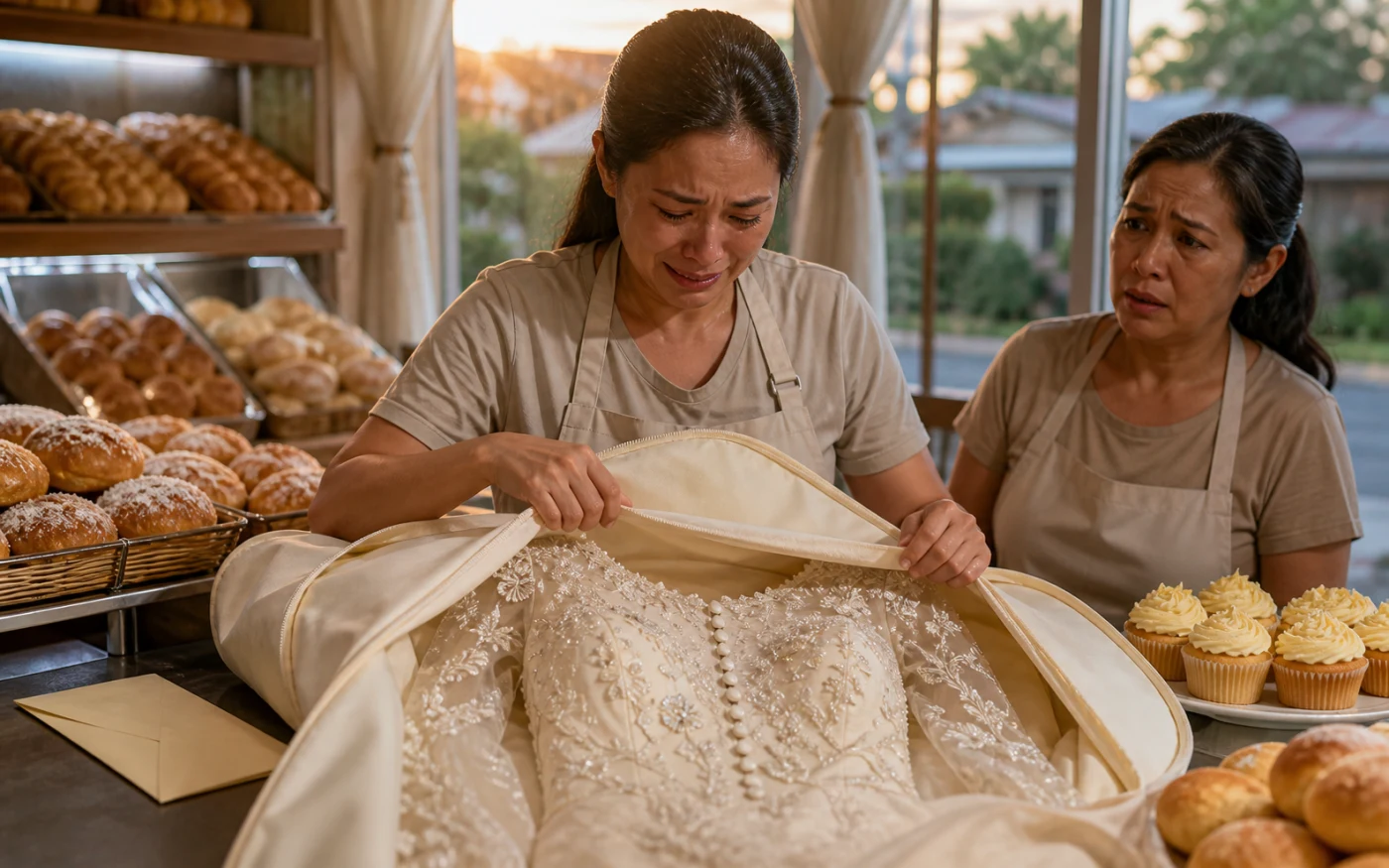
I pulled the zipper down.
First I saw the sleeves, sheer and pale as morning light. Then the hand-embroidered sampaguita vines, the seed pearls, and the scalloped hem I had traced with one finger when I was seven.
My mother’s piña wedding gown.
Every pearl was intact. The fabric had been cleaned. The torn seam near the waist had been repaired so carefully that even Mama might not have found it.
Pinned to the bodice was a note.
Wear it well, Nina.
I sat on the bakery floor and sobbed.
Fifteen years earlier, Mama had died after seven months in the hospital. She left Ate Bea and me her bakery, her recipes, and debts so large that every knock at the door made us afraid.
We sold her jewelry first. Then the mixer. Then Bea said we had to pawn the gown.
“It’s just a dress,” she had shouted.
“It was hers!” I shouted back.
The money paid one hospital bill. The words we threw at each other cost much more.
Bea moved to Seattle six months later. At first we exchanged stiff birthday messages. Then only Christmas greetings. Then nothing.
Ten years passed.
But that note—who else could have written it?
With shaking hands, I searched for the Seattle number I had never managed to delete. It rang five times.
“Hello?”
Her voice was older, but she was still my ate.
“Bea.”
Silence.
“Nina?”
“Thank you,” I whispered. “Thank you for bringing Mama back to me.”
“What are you talking about?”
“The dress. It’s here. Ang ganda pa rin.”
The line became so quiet that I heard an announcement in the background.
“Nina,” Bea said slowly, “I didn’t send any dress.”
My crying stopped.
“Then where are you?”
Another airport announcement echoed behind her.
Bea took a broken breath.
“I’m at the Manila airport,” she said. “Someone bought me a ticket home.”
PART 2: Who Brought Her Home
For a moment, neither of us spoke.
Then Bea laughed through her tears. It was the same breathless laugh she had whenever Mama caught us stealing warm pandesal.
“Your wedding is today, di ba?” she asked.
“In less than four hours.”
“Naku, Nina. I’m still at NAIA.”
“Who bought your ticket?”
“I don’t know. Last week, I received an email with the booking and a message saying you needed your sister. I thought you sent it.”
“You came without checking?”
“I was afraid if I called, you’d tell me not to.”
That hurt because it was true.
I looked at Mama’s gown spread across the counter between trays of bread. All those years, I had told myself Bea abandoned me. It was easier than admitting I had also let pride become a locked door.
“Ate,” I said, my voice small, “I’m sorry.”
She began crying harder.
“Ako rin. I’m so sorry.”
Lorna turned away and pretended to rearrange paper bags.
“Can you make it?” I asked.
“I’m already looking for a taxi.”
“Take one to Antipolo. Mark’s cousin Jun will meet you there on his motorcycle.”
“Motorcycle? In this dress?”
“You came dressed already?”
“Of course. I missed ten years. Ayokong ma-late pa.”
For the first time that morning, I laughed so hard I had to hold the counter.
Then someone knocked on the glass door.
Outside stood twenty children and three women from Bahay Pag-asa, the nearby shelter where Mama used to send leftover bread. One woman held a card addressed to me.
The bakery has been bought out. Please give everything to the guests outside.
I stared at the display. The stranger had not paid ten thousand dollars because one buyer wanted two hundred pastries. He had paid so I could give them away.
We opened the doors.
The next hour became beautiful chaos. Children carried boxes of cheese rolls. Tricycle drivers received loaves. Lorna gave cupcakes to street sweepers and packed ensaymada for the parish volunteers.
“Blessing sa kasal mo!” an old customer called.
“Save some for yourselves,” I told the children.
“Ate Nina, all of these?” one little boy asked, his arms barely fitting around a box.
“All of them.”
His grin made the whole shop brighter.
At seven thirty, I carried Mama’s gown upstairs to our tiny storeroom and stepped into it.
It fit as though she had measured me yesterday.
Lorna fastened the pearl buttons while both of us cried. When I looked in the mirror, I did not see a younger version of Mama. I saw myself—the laugh lines, the flour burn on my wrist, the silver beginning at my temples.
But around me was the work of her hands.
“Your mama would be proud,” Lorna whispered.
My phone rang. It was Mark.
“Good morning,” he said, too calmly.
“Do you know anything about a black car?”
A pause.
“Maybe.”
“Ten thousand dollars, Mark?”
“The driver wasn’t supposed to say the amount.”
I gripped the phone. “Ikaw lahat ito?”
“Please come to the church, Nina.”
“You bought Mama’s dress?”
“Come to the dressing room. May sasabihin ako.”
Then he ended the call.
By nine fifteen, rain was pounding the church roof. The aisle flowers drooped in the humidity, my veil kept catching on the car door, and Bea still had not arrived.
I should have been panicking.
Instead, holding up Mama’s skirt, I ran through the side entrance and pushed open the dressing-room door.
Mark was waiting inside.
And beside him stood the stranger from the black car, holding a small wooden box.
PART 3: What Mark Had Hidden
The stranger smiled and offered me the box.
“My name is Mr. Soriano,” he said. “My father owned the pawnshop in Laguna.”
Inside lay an old pawn ticket, creased and faded. Bea’s signature was at the bottom.
“The gown was never sold,” he explained. “My father knew its value, so he kept it stored separately. When he died, I found it among his private inventory.”
Mark looked almost embarrassed. “I started searching three years ago.”
Three years—the entire time we had been together.
He told me he had begun with the pawnshops closest to the bakery. On Saturdays, after installing cabinets or repairing roofs, he rode buses to Laguna and showed owners a photograph of Mama’s gown.
Eventually, he found Mr. Soriano.
“The price was more than I had,” Mark said. “So I restored furniture at night.”
I remembered the evenings he arrived with sawdust in his hair. The dinners he claimed he had already eaten. The new shoes he kept saying he didn’t need.
“Why didn’t you tell me?”
“Because you would’ve sold something to help me buy it.”
Mr. Soriano laughed softly. “That is exactly what he said.”
“And the ten thousand dollars?”
Mark’s ears turned red. “A client paid me in dollars for restoring an antique narra dining set. I know what the bread is worth. I paid ten thousand anyway.”
“Mark!”
“Use what’s left for the bakery roof. And a new mixer.”
I covered my mouth.
“You gave up everything for your family, Nina,” he said. “It was time someone gave it back to you.”
I wanted to scold him. I wanted to ask how many nights he had worked while I slept.
Instead, I stepped forward and pressed my forehead against his chest.
His hands hovered above the delicate sleeves, afraid to touch them.
“You can hold me,” I whispered. “Hindi ako antique.”
He laughed, then wrapped his arms around me.
“Bea’s ticket too?” I asked.
“That was harder than finding the dress.”
“How did you know where she lived?”
“You keep her Christmas cards in Mama’s recipe book.”
Of course he knew. Mark noticed every loose hinge in my life.
The church bells rang the quarter hour.
I pulled back. “She may not make it.”
He glanced toward the window. “She will.”
At nine fifty-five, the rain became a silver curtain. Guests squeezed inside shaking umbrellas. Father Ramon checked his watch. Lorna stood at the church entrance with me, holding my bouquet in one hand and my trembling fingers in the other.
“We can wait,” she said.
I looked down the empty road.
Ten years had already been too long.
Then a motorcycle horn sounded through the rain.
Jun’s battered motorbike turned the corner, splashing through a puddle. Behind him rode a woman in a blue dress, one hand gripping her skirt and the other clutching a suitcase.
“Ate!”
The motorcycle had barely stopped when Bea jumped off. Her hair was soaked, one heel was broken, and mascara streaked both cheeks.
She ran toward me.
For one terrible second, we stopped an arm’s length apart, as if the last decade still stood between us.
Then Bea saw the sampaguita embroidery.
Her face folded.
“Mama’s dress,” she whispered.
I nodded.
“I was wrong,” she said. “It was never just a dress.”
“Patawad, Nina.”
“Patawad din, Ate.”
She pulled me into her arms.
The church doors were open behind us. Everyone could see us crying in the rain, but I didn’t care. Bea smelled like airport coffee and wet fabric. She held me with the strength of all the years we had wasted.
“I thought you hated me,” she said.
“I tried. Hindi ko kaya.”
She laughed against my shoulder. “Good. Me neither.”
Lorna shoved tissues at both of us. “Enough. Papangit kayo.”
Bea wiped beneath my eyes and straightened Mama’s veil with the care of an older sister who had never left.
“Ready?” she asked.
I handed her my bouquet. “Walk with me.”
The organ began.
We entered together.
People rose as Bea and I walked down the narrow aisle, our wet shoes squeaking on the tiles. The gown shimmered under the church lights. Every hand-stitched flower seemed alive.
At the altar, Mark was waiting in a barong he had sewn one button back onto that morning. His eyes were already full of tears.
Halfway down the aisle, Bea squeezed my arm.
“He did all this?”
“All of it.”
“Then don’t make him wait.”
We reached the front. Bea placed my hand in Mark’s, but he caught hers too.
“Welcome home, Ate Bea,” he said.
She cried again.
Father Ramon cleared his throat and pretended not to.
When it was time for our vows, Mark unfolded a page, looked at it once, and put it away.
“Nina,” he said, “I can’t promise nothing will break. I only promise you won’t fix it alone.”
I looked at my sister in the front row, at Lorna beside her, and at the sleeves Mama had embroidered before any of us knew how much we would lose.
“And I promise,” I told him, “that when you carry something heavy, you will tell me.”
Everyone laughed, including Mark.
Then he slid the ring onto my finger.
After the ceremony, we stepped outside into sudden sunlight. Water still dripped from the church roof. The children from Bahay Pag-asa waited at the gate, holding the last box from the bakery.
The little boy from that morning ran to us and lifted the lid.
Inside was one slightly crushed ensaymada.
“We saved this for you, Ate Nina,” he said.
I tore it into three pieces.
One for Bea. One for Mark. One for me.
Under the bright clearing sky, my husband and my sister leaned close so the sugar would not fall on Mama’s dress, and we ate it together.