
I Bought a Vintage Balikbayan Box at an Airport Auction and Found a 1990s Pop Star’s Unreleased Album Master Tapes Hidden Inside Canned Goods
PART 1: The Box That Sang
I paid ₱3,200 for a moldy balikbayan box because I thought the corned beef inside might still be sellable.
Yes. That was my business model.
I bought unclaimed cargo from airport clearance sales, cleaned whatever survived, and resold it online.
Rice cookers. Rubber shoes.
One box containing thirty-seven identical snow globes from Las Vegas.
If it was cheap and did not hiss when I touched it, I bid.
This box had been found during the demolition of an old cargo annex near NAIA.
The customs officer said it had probably fallen behind steel shelving years ago.
Its faded shipping label said LOS ANGELES TO MANILA, AUGUST 1998.
Across the top, someone had written in black marker: FOR GRACE. HANDLE LIKE A BABY.
“Kuya Carlo, that box is ancient,” my coworker Grace said.
She was taping orders beside me in our tiny Parañaque warehouse, one hand working while the other rocked her daughter’s stroller with her foot.
Mika was six, clever, and permanently sticky.
“Vintage,” I corrected.
The first layer held old shirts, melted chocolate, and canned goods.
Spam. Vienna sausage. Corned beef.
The labels had gone yellow, so I was already mourning my ₱3,200.
Then I lifted one can.
Too light.
I shook it.
Something clicked inside.
“Huwag mong buksan,” Grace said. “Baka may multo.”
Naturally, I opened it.
The bottom had been cut off and neatly soldered back on.
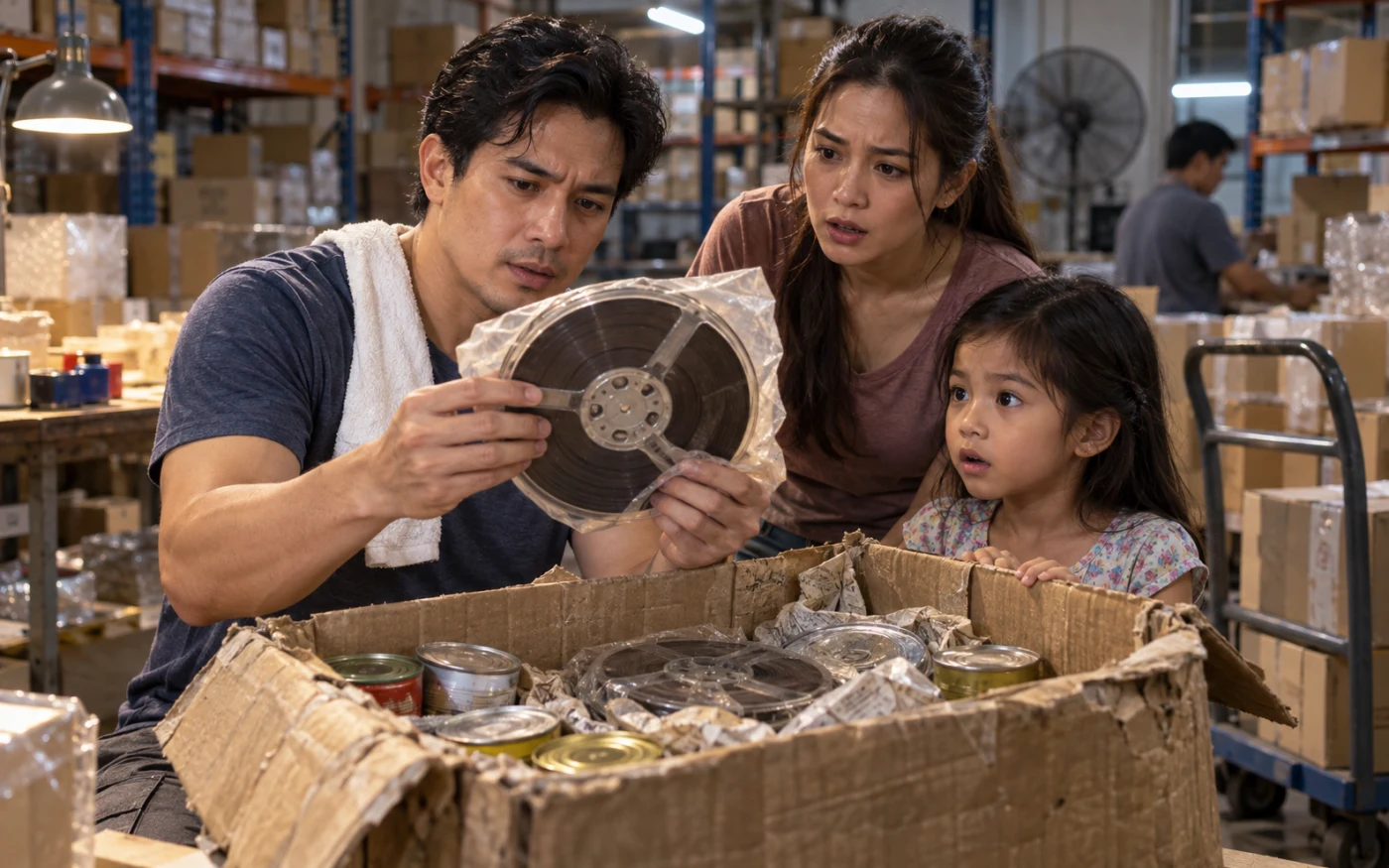
Inside was a reel of quarter-inch recording tape wrapped in wax paper.
The next can held another. Then another.
Twelve cans. Twelve reels.
Under them sat four black studio tapes marked in silver pen: T. DE LEON — GLASS HOUSES — FINAL MASTER, 1998.
My knees actually weakened.
Tomas “Teo” de Leon had been the voice of the nineties. Long hair. Leather jacket.
That cracked, aching voice every jeepney driver played after a breakup.
Then, in 1998, at the height of his fame, he disappeared before the release of his fourth album.
No farewell concert. No interview. Nothing.
People said he had died in Los Angeles.
Joined a cult. Become a monk. Married a billionaire.
Every titas’ reunion had a theory.
I borrowed an old reel machine from Mang Joel, who repaired karaoke units near Baclaran.
I threaded one of the four black master tapes. It hissed. A guitar entered, low and clean.
Then that voice came through the dusty speakers.
“If I come home empty-handed, will you know me by my song?”
Grace stopped taping boxes.
Mika stopped licking a label.
Mang Joel crossed himself.
It was Teo. Older than his biggest hit but unmistakable.
The song opened into drums and a chorus so huge that the three of us just stared at the machine.
“Play it again,” Grace whispered.
I should have called a lawyer.
Instead, I posted five seconds on Facebook with the caption: AIRPORT AUCTION FIND. DOES ANYONE KNOW THIS SONG?
By dinner, it had two million views.
By midnight, reporters were outside our warehouse.
By morning, Crown Star Records had sent a letter claiming every reel, every note, and possibly my firstborn child.
Then a message arrived from an account with no photo.
I KNOW WHAT IS ON THE SMALL REELS.
DO NOT PLAY THEM.
BURN EVERYTHING.
I typed, Who are you?
The reply came immediately.
TEO DE LEON.
And then my phone rang.
PART 2: The Name on Tape
The man on the call did not sound like a rock star. He sounded tired.
“Mr. Carlo Cuevas?”
“Prove it’s you.”
He sighed, then sang the next two lines of the unreleased song. No guitar. No effects. Just that famous broken-glass voice coming through my cheap phone.
My whole arm prickled.
“Please,” he said. “The album is music. The small reels are not. Those are journals. I made them when I was sick, ashamed, and trying to get sober. May batang madadamay.”
He wanted to meet alone.
I chose a crowded lugawan and brought Mang Joel anyway.
Teo arrived wearing a cap, thick glasses, and a jacket despite the heat.
His hair was gray now. His hands shook when I put one wax-wrapped reel on the table.
“I recorded Glass Houses in Los Angeles,” he said.
“The label wanted another album about drinking and heartbreak. They did not want me sober. I was missing rehearsals. Breaking things. Hurting people.”
He had a four-year-old daughter in Quezon City named Grace Mariel Mercado.
My spoon hit the bowl.
Teo continued without noticing. “Her mother, Teresa, told me to get clean before I came near them again. Tama siya. So I entered treatment. I made the album there. Between songs, I recorded messages for my daughter. Birthday stories. Apologies. Promises.”
The tapes and canned goods were packed into a box for Grace, care of Teresa.
A Filipino nurse in Los Angeles helped him ship it quietly because Crown Star wanted the masters.
The box never arrived.
“When Teresa did not answer my letters, I thought she wanted me gone,” he said.
“Later, I came home once. I saw Grace outside school with Teresa and a man carrying her backpack. They looked complete. I was sober, but I was still a coward. Umalis ako ulit.”
He had spent almost thirty years repairing guitars in a small Baguio shop, telling himself that staying away was his one decent act.
“And now?” I asked.
“Now strangers will hear me crying into a microphone while my daughter learns from Facebook that her father chose a record over her.”
“Did you?”
His eyes filled. “No. I chose fear. Mas masahol yata.”
I did not promise to burn anything.
Back at work, Grace was arguing with a delivery rider while feeding Mika crackers.
I had known her for three years.
She worked ten-hour shifts, sold banana bread on Sundays, and kept an envelope marked MIKA COLLEGE even when it contained only two hundred pesos.
Her full name was printed on the payroll folder beside me.
Grace Mariel Mercado.
I felt the floor tilt.
“Grace,” I said, “what was your mother’s name?”
She looked at me slowly. “Why?”
“Please.”
“Teresa. Carlo, ano ba?”
I locked the warehouse door. Then I placed the old shipping label in front of her.
She saw FOR GRACE.
All the color left her face.
“You found him?” she asked.
“He found the tapes.”
“That’s not what I asked.”
I nodded.
She shoved me.
Then she covered her mouth and cried so hard that Mika began crying too. I reached for her, but she stepped back.
“Ma died eight years ago,” she said. “She only told me my father was a musician who loved applause more than people.”
I told her Teo had once seen her outside school with her mother and a man carrying her backpack.
“That was Uncle Ramon,” Grace said. “Not a husband. And we moved twice after 1998. If he sent letters, they never reached us.”
Her voice cracked. “Thirty years. He gets all that silence, then one sad song and everybody forgives him?”
“No,” I said. “But there may be something you should hear before you decide.”
We played the first journal reel.
Teo’s young voice filled the warehouse.
“Hello, anak. It’s your fifth birthday next week. I bought you the red shoes, not the white ones, because you said white shoes look like nurse shoes.”
Grace made a sound like someone had punched her.
On another reel, he read her favorite book and forgot the rabbit’s name.
On another, he admitted he had relapsed, canceled his flight home, and entered treatment again because he refused to let his daughter meet him drunk.
The last tape was dated August 12, 1998.
“I am sending you the only good thing I made this year,” young Teo said. “Not the album. The truth. I loved you every day I failed to come home.”
Grace wiped her face with packing tissue.
“I still hate him,” she whispered.
“Okay.”
“I want to see him.”
So I called Teo and said, “Tomorrow. Four o’clock. Come alone.”
Grace grabbed my wrist.
“No,” she said. “Bring his guitar.”
PART 3: Would She Call Him Father?
We met in the empty covered court behind our warehouse because Grace did not want cameras, lawyers, or some dramatic restaurant audience.
Of course, it became dramatic anyway.
Teo arrived two hours early with his guitar and a pair of red shoes.
The second pair.
Tiny. Faded. Still inside their 1998 box.
“I bought these the year after,” he told me. “I never had the courage to give them.”
When Grace walked in holding Mika’s hand, the man who had faced arenas lowered his head like a schoolboy waiting outside the principal’s office.
Grace stood six feet away.
“Look at me,” she said.
He did.
“You should have knocked on our door.”
“Yes.”
“You should have asked Uncle Ramon who he was.”
“Yes.”
“You do not get to call disappearing love.”
Teo’s mouth trembled. “I know.”
He did not defend himself. That saved him.
He placed the little shoes on a plastic chair and said, “I cannot return your birthdays. I cannot ask you to forgive a man you have met for five minutes. But if you allow it, I can show up tomorrow. Then the next day. Kahit galit ka pa.”
Mika tugged her mother’s sleeve. “Mama, is he the singer from Kuya Carlo’s video?”
Grace gave one wet laugh. “Unfortunately.”
Mika stared at Teo. “Can you play the box song?”
He looked at Grace for permission.
After a long moment, she nodded.
Teo played the unreleased song under a rusted basketball hoop. Halfway through the chorus, Grace began singing harmony.
He stopped.
“Why do you know that?”
“Mama used to sing it when she washed dishes,” Grace said. “She knew your song.”
Teo covered his face.
That was when Grace crossed the six feet between them.
She did not call him Papa. She did not magically forgive him.
She put one hand on his shoulder and said, “Finish it.”
So he did.
The legal fight changed after that.
Teo still owned the physical masters, and an old contract showed Crown Star had forfeited the unreleased album when it shelved the project.
The company backed down after fans started posting photos of canned goods with the words RELEASE THE CORNED BEEF TAPES.
Teo agreed to release Glass Houses on one condition: the journals belonged to Grace alone.
No documentary. No bonus tracks. No strangers consuming her pain.
The album exploded.
But the best part happened three months later, again at our covered court.
We held a free neighborhood concert for the release.
Mang Joel handled the sound.
Aunties brought pancit in aluminum trays.
Teenagers wore fake leather jackets.
Even the customs officer came and waved the auction receipt like he deserved producer credit.
Before the last song, Teo called Grace and Mika onto the stage.
He announced that his album royalties were going into a family trust: school through college for Mika, a paid-off home for Grace, and an emergency fund she could control herself.
Then he pointed at me.
“And Carlo,” he said, “will run the Teo de Leon Archive, so no other piece of our music spends decades hiding beside expired Spam.”
The crowd dragged me onstage while I shouted, “Sandali! Wala akong sapatos!” because Mika had somehow stolen both of them.
Grace was laughing. Teo was crying. Everyone was filming.
Then Mika sat at the keyboard and played the opening notes of the box song.
She had been practicing with her grandfather every Saturday.
Grandfather.
That was what she called him.
Grace took the microphone. She looked at Teo for a long moment, with all those missing years still between them but no longer empty.
“Ready, Pa?” she asked.
The whole court went silent.
Teo could not answer. He only nodded.
Then father, daughter, and granddaughter sang the chorus together while the old balikbayan box sat at the front of the stage, covered in airport tape, finally delivered to Grace.