
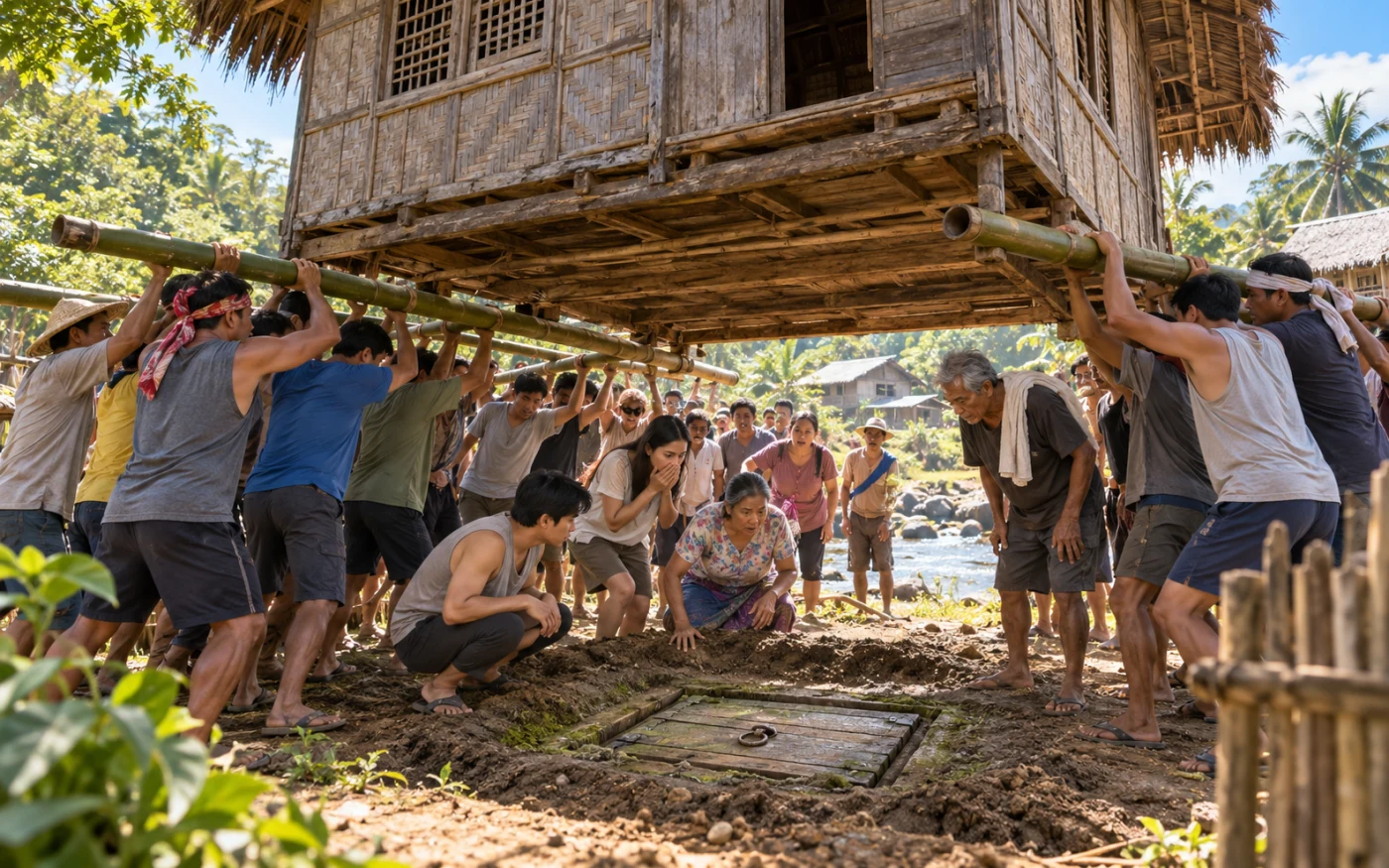
Forty Neighbors Carried Our House Across the River. Underneath It Was a Vault Full of Things Their Families Thought Were Gone Forever.
PART 1: The House Had Secrets
The first time forty people lifted my house, everyone was laughing.
The second they saw what was underneath it, nobody made a sound.
Not even Tito Boy, and that man once talked through an entire funeral Mass.
Our old nipa house had stood beside the river in Barangay San Roque for more than a hundred years.
Almost every wall had been replaced at least twice.
My great-grandparents lived there. My lola raised six children there. My mother raised me there.
By the time it came to me, the floor leaned toward the kitchen, the roof leaked above my bed, and one wall shook whenever a tricycle passed.
But it was ours.
And we were poor enough that “ours” mattered.
My brother Joel repaired motorcycles.
I sold rice cakes online and at the school gate.
We still had debts from Mama’s last illness, and when our refrigerator died, we spent three weeks pretending a cooler full of ice was basically the same thing.
Then the river ate three meters of our yard in one rainy season.
Captain Lito said the next big flood might take the kitchen.
A church family offered us an unused lot on higher ground across the river.
Ninang Diane simply told me, “Use it. Your children need somewhere safe. Don’t be stubborn.”
We had no money for demolition or new lumber, so Captain Lito gave us the old answer.
“Ilipat natin. Bayanihan.”
I thought he was joking.
He was not.
On Saturday morning, forty neighbors arrived with bamboo poles, rope, slippers, towels, pancit, and the confidence of people who would not personally be paying for my hospital bill.
My cousin Mayet brought a drone because the tourism council wanted a cheerful video titled TRADITION LIVES IN SAN ROQUE.
I was not cheerful.
“Careful with Lola’s aparador!” I kept yelling.
“Empty na!” Joel yelled back.
“Careful anyway!”
Tita Lucy, an older woman who had moved back to the barangay the year before, stood beside the road serving coffee.
She had known Mama when they were girls, but whenever I asked about those days, she smiled and changed the subject.
That morning she kept staring at our house.
I thought she was worried it would fall.
The workers slid bamboo poles beneath the floor. Captain Lito raised one hand.
“Isa! Dalawa! Tatlo!”
The whole house rose.
My whole childhood rose with it.
Men groaned. Women shouted instructions louder than the men. Children ran alongside.
Our yellow dog, Bawang, barked as if he were the foreman.
For ten glorious seconds, it worked perfectly.
Then Mayet screamed.
“Wait! May pinto sa lupa!”
Everyone stopped.
Forty people stood under my house, bent like question marks.
Mayet lowered the drone.
On her phone screen was a square wooden hatch exactly where our kitchen had been, almost invisible beneath packed soil and moss.
An iron ring sat in the middle.
I had lived there for thirty-one years.
I had never seen a hatch.
They lowered the house onto temporary blocks.
Within minutes, half the barangay had formed a circle.
“Treasure,” whispered a boy.
“Japanese gold,” Tito Boy said immediately.
“Shabu lab,” somebody muttered.
“Under a kitchen?” Joel snapped. “Ano kami, tanga?”
Then Aling Vangie pushed through the crowd.
She owned the hardware store, three rental houses, and the loudest voice in San Roque.
She stared at the hatch, then at me.
“All these years,” she said, “you kept saying you had no money.”
That hurt because it was true.
Everybody knew our roof leaked. Everybody knew I had borrowed money when Mama got sick.
Now they were looking at our patched roof and my worn slippers as if poverty had been a costume.
Then I remembered something I had not thought about in years.
Near the end of her life, Lola Amalia sometimes pointed toward the kitchen and said, “Dry room.”
Mama thought she meant the pantry. So did I.
“I didn’t know this was here.”
“Then open it,” Vangie said.
Joel fetched a crowbar. The wood cracked, releasing cold, dry air.
Beneath the hatch were stone steps.
Captain Lito shone his flashlight down.
“There’s a room.”
Somebody gasped.
Somebody else started livestreaming.
And from the darkness below us, painted in white across the first shelf, we saw one word.
FLORES.
Aling Vangie’s surname.
She turned to me.
“Why is my family’s name under your house?”
PART 2: What Else Was Hidden
I went down first.
Not because I was brave.
Because it was my house, my dead mother’s family, and my humiliation waiting at the bottom.
The chamber was dry and lined with shelves.
On them sat biscuit tins, wooden boxes, ammunition cases, jars, and bundles sealed in waxed cloth.
Every container had a surname painted on it.
FLORES. ORTEGA. CASTILLO. RIVERA. GARCIA.
Names from our street. Names from families who had moved to Manila, California, Dubai.
“Open Flores,” Vangie said.
The green tin held a land title, a black-and-white wedding photograph, baptismal certificates, a velvet pouch, and a letter.
Vangie grabbed the photograph.
“Nanay and Tatay.”
She sat down.
“I thought this was lost in the flood.”
Inside the pouch was a gold necklace with a blue pendant and three old coins.
Vangie touched the necklace.
“My mother looked for this until she died.”
Nobody accused us of hiding money after that.
They started calling names.
By noon, the yard looked like a reunion arranged by ghosts.
Mang Oca found his brother’s medals, letters, and old watch.
The Garcia family found a silver rosary, two gold bracelets, and photographs of grandparents they had never seen young.
There were valuables everywhere.
But people reached first for faces.
For handwriting.
For things their dead had touched.
Then Tito Boy lifted a silver pocket watch.
“This is not biscuit-tin treasure anymore.”
Captain Lito slapped his hand down. “Put that back before your wife sells you instead.”
At the bottom of the chamber, Joel found three ledgers wrapped in oilcloth.
The newest was Lola Amalia’s.
The second belonged to her mother.
The oldest was written by a woman named Basilia—my great-great-grandmother.
That was when the story changed.
Our family had not always been poor.
Long before the river shifted and land was divided and sold, ours had been one of the old established families in San Roque.
The ancestral house stood on the highest ground in the area.
The stone room beneath it had been built to keep documents, jewelry, coins, and valuables safe from water.
Then neighbors began bringing their precious things too.
During floods.
During typhoons.
During wartime evacuations, when families left carrying babies and one bag.
The ledgers listed land papers, watches, wedding rings, medals, rosaries, silver pieces, photographs, even church objects entrusted to individual families for safekeeping.
Most were reclaimed.
Some were not.
Families moved. Elders died. Children were never told.
The floor was repaired over the hatch.
The old ledgers stopped naming the family chest.
Then Lola Amalia had a stroke, and the secret collapsed into two scraps of family lore.
Great-Lola kept things safe.
Dry room.
That was all Joel and I had ever heard.
Now I finally understood what both meant.
Then Mayet stopped filming.
We had found a small red box marked in Lola’s handwriting.
LUCIA MERCADO — HER HANDS ONLY.
I looked up.
Tita Lucy stood at the edge of the crowd.
Her coffee tray slipped.
Mercado was her maiden name.
She had left San Roque at seventeen after a terrible fight with her father and had not returned for more than forty years.
By the time she finally came back, Mama had been dead five years.
“I came too late,” she whispered.
I stared at her. “You bought rice cakes from me every Tuesday.”
“I was trying to be brave.”
“For a year?”
She wiped her eyes. “I am slow.”
That made half the yard laugh, including me.
Her hands shook so badly that I opened the box for her.
There was no gold.
There were letters.
Dozens of them.
All addressed to Lucia.
All written by my mother.
Mama had written on birthdays for years, even after envelopes came back because nobody knew where Lucy had gone.
Lola had saved every one.
There was also a photograph of Mama and Lucy beside the river at sixteen.
On the back Mama had written:
Sisters by choice. Come home when you are ready.
Lucy sat down in the grass.
She opened the last letter, then handed it to me because she could not speak.
Mama’s handwriting was shaky.
Lu, if you come back and I am gone, do not stand outside my house.
Knock. My daughter will feed you. She always cooks too much rice.
I laughed and cried at the same time.
Lucy grabbed my hand.
“She waited for me?”
“Until she couldn’t write anymore.”
She folded against me, sobbing.
For a moment, it felt like Mama had reached through that box and pulled Lucy home herself.
Nobody hurried her. Mayet finally put her phone away.
Someone brought Lucy a chair and a glass of water.
She sat with Mama’s letters in her lap, touching each envelope as if she were counting birthdays she had been given back.
Only when the crying had quieted did Joel shout from below.
“Ate.”
Behind a false panel, he had found a long ironwood chest.
Unlike every other container, it carried only our own surname.
Beneath it were six words in Basilia’s handwriting.
FOR THE HOUSE.
OPEN WHEN IT LEAVES THIS GROUND.
PART 3: What Was Ours
Nobody touched the chest for almost a minute.
Then Tito Boy whispered, “If that thing contains old curtains, I’m going home.”
Aling Vangie elbowed him.
The key was tied inside Basilia’s ledger.
On top lay a photograph of our house when rice fields still surrounded it.
Basilia stood on the veranda beside a board that read SAFE ROOM — FAMILIES RECEIVED.
Below the photograph were our family’s own things.
A pair of thick gold bracelets.
A carved wooden santo with a silver halo.
Antique silver candlesticks. A pocket watch. A pouch of old coins. A small diamond brooch.
Jewelry wrapped in cloth and tagged with names.
And a letter.
Our family had once owned rice land and several houses. Over generations, the land was divided, sold during hard years, lost to floods, or used to pay debts.
Eventually, almost nothing remained except the old house.
But the heirlooms stayed in the safe room.
Basilia had ordered the next keeper to leave that chest sealed unless the house itself had to leave the ground.
Her daughter copied the warning into the next ledger.
After that, the instruction disappeared from the family records.
Basilia had written one sentence twice.
If the house must leave the ground, the family will need help beginning again.
I sat there staring at gold bracelets while wearing slippers repaired with glue.
We had been sleeping above an emergency fund our ancestors forgot to explain.
Captain Lito crouched beside me.
“Don’t sell anything today.”
“I know.”
Aling Vangie pointed at me, her mother’s blue pendant already around her neck.
“And when you do, proper appraisal. Hindi kay Tito Boy.”
“I can hear you,” Tito Boy said.
“Good.”
The house still had to move.
By then, almost twice as many people were waiting to help.
Families who had recovered boxes came back with rope, tools, food, and relatives.
Tita Lucy tied a towel around her head and took over the cooking.
Aling Vangie sent two trucks from her hardware store.
“No bill,” she said when I protested. She touched her mother’s blue pendant. “Keep your treasure. We already got ours.”
That afternoon, nearly seventy shoulders went under our house.
“Isa! Dalawa! Tatlo!”
The house rose.
Halfway across the shallow river, Joel slipped.
The house tilted.
Everyone screamed.
Then Aling Vangie, sixty-two years old and wearing jeweled slippers, shoved her shoulder harder under the bamboo.
“Huwag bibitaw!”
Nobody let go.
We reached the other side soaked, shaking, and cheering.
Over the next weeks, the barangay strengthened the house because they wanted to.
Carpenters replaced rotten posts.
Vangie’s workers put on a roof that did not need cooking pots underneath it.
Families donated lumber, paint, meals, and labor.
Lucy kept Mama’s letters. She gave me the photograph for our wall.
From our own chest, we kept the santo, one bracelet, the diamond brooch, and the pieces tagged with our ancestors’ names.
Then we took the rest for proper appraisals.
We sold a handful of pieces.
It was enough to clear every debt Mama had left behind.
Replace the refrigerator.
Set aside university money for both my children.
And, put more savings in the bank than I had ever imagined our family owning.
I kept selling rice cakes because I liked the work.
But I stopped calculating whether a broken appliance would ruin us.
I stopped wondering which bill could wait.
For the first time in my adult life, money had become something we could plan with instead of something we were always running out of.
The barangay also built a small dry room for the unclaimed boxes.
On the day it opened, Lucy arrived carrying a pot of arroz caldo so large two teenagers had to help her.
Inside our repaired house, I had framed the photograph of her and Mama beside the river.
Lucy stopped when she saw it.
“You kept this one?”
“Of course.”
She touched Mama’s face through the glass.
Then she looked around at the new roof.
My children stealing lumpia.
Joel showing Captain Lito the level floor.
And, Aling Vangie arguing with Tito Boy over whether he was allowed near the antique cabinet.
Lucy smiled.
“Your mother said you would feed me.”
I handed her a bowl.
“She forgot to warn you that now you have to help wash dishes.”
Lucy laughed and sat at our table.
That night, heavy rain woke me.
Half asleep, I reached beside the bed for the plastic bucket that had lived there for years.
My hand found empty floor.
No drip.
From the kitchen came Lucy’s laugh and the clink of bowls.
Someone was still eating.
Someone was always still eating.
Our old house stood on safe ground.
Our debts were gone.
My children’s future was funded.
And nobody I loved was standing outside.