
I Supported My Family From Abroad for 14 Years. When I Came Home, Nobody Was at the Airport...
PART 1: The Empty Arrival
I knew my family had learned to live without me when I came home after fourteen years—and not one of them was waiting at the airport.
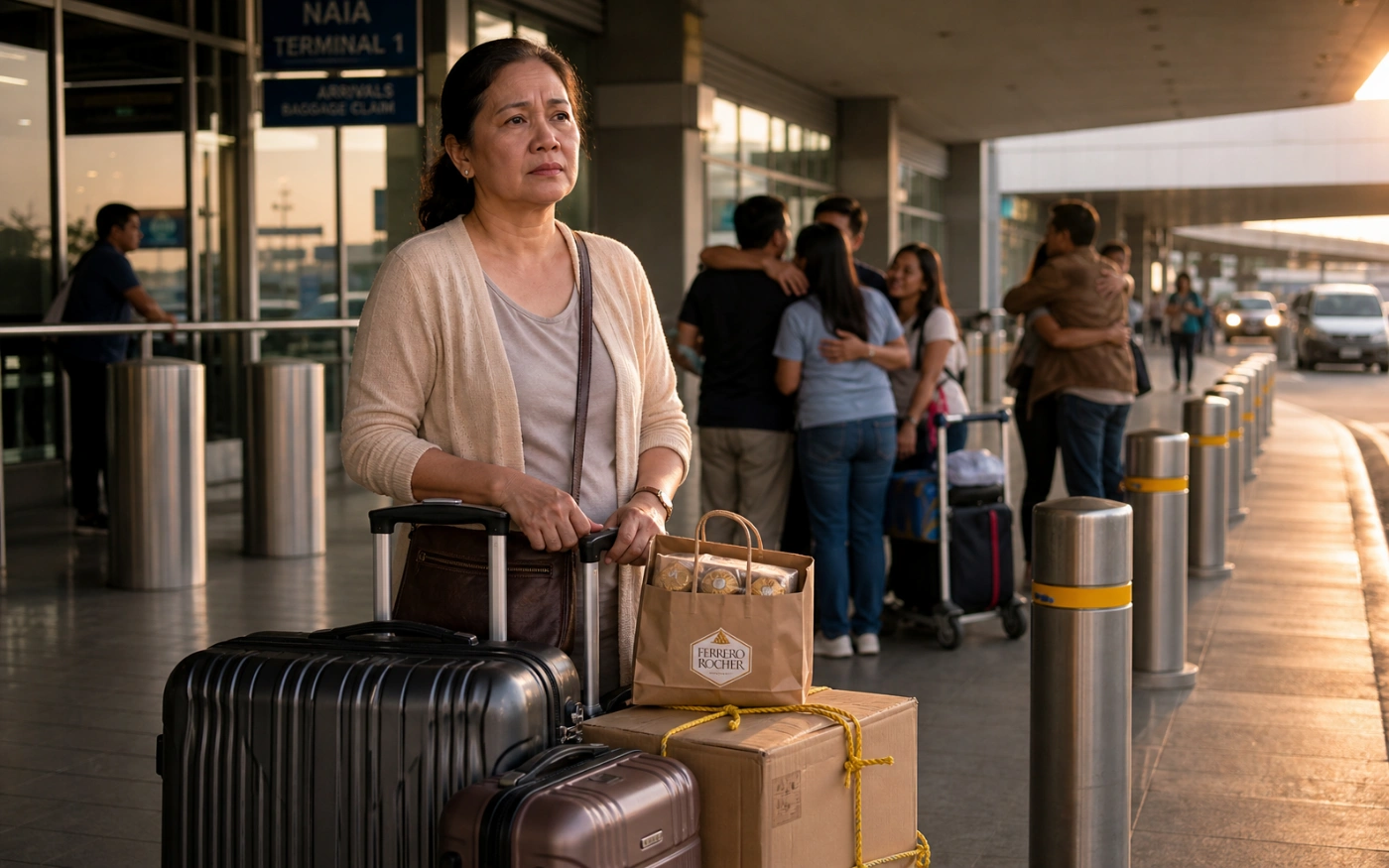
For forty minutes, I stood outside arrivals with two suitcases, a box tied with yellow rope, and a paper bag of chocolates slowly melting against my leg.
Every time a van slowed down, my heart jumped.
Every time somebody shouted “Ate!” I turned.
But the arms opening were never for me.
Around me, families cried and laughed.
Children threw themselves at fathers who smelled of airplanes.
A woman beside me kept kissing an old lady’s cheeks while three men fought over her luggage.
I smiled at them because it was easier than looking at the empty lane in front of me.
“Baka traffic lang,” I whispered.
My original flight had been cancelled, and my airline cleared me onto a flight landing more than three hours early.
But, I messaged the family group from the gate as soon as I knew.
They moved me to an earlier flight.
Landing early. 11:20.
Then, after we landed:
Landed na. Getting my bags.
I’m outside. Nasaan kayo?
All delivered. None read.
I called Lorna. I called Jun. I called Bebeth, who usually slept with her phone beside her pillow.
Nothing.
A guard finally asked, “May susundo po?”
“Yes,” I said quickly. “Malapit na sila.”
It was a small lie, but it cracked something open inside me.
I had imagined this homecoming for years.
In Hong Kong, while washing another family’s dishes, I imagined Lorna pushing through the crowd first.
While folding school uniforms that did not belong to my nieces and nephews, I pictured Jun grabbing my suitcase and complaining about the weight.
I imagined Bebeth crying before she even reached me.
Fourteen years is long enough for a family to learn new shapes.
Lorna’s children had been toddlers when I left.
Now Mika was in college, and Paolo’s voice was deeper than Jun’s.
Bebeth married a man I first met through a frozen video call.
Jun lost a front tooth in a motorcycle accident and let me notice it myself during Christmas karaoke online.
The rest of their lives reached me through a screen. Sometimes I woke to two hundred family messages—photos of pancit, jokes I did not understand, plans already finished. By the time I was free to reply, everybody was asleep.
Slowly, I became a small round photo on their phones.
Useful every month.
Loved, probably.
Needed? I was no longer sure.
My money still arrived on the fifteenth. Roof repair. Tuition. Medicine. Cement. A water tank I had never touched.
Money can fill a refrigerator. It cannot take a seat at dinner.
At fifty-two minutes, the chocolate bag tore. One box fell onto the pavement.
I crouched, picked it up, and told myself I was done waiting.
Then I dialed the only other number I still knew by heart: the sari-sari store two doors down from our house.
“Hello, Cora’s stor—”
“Aling Cora, si Marites po.”
Something crashed on the other end.
Then Aling Cora screamed, “SUSMARYOSEP!”
I pulled the phone away from my ear.
“Nasa Pilipinas ka na?”
“Oo. I’m at the airport. Nobody came. They aren’t answering.”
Silence.
Now that frightened me, because Aling Cora had never met a silence she couldn’t fill.
“Aling Cora?”
“Ha? Oo. Sandali. Listen to me.” I heard oil sizzling and somebody shouting behind her. “Don’t leave. Don’t take a taxi. Someone is coming for you. Promise.”
“Sino?”
She hung up.
So I stayed beside my luggage, sweaty and angry and trying very hard not to cry.
Twenty minutes later, I heard an engine coughing its way toward the curb.
Then I saw what Aling Cora had sent to collect me.
PART 2: Who Came to Get Me
A tricycle.
She sent me a tricycle.
It came rattling toward arrivals with a guard already waving both arms at it. Taped to the windshield was a piece of Nescafé carton with black marker across it.
WELCOM HOM ATE MARITIS
The driver looked about nineteen. Basketball shorts. Rosary on the mirror. Hair still wet with sweat.
"Ate Marites po?" he called.
I looked behind me in case there was another Marites whose family had also abandoned her.
"Ako po si Toto. Apo ni Lola Cora."
Then I looked at his sidecar.
It was full of monobloc chairs.
Six white plastic chairs were nested together where a passenger was supposed to sit.
Three yellow balloons were tied to the frame, and a rolled-up object wrapped in a rice sack was jammed underneath them.
I stared at Toto.
"Saan ako uupo?"
"Sandali lang po."
He hauled the chairs out, stacked them on the tricycle roof, and tied them down with the coil of rope.
Then he wedged both suitcases beside me, put my yellow-rope box across my knees, and shoved the wrapped bundle at my feet.
I had spent fourteen years imagining my family running toward me. Instead, I was folded into a tricycle under six plastic chairs.
"Nasaan pamilya ko?" I asked as we pulled away.
Toto stared very hard at the road.
"Busy po."
"Busy."
"Opo."
"All of them?"
His shoulders rose almost to his ears.
"Lola Cora told me to bring you home, Ate. That's all I know."
That answer did not improve my mood.
The ride home should have made me happy.
The heat was familiar. The traffic was not.
New buildings stood where old stores used to be. Streets I knew had grown gates, signs, second floors.
I kept looking for one thing I would recognize.
Then Toto turned onto our street and stopped.
I stared through the sidecar opening.
"Dito ba talaga?"
"Opo."
Our old house was gone.
The rusty gate was gone. The narrow two-room house where we had slept shoulder to shoulder was gone.
In its place were three small cream-colored units around a paved courtyard. Red roofs. Yellow curtains. Potted plants lined along the wall.
For one terrible second, I thought maybe they had sold the property and simply forgotten to mention that too.
Then I saw the old santol tree leaning over the back wall.
Same tree.
Same lot.
Different life.
Toto carried my luggage through the unlocked gate. The first unit had a wooden sign beside the door.
JUN & ANA.
The second said LORNA'S HOME.
Slippers covered the steps. Through the window I saw family photographs, toys, and a guitar I recognized from video calls.
The third unit stood at the back.
No name on the door.
No slippers outside.
Nothing.
My throat tightened.
"Toto," I said, "where am I going to live?"
He looked at that third door, then at me.
"Ate... buksan mo po."
The door was unlocked.
Inside was a small living room with yellow curtains, a woven rug, two chairs, and a couch that still looked too new to sit on.
On the wall hung our family picture from before I left.
Beside it was a framed screenshot from a video call. My own face filled half the picture, frozen mid-sentence above Lorna's rice cooker.
I covered my mouth.
On a shelf sat the wooden carabao I had mailed home years ago. Next to it was the chipped BEST ATE mug Mika made in grade school. She had told me it broke.
Somebody had glued the handle back on.
The kitchen cabinets were full.
Rice. Coffee. Sardines. My favorite crackers.
There were eggs in the refrigerator and a pitcher of cold water.
Then I saw the paper taped to the refrigerator door.
MARITES' HOUSE — CLEANING SCHEDULE
Jun — Saturday.
Lorna — Wednesday.
Mika & Paolo — Sunday.
Bebeth — Tuesday.
The page was covered in crossed-out dates. I lifted the bottom edge.
There was another schedule underneath it.
And another.
Four months.
They had been cleaning my house for four months before I ever stepped inside it.
I sat down right there on the kitchen floor.
All the anger I had carried from the airport broke at once.
I cried into both hands.
Then I heard something outside.
One drumbeat.
Then another.
Then a megaphone screamed my name from the end of the street.
PART 3: What Was Coming Down the Street
I ran to the gate with tears still on my face.
Coming toward me was half the barangay.
At the front was the elementary school drum and lyre group, eleven children in mismatched uniforms trying very hard to march together.
Behind them came Kapitan Delfin with a megaphone that kept squealing.
Behind him, two teenagers carried a tarpaulin across the whole road.
WELCOME HOME ATE MARITES
14 YEARS
MAHAL KA NAMIN
Beside the words was a four-foot photograph of my face from a video call.
My mouth was open.
I was chewing.
Of all the pictures they had of me, this was apparently the one chosen for public display.
Behind the banner came Aling Cora in her apron, still carrying a tray of pancit.
At the gate, Toto was already untying the monobloc chairs from his tricycle roof. One by one, he carried them into my courtyard while neighbors grabbed them and sat down.
I had spent the whole ride thinking my family could not even send a vehicle with room for me.
The chairs were for my party.
Then I saw Lorna.
She was running ahead of everybody with one slipper missing.
"ATE!"
She hit me so hard we nearly fell into the gate.
Bebeth came next. Then Mika. Then Paolo, who had somehow become a grown man while I was away and lifted me clear off the ground.
I cried. They cried. Somebody behind us kept beating the drum because nobody had told the children when to stop.
Then I remembered the airport.
I pushed Lorna back by the shoulders.
"BAKIT WALANG SUMUNDO SA AKIN?"
The whole front row of the parade went quiet.
Lorna's eyes went huge.
"Ate, we thought two-forty!"
"I TEXTED ALL OF YOU!"
She grabbed my wrist and pulled me toward a red cooler in the courtyard.
She opened it.
Inside, on top of the ice and soft drinks, were eleven cellphones sealed in plastic bags.
I stared at them.
Then at her.
"Ano 'to?"
Lorna covered her face.
"My idea."
A voice behind her said, "Bad idea."
"Tumahimik ka, Jun."
My brother stepped forward holding a laminated airport sign.
MARITES DELA CRUZ — WELCOME HOME
My name was spelled perfectly.
Then the whole stupid chain finally made sense.
Lorna had collected everybody's phones at eight because they were decorating and she was terrified somebody would post a picture.
At 8:40, while they were all phoneless, I got my new seat.
Jun had checked my flight the night before and still expected me at 2:40. He wasn't leaving until 1:30.
Aling Cora alone had stayed at her store finishing the pancit.
My noon call reached the one person still holding a phone.
Toto happened to be there picking up chairs, rope, and balloons for the party.
She sent him straight to me, then ran to tell everyone I had arrived three hours early.
By the time Toto got me home, they had dragged the whole welcome parade forward.
Jun held up the sign.
"I swear, Ate. I was going to be there."
Bebeth pointed at Lorna. "I told her somebody should keep one phone."
"And I said that would ruin the surprise," Lorna muttered.
"The surprise was nearly Ate taking a taxi home alone," Jun said.
I laughed before I wanted to.
Lorna started pulling phones from the cooler. One after another lit up with my messages.
They moved me to an earlier flight.
Landed na. 11:20.
I'm outside. Nasaan kayo?
Her face crumpled.
"Ate, patawad. We didn't forget. We were hiding from you."
Aling Cora slapped Jun lightly on the arm with a folded towel.
"Next time, hide with one cellphone."
That finished me.
I laughed so hard I had to sit down.
The children started drumming again because they thought that meant the emergency was over.
Then everyone poured into my little house.
There were too many people for the room.
Titas sat shoulder to shoulder on the rug.
Children crawled under the coffee table.
Plates of pancit passed over people's heads.
My cousin Nene ate beside the bathroom door because that was the only space left.
I looked around at all those faces and thought about myself at the airport, watching other families hug.
Now I could barely move because mine had packed themselves around me like sardines.
Bebeth pushed through the crowd and grabbed my hand.
"May isa pa."
She turned my palm over and dropped a key into it.
A small wooden tag hung from the ring.
ATE MARITES.
I looked at Jun.
He nodded toward the room.
"The money you sent kept this family standing," he said. "Roof, school, bills, everything. When we finally got on our feet, we rebuilt this place. But your house, Ate? Hindi galing sa padala mo."
Lorna wiped her face.
"Two years kaming nag-ipon. All of us. Little by little. We wanted one thing here that you didn't have to pay for yourself."
I looked toward my door.
The other two units had names.
Mine still didn't.
"Bakit walang sign?" I asked.
Paolo grinned and disappeared outside.
He came back carrying the rolled-up rice sack that had been jabbing my ankle in Toto's tricycle.
Inside was a wooden sign.
Hand-painted. Slightly crooked.
ATE MARITES.
"We didn't hang it," Mika said. "Ikaw dapat."
Five minutes later Toto dragged over one of the same monobloc chairs he had hauled from the airport.
I climbed onto it while Jun held my waist, Lorna held my elbow, and at least twenty relatives gave instructions nobody had asked for.
"Kaliwa pa!"
"Hindi, kanan!"
"Straight na 'yan!"
"Hindi straight!"
I hammered the sign above my own door.
It went up crooked.
Jun reached for the hammer.
"Ayusin ko."
I pulled it away.
"Hayaan mo."
We ate in the courtyard until the light was gone.
The welcome banner hung between the santol tree and the gate, my giant chewing face watching over everybody.
Late that evening, when the plates were almost empty and the children were falling asleep on laps, I sat outside my little house with Bebeth's youngest asleep against my chest.
I kept looking at the sign over the door.
My name.
Crooked.
And in my hand, warm from holding it all night, was the key.