
At 63 I Asked My Son-in-Law to Teach Me to Drive. He Thought I Was Punishing Him.
PART 1: My Impossible Request
The morning I asked my son-in-law to teach me to drive, he went so quiet I could hear the refrigerator humming behind him.
Then Rueben looked at my daughter Cely and said, “So this is because I missed taking you to church last Sunday?”
I should have told him the truth right then.
Instead, I folded my hands on their kitchen table and said, “No. I simply want to learn.”
That made everything worse.
I was sixty-three years old. My husband, Arturo, had done all the driving before he died. After that, Rueben took over without one complaint.
For nine years, he brought me to the doctor, the market, church, even the pharmacy when all I needed was ointment for a rash I refused to describe.
Cely had arranged it after the funeral.
“Ma, call Rueben anytime,” she had said. “Kahit kailan.”
And he really came anytime.
But over the past year, his face had changed.
He still smiled when he pulled up, but the smile looked borrowed.
Cely’s voice was always rushing.
Their little boy, Nico, had begun having trouble forming words, and three mornings a week Cely took him across town to a child development center.
They never told me how hard it was.
They did not have to.
I noticed Cely answering work calls while spooning lugaw into Nico’s mouth.
I noticed Rueben wearing the same wrinkled polo from morning until late at night.
I heard them whisper about her supervisor when they thought I was in the bathroom.
Twice, Cely said, “It’s okay, Ma,” with tears already waiting in her eyes.
So I stopped calling for rides.
I took two jeepneys to the market. I paid a neighbor’s college son to bring me to my checkup.
Once, I walked forty minutes home from church carrying a bag of lanzones because I was too proud to call them.
They thought I needed less.
Then, one Thursday, I was at their house when Cely’s phone rang.
She stepped into the hallway, but I heard her say, “Please, sir. Nine months lang. After that, the therapist says he should be fine.”
There was a pause.
Then my daughter whispered, “I understand I’ve already been spoken to twice.”
She came back smiling so hard it frightened me.
That night, I opened the old metal box where Arturo had kept receipts, insurance papers, and the keys to his faded blue Toyota.
The car had sat under a cover beside my house for almost two years. Rueben started it once a month. He kept telling me to sell it.
I took out the keys.
The next morning, I made my impossible request.
Cely stared at me. “Ma, why now?”
“Because I am still alive now.”
Rueben leaned back and rubbed both hands over his face.
“If you’re angry, Nanay, just say it.”
“I am not angry.”
“You stopped asking me for rides.”
“You are busy.”
“Exactly.” His voice sharpened. “I know. I know I’ve been busy. I know I missed church. I know last month you waited two hours at the clinic.”
“I did not complain.”
“That’s what makes it feel like a complaint.”
Cely said, “Rueben, tama na.”
But I understood him. He thought I had placed my disappointment on the table and disguised it as a driving lesson.
Still, I could not tell them my plan. If I said I wanted to take Nico, Cely would refuse before I finished the sentence.
She would say the highway was too fast. She would say I was too old. She would say she could manage.
My daughter had been saying she could manage since she was ten years old.
So I lifted my chin. “Saturday morning. Six o’clock. There will be fewer cars.”
Rueben stared at me as if I had sentenced him.
Saturday at six, he arrived carrying two coffees and looking like a man reporting for punishment.
He uncovered Arturo’s Toyota, checked the tires, and opened the driver’s door.
“Before anything,” he said, “you listen to me.”
“Of course.”
“You don’t panic.”
“I never panic.”
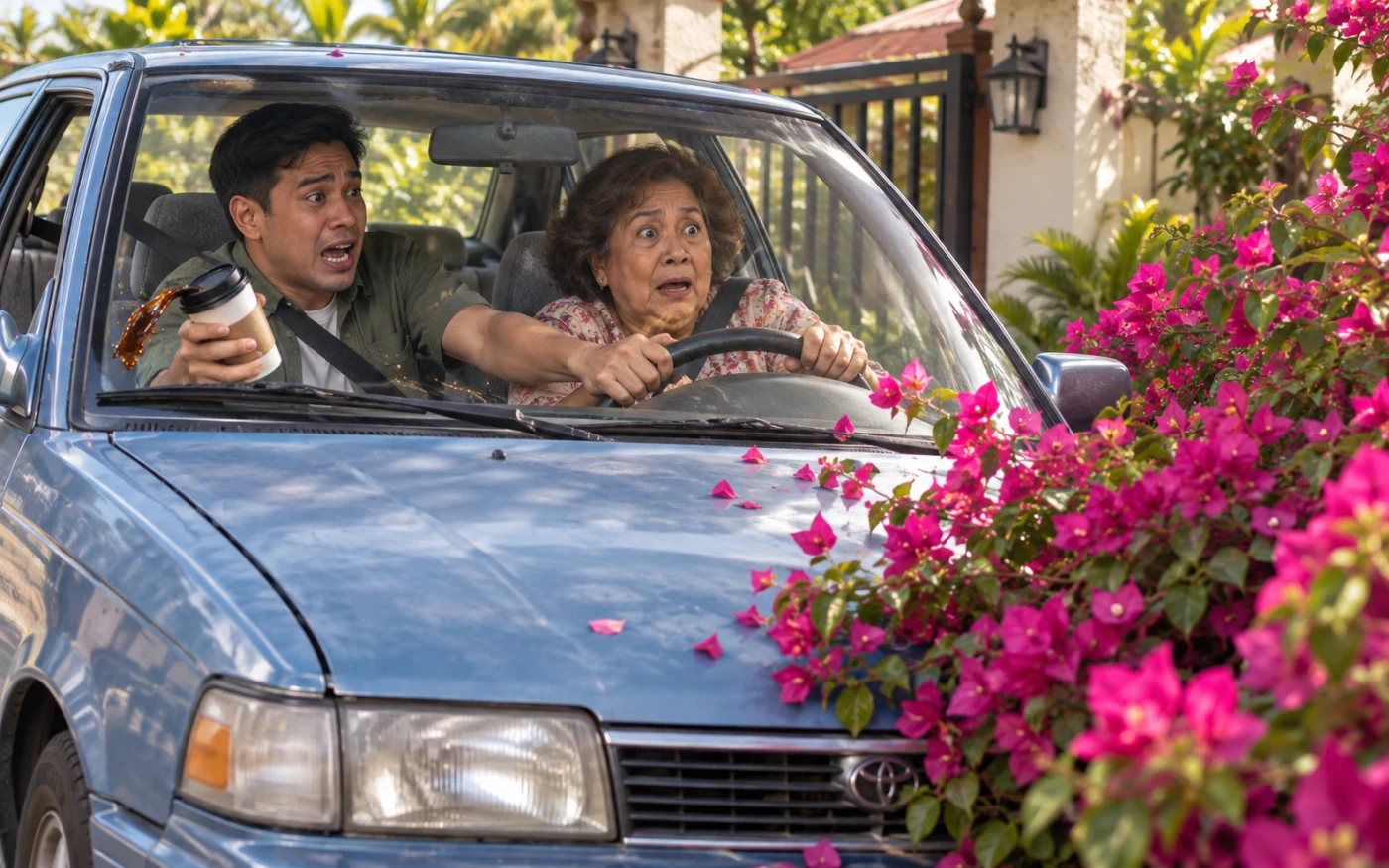
Ten minutes later, I drove through my own bougainvillea.
PART 2: Why He Grabbed the Wheel
The bougainvillea survived. Rueben’s coffee did not.
It flew from his hand when he grabbed the wheel, splashed across the dashboard, and dripped onto his trousers.
I froze with both feet pressed down.
Unfortunately, one foot was on the accelerator.
“Brake!” he shouted.
“Which one?”
“The other one, Nanay! The other one!”
The Toyota stopped with its nose inside the flowers and Rueben half-standing in his seat.
For several seconds, neither of us spoke.
Then I said, “You told me not to panic.”
He closed his eyes.
Our lessons continued.
Every Saturday, Rueben came before sunrise. Every Saturday, we found a new way to offend each other.
He told me I hugged the right side of the road.
I told him the right side had fewer oncoming vehicles.
He told me to check my mirrors.
I adjusted my hair.
He said, “The mirrors are not for your face.”
I said, “Then why do they show it?”
He turned toward the window and breathed slowly.
On our fourth lesson near the road to Baras, a tricycle appeared behind us. I was driving twenty kilometers per hour.
The driver honked.
I slowed to fifteen.
“Why are you slowing down?” Rueben asked.
“He is making me nervous.”
“Then let him pass.”
“He has plenty of road.”
The tricycle honked again. Rueben waved him around us, then apologized through the open window as he passed.
“Why did you apologize?” I demanded.
“Because we are blocking Rizal province.”
“Only one lane.”
He laughed once, but there was no happiness in it.
“You’re not taking this seriously.”
I pulled over so suddenly that his shoulder hit the door.
“I wake at four-thirty to prepare before you arrive. I read the driver’s manual every night. I practice changing gears while sitting at my dining table. Do not tell me I am not serious.”
“Then what is the deadline?” he asked.
My heart jumped.
“Deadline?”
“People don’t suddenly decide at sixty-three that they need a license this badly. You keep asking how long until you can drive alone. So when do you need it?”
I looked straight ahead.
“When I am ready.”
He slapped one palm against his leg. “Ay, naku. Fine.”
He thought I was being stubborn.
I was afraid.
Cely had already missed more work. Nico’s appointments were every Monday, Wednesday, and Friday at nine.
If I failed, my daughter might lose the job she had worked eleven years to earn.
But if I told Rueben, he would carry my fear too. He was already carrying groceries, bills, overtime, Nico, and every favor he believed he owed me.
So we drove on in silence.
The day before my first test, he made me practice parking between two plastic chairs in my yard.
I crushed one.
On the test, I forgot the handbrake.
I failed before lunch.
Rueben was waiting outside with pandesal and bottled water. When he saw my face, he put the food away without asking.
“Next time,” he said.
“You sound relieved.”
He blinked. “What?”
“You never believed I could do it.”
“I have spent six Saturdays believing you can do it.”
“You have spent six Saturdays shouting.”
“Because you almost killed three chairs.”
I walked past him and hired a tricycle home.
The next Saturday, he did not come.
At seven, I phoned Cely.
“Where is your husband?”
She sighed. “Ma, he thinks you don’t want him teaching you anymore.”
“Did he say that?”
“He said you took a tricycle.”
“Because I was angry.”
“Yes. That is usually why people leave.”
I put down the phone and marched to the covered car. I sat in the driver’s seat alone.
My hands shook before I even touched the key.
Then someone knocked on the window.
Rueben stood outside holding two coffees.
I lowered the glass.
“You are late,” I said.
“You fired me.”
“I did not.”
“You left.”
“I came back.”
He looked at me for a long time. Then he walked around and got into the passenger seat.
“Again,” he said.
I failed my second test by touching a cone during reverse parking.
This time, Rueben did not bring pandesal. He brought the two plastic chairs from my yard and set them up in an empty lot near Pililla.
“We stay until you can park without murdering either one.”
The sun climbed. Sweat ran down his neck. I reversed, corrected, and reversed again until my shoulders burned.
At last, I parked perfectly between them.
Rueben tapped the dashboard.
“Again.”
I did it again.
Then his phone rang.
It was Cely. Even from my seat, I heard her crying.
“They gave me a final warning,” she said.
Rueben went pale.
And without thinking, I whispered, “I know.”
PART 3: What I Already Knew
Rueben ended the call and turned toward me.
“What do you mean, you know?”
There was no use hiding it anymore.
I gripped the steering wheel. “I heard Cely talking to her supervisor. I know about Monday, Wednesday, and Friday. I know she needs nine months.”
His mouth opened, but nothing came out.
“That’s why you want to drive?”
“I have places to go too,” I said weakly.
“Nanay.”
I looked down.
“Yes.”
He leaned back against the seat. For weeks he had believed each lesson was my way of punishing him. Now the truth sat between us, hot and embarrassing.
“Why didn’t you tell us?”
“Because Cely would say no.”
“She will say no.”
“I know my daughter.”
“And you let me think you were angry with me.”
“You decided that alone.”
“Because you stopped calling.”
“Because you were tired.”
His face crumpled for just one second.
Then he looked out the window and rubbed his eyes with his thumb and finger.
“I thought I failed you,” he said.
My anger disappeared.
“Rueben, look at me.”
He did not.
“You came for nine years,” I said.
“Hospital, palengke, church, everything. You came when you had a fever. You came when your tire was flat. One time you came wearing two different slippers.”
“It was dark.”
“I never forgot.”
His jaw tightened.
“I did not stop calling because you failed me. I stopped because you are my family, not my driver.”
At last, he faced me.
I looked at the two plastic chairs.
“Now teach me properly. Walang sigaw.”
He nodded. “And no arguing.”
“Do not ask for miracles.”
For the next two weeks, we practiced every day he could spare. He stopped shouting. I stopped pretending I was not scared.
When a bus roared beside me, I said, “Natatakot ako.”
He answered, “I know. Hold steady.”
When I stalled at an intersection, he did not grab the wheel. He said, “Breathe. Start again.”
When I parked crooked, he made me look for myself instead of telling me what I had done wrong.
On my third test, the examiner had a square face and no patience. He told me to turn left, reverse, park, and stop on a slope.
My knees trembled the entire time.
I could hear Rueben’s voice although he was waiting outside.
Hold steady.
Start again.
Look for yourself.
When the examiner finally made a mark on the paper, I could not read his expression.
“Passed,” he said.
I did not cheer. I did not cry. I only thanked him and walked outside.
Rueben stood up so fast he dropped his bottled water.
I held out the paper.
He read it, then shouted, “You passed!” loudly enough for everyone to turn.
He hugged me in front of the whole office. I felt his shoulders shaking.
“Huwag kang umiyak,” I whispered, although I was crying too.
That evening, Cely cooked pancit. Rueben wanted to tell her everything, but I kicked him under the table.
I needed to do this my way.
So we said nothing about Mondays, Wednesdays, or Fridays.
At eight o’clock the following Monday morning, I drove Arturo’s blue Toyota to their house.
I had washed it twice. Nico’s little booster seat was secured in the back.
Beside it were crackers, water, wipes, and the red toy jeepney he carried everywhere.
I parked in front of their gate, straight and careful.
Then I walked to the door with my keys held out.
Cely opened it wearing her office blouse on top and pajama pants below. Nico clung to her leg. Her eyes moved from my keys to the car.
“Ma?”
“His appointment is at nine.”
Her face changed.
“No.”
“I passed.”
“No, Ma. The traffic—”
“I practiced the route.”
“Three times,” Rueben called from behind her.
Cely spun toward him. “You knew?”
“I was her terrified passenger.”
“You both hid this from me?”
“You hid the final warning from me,” I said.
She went still.
Nico looked up at all of us and covered his ears.
That ended the shouting before it began.
I knelt in front of him. “Lola will take you today, anak. Mama will go to work.”
He studied my face, then lifted his red jeepney.
“Lola drive?” he asked.
Those two clear words broke my daughter.
Cely pressed both hands over her mouth. Rueben wrapped an arm around her while she cried into his shoulder.
I waited. I did not argue. I simply kept my keys out.
Finally, Cely took her bag from the hook by the door.
She checked the booster seat herself, tightened it, checked it again, and gave me instructions all the way to the gate.
“Stay in the right lane. Don’t follow buses. Call me when you arrive. And Ma—”
“Oo, anak.”
She held my face between her hands.
“Thank you.”
Rueben buckled Nico in. Before closing the back door, he leaned toward me.
“Mirrors?” he asked.
I checked all three.
“Seat belt?”
I pulled it across my chest.
“Bougainvillea?”
“Still alive.”
He stepped back.
I started the engine. Cely stood at the gate in pajama pants, crying and waving.
Rueben stood beside her with one hand over his heart.
From the back seat, Nico lifted his red jeepney and said, very carefully, “Go, Lola.”
So I did.