
They Sent Me My Husband's Ashes from Riyadh Nine Years Ago. At Our Daughter's Valedictory Speech, a Blind Man Stood Up in the Last Row and Said Her Baby Name.
PART 1: The Voice Behind Me
My dead husband called our daughter by her baby name in a crowded gymnasium.
I knew his voice before I saw his face.
I also knew exactly where I had buried him.
Nine years earlier, men from his company had sent me a sealed urn from Riyadh, a letter of regret, and one hundred forty thousand pesos. They said Ambo had died in a refinery fire. They advised me not to open the urn because of the condition of the remains.
So I did not.
I buried him under the acacia tree in Tanay. I wore white. Our nine-year-old daughter, Angelie, hugged the wooden cross and screamed, “Papa, come back!” until my sister had to carry her away.
At forty-four, I had been a widow longer than I had been a wife.
Then, last March, Angelie graduated valedictorian of San Ildefonso College.
That morning, she came out of our bedroom in her white dress and graduation gown. I had been frying longganisa, but I turned off the stove because my hands suddenly shook.
She looked so much like Ambo when she was nervous. Same tight mouth. Same habit of rubbing her thumb against one finger as if counting invisible coins.
“Ma, pangit ba?” she asked.
“You look expensive,” I said.
She laughed. “That means borrowed.”
“Everything beautiful is borrowed. Even your face. That belongs to me.”
She rolled her eyes, but she hugged me.
We survived the first two years through my sari-sari store and other people’s laundry. Then, when Angelie was eleven, the mysterious Corazon Scholarship appeared. Every June after that, an envelope arrived through Ambo’s cousin Ramon. Tuition. Uniforms. Books. Later, review classes and graduation fees. Cash. Exact amount. Always on time.
Ramon said the donor was an overseas worker who wanted privacy.
“Why us?” I asked him every year.
“Ate Cora helped his family once,” he would say, naming my late mother. “He never forgot.”
It made sense. My mother had fed half the barangay from a pot that was never full.
Still, I wrote thank-you letters. Angelie drew flowers on them when she was younger. When she turned sixteen, she wrote, “I promise I will make your kindness worth it.” Ramon collected every letter for the foundation.
We never received a reply.
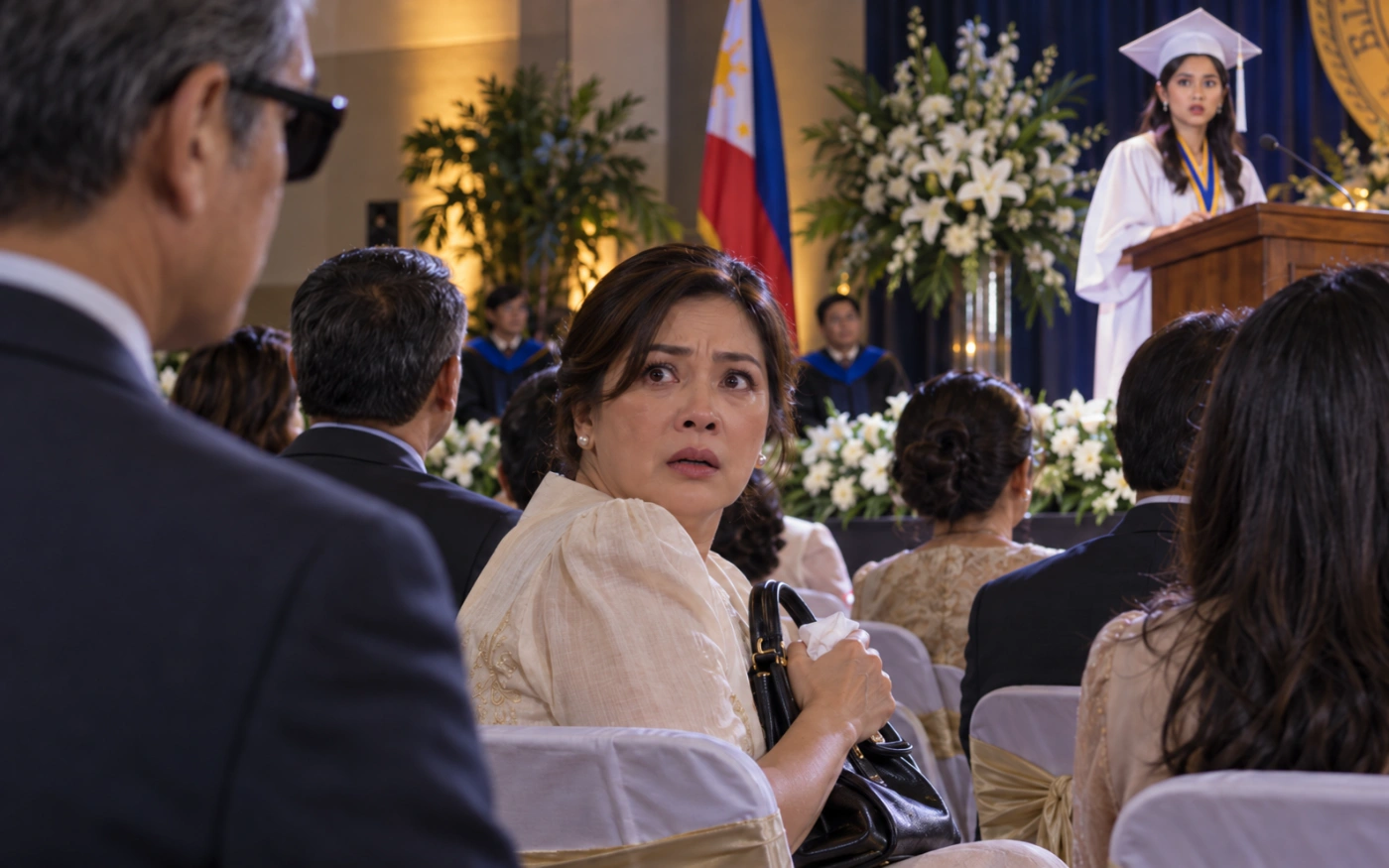
At the ceremony, I sat in the third row with my handbag on my lap and Ambo’s old handkerchief folded inside it. I had carried that handkerchief to every important event—Angelie’s recognition days, her first debate contest, her college entrance exam.
My husband had missed all of them.
Or so I believed.
When they called Angelie’s name, the gym exploded. I stood too quickly and hit the chair in front of me.
“That’s my daughter!” I shouted.
Everyone already knew. I shouted anyway.
She walked onto the stage, gold medal shining against her gown. Then she took the microphone.
“Nine years ago,” she began, “my mother lost her husband, and I lost my father. But my mother taught me we could miss him and still keep living.”
People laughed softly. I cried immediately.
“Today I also want to thank the Corazon Scholarship Foundation. I have never seen your office. I have never met the person behind it. But because of you—”
A chair scraped in the last row.
A thin man stood up.
He wore dark glasses. His hair was gray at the temples, and one trouser leg hung strangely over a stiff knee. In his right hand was a white cane.
His left hand trembled against his chest.
“Ngingi,” he said.
The microphone shrieked.
Angelie stopped breathing.
Nobody had called her that since she was nine. When she was a baby, she could not say Angelie. She said Ngingi. Ambo loved it so much he refused to stop, even after she complained she was already a big girl.
I turned.
The man said it again.
“Ngingi.”
I ran down the aisle in the only good shoes I owned.
I did not walk. I did not think. I ran straight at a blind man and hit him with both fists.
Once on the chest.
Twice on the shoulders.
“Who are you?” I screamed. “Who told you that name?”
He did not protect himself. His cane fell. He only stood there crying while I struck him.
Then I grabbed his face.
There was a small hard bump below his left ear. A scar from the boil I had treated with warm cloth when we were newly married. His right front tooth was chipped. I felt it under his lip with my shaking thumb.
My knees almost gave way.
“Ambo?”
His hands found my arms.
“Mila,” he whispered. “Galit ka pa rin manuntok.”
Only one man had ever teased me about punching when I was angry.
My dead husband pulled me against his chest.
And from the stage behind me, our daughter screamed, “Papa?”
PART 2: Why He Stayed Dead
The whole gymnasium vanished for me.
There was only Ambo’s shirt under my fists. His breath against my hair. The smell of soap, sweat, and something medicinal.
Alive.
Warm.
Impossible.
I pushed him away so hard that he nearly fell.
“You let me bury you.”
His face broke.
“Mila—”
“You let your child cry over ashes!”
Principal Ramos hurried toward us, but Angelie was faster. She came down the stage steps with her medal bouncing against her chest. She stopped two meters away.
She did not hug him.
She stared at the white cane on the floor.
“If you’re my father,” she said, “what did you put in my lunch box on my first day of Grade One?”
Ambo turned toward her voice.
“Two boiled eggs. Rice. And a note saying you were braver than Wonder Woman.”
Angelie’s chin shook.
“There was no spoon.”
“I forgot it.”
“You always forgot it.”
“You always came home angry.”
She covered her mouth.
Before either of us could move, Ramon appeared beside Ambo and picked up the cane.
That was when I understood the second betrayal.
I slapped Ramon.
The sound cracked through the silent gym.
“You knew.”
He lowered his head. “Ate Mila, please.”
“Seven years, Ramon.”
Principal Ramos opened the faculty room so we could get away from hundreds of staring people. Angelie’s unfinished speech remained on the stage. Parents whispered. Phones were raised everywhere.
Inside, I locked the door.
“Talk,” I said.
Ambo sat with both hands on top of his cane. Angelie stayed beside me. I wanted to hold her, but her body was stiff as wood.
Ambo told us about the fire.
An explosion threw him from a steel platform. Three workers died. Another man was found wearing the metal identification tag Ambo had lent him because the man’s own tag clip had broken that morning.
Ambo was taken unconscious to a government hospital under the wrong name.
“My legs were crushed,” he said. “The burns damaged my eyes. There was swelling in my brain. For months I could not speak. I could not even tell them who I was.”
Ramon had gone looking after the company declared him dead, but by then Ambo had been transferred twice. It took nearly two years for an aid worker to match his fingerprints to an old employment file.
“Two years?” I said. “What about the other seven?”
There it was. The question that mattered.
Ambo gripped the cane until his knuckles whitened.
“When I could finally call the company, their lawyer visited me. He said they had closed the case. They had paid you. If I corrected the record, they would recover the settlement and medical costs. He said I could be detained because my work papers had expired while I was in the hospital.”
“One hundred forty thousand pesos,” I said. “You traded nine years for that?”
“No.” His voice rose for the first time. “I traded them for her school.”
He pointed blindly toward Angelie.
He had already asked Ramon about us. My sari-sari store was failing then. I had borrowed money for Angelie’s uniform. She was about to transfer to a cheaper school and give up the science program she loved.
Ambo had no money to fight anyone. He had no proper documents, no sight, and two damaged legs. He believed coming home would take back the little we had received and give us one more mouth to feed.
So he made the worst decision of his life.
He stayed dead.
At first, he folded boxes in a warehouse by touch. Later, a shop owner taught him to repair prayer beads and string small decorative pieces. His fingers became quick. He lived in a room with three other men and sent almost everything to Ramon.
“Corazon,” Angelie whispered.
Ambo nodded. “Your grandmother never let me leave her house hungry when I was courting your mother.”
Ramon opened his bag and placed a bundle of old envelopes on the table.
Our letters.
Every flower Angelie had drawn. Every report card. Every thank-you note, softened at the folds from being opened again and again.
“I listened to your school programs through Ramon’s phone,” Ambo said. “Recognition day. Your debate. Even the Christmas song where you forgot the second verse.”
Angelie looked at Ramon. “You were always holding your phone up.”
He nodded, crying now. “Your papa would stay awake all night because of the time difference.”
I wanted to understand. I wanted to throw them both through the window.
“You could have told me,” I said to Ambo. “You decided what I could survive without asking me.”
“I was ashamed.”
“Good. You should be.”
He bowed his head.
For once, nobody asked me to forgive quickly.
Outside, the audience began clapping for the next graduate. Life had continued while mine split open.
Angelie picked up one of her childhood letters. On the bottom was a greasy thumbprint, dark from years of touching.
“Why today?” she asked.
Ambo reached inside his coat and placed an airline envelope on the table.
“I came only to hear your name called,” he said. “I promised myself I would not speak. Then you thanked me, and I forgot how to be dead.”
I opened the envelope.
Inside was a ticket leaving Manila at eleven that night.
“I was going back,” he whispered. “I was going to disappear again after today.”
PART 3: What Angelie Made Him See
I tore the ticket in half.
Then again.
Tiny pieces fell across the principal’s desk.
Ambo stood so quickly his bad leg buckled. “Mila, no! That ticket cost—”
“Nine years,” I said. “That is what this ticket cost.”
He went quiet.
I was still furious. Love did not erase that. His sacrifice had paid for our daughter’s future, but his silence had stolen birthdays, fevers, report cards, arguments, and nine Christmas mornings.
“You do not get to decide alone again,” I told him. “Not whether we are poor. Not whether you are a burden. Not whether your daughter deserves a father only from inside a telephone.”
His mouth trembled. “What if you cannot forgive me?”
“Then you will sit where I can see you while I try.”
Angelie made a sound between a laugh and a sob.
Someone knocked on the faculty-room door. Principal Ramos leaned in and said the ceremony had stopped. Nobody wanted the next speech. Nobody was listening. The graduates were waiting for their valedictorian.
Angelie looked at her father.
“Will you come back inside?”
Ambo touched his glasses. “People saw everything.”
“Yes,” she said. “Including Mama attacking a disabled man in high heels.”
“They were low heels,” I said.
That finally made Ramon laugh. I pointed at him.
“Do not become comfortable. I am still deciding what to do with you.”
He stopped laughing.
We returned to the gymnasium together.
Ramon guided Ambo down the aisle, but halfway there, I took the white cane in one hand and my husband’s elbow in the other. I was not ready to hold his hand. The elbow was enough.
For that day, it was everything.
The gym rose when Angelie entered.
Not just the students. Everyone.
She walked back to the stage while the applause rolled around us. Ambo flinched at the noise. I felt his fingers searching in the air, so I put his hand on the back of the empty chair beside mine.
“Sit,” I whispered.
Angelie returned to the microphone. Her printed speech was still there, but she folded it.
“I was supposed to tell you that education opens doors,” she said. “Apparently, it also raises the dead.”
The gym burst into shocked laughter.
Even Ambo laughed. I had forgotten that laugh. It started as a wheeze, then shook his whole chest.
Angelie looked toward the sound.
“Since I was eleven, I thanked a stranger for keeping me in school. Today I learned he was not a stranger. He was my father, making a terrible decision for a loving reason.”
Ambo lowered his head.
“Papa,” she said, “I am angry with you.”
The room became still.
“I love you. But I am angry. You will have to earn back all the days you gave away.”
He nodded, tears slipping below his glasses.
“Start now,” she said.
Angelie left the stage.
She came straight down the center aisle in her white gown and gold medal. When she reached us, she knelt in front of her father.
Ambo lifted both hands but stopped, uncertain.
“I don’t know what you look like now,” he whispered.
Angelie took his right hand.
First she pressed it to the top of her graduation cap. Then to the medal at her chest. Then along her cheek, slowly, letting his fingertips find her eyebrows, her nose, the curve of her smile.
“See?” she whispered. “I grew up.”
His thumb brushed the tears under her eye.
“Ngingi,” he breathed.
This time she did not tell him she was too old for the name.
She put her arms around him.
I have never heard a gymnasium go so quiet.
Then I bent down and wrapped my arms around them both.
Ambo’s hand found my face too. He touched the new lines beside my mouth, the ones nine years had put there. I wanted to pull away. Instead, I let him learn them.
“Mila,” he whispered, crying into our daughter’s shoulder, “I’m home.”
I pressed his old handkerchief into his palm.
“You missed the speech,” I told him. “But you are not missing dinner.”
And our daughter laughed between us, wearing the medal her father had paid for one careful bead, one folded box, and one lonely year at a time.