
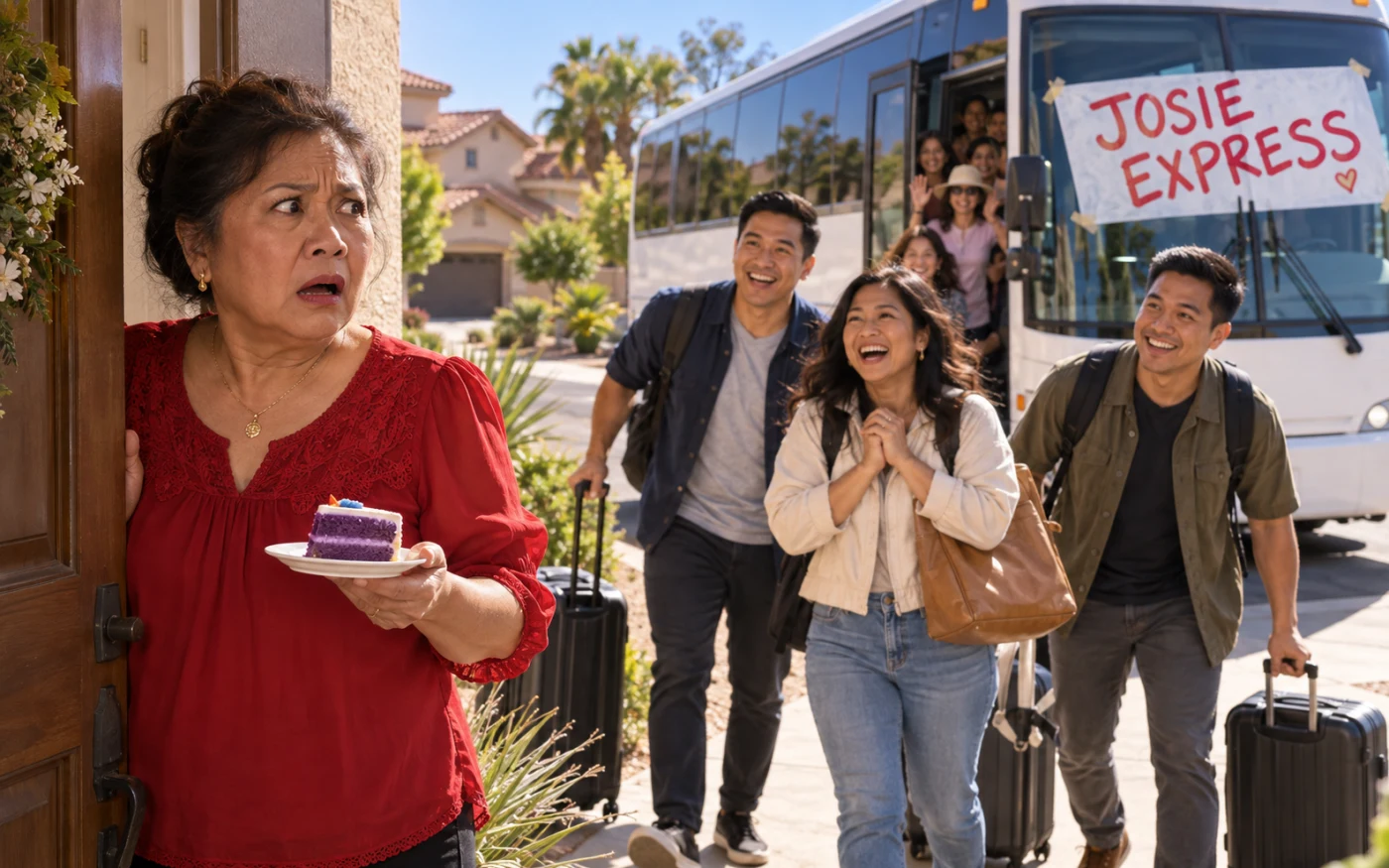
My Entire Family Forgot My Sixtieth Birthday. Then a Bus Pulled Up Outside My House with My Name on It.
PART 1: The Silent Phone
By nine in the morning, I had checked my phone seventeen times.
No missed calls.
No singing voicemail from my sister Aileen.
Not even one of those Facebook birthday greetings from a woman I worked with in 1998 who usually calls me “Josie dear” and adds twelve roses.
I was sixty years old, sitting alone at my kitchen table in Mesa, Arizona, wearing the new red blouse I had bought for myself, and my entire family had apparently forgotten I existed.
That sounds dramatic. Fine. I was being dramatic.
But I am the person who remembers everything.
I know that my son Martin likes chocolate cake but hates chocolate frosting.
I know my daughter Grace’s mother-in-law’s birthday.
I once mailed a graduation gift to my cousin’s child in Nevada even though I had met that child exactly twice.
For thirty-two years, I kept one spiral notebook labeled FAMILY IMPORTANT.
Birthdays. Flight numbers. Allergies.
Who needed a ride.
Who was not speaking to whom and therefore could not be seated together at Thanksgiving.
Every reunion happened because I made it happen.
So yes, I expected one phone call.
At 9:14, Martin finally texted.
Busy today, Ma. Call you later.
No “happy birthday.”
Grace sent, Crazy morning. Love you!
My youngest, Eric, sent a thumbs-up emoji to a message I had sent him the night before about renewing his car registration.
The thumbs-up nearly killed me.
At eleven, I called Aileen about our birthday lunch.
“Ate, I’m so sorry,” she whispered. “Something came up.”
Behind her, I heard people shouting and what sounded like a metal pan hitting the floor.
“Are you having a party?” I asked.
“What? No! That is the television.”
Then a man yelled, “Where do you want the pancit?”
Aileen hung up.
I stared at my phone.
Maybe she was helping with a church event.
Maybe there was an emergency.
Maybe everybody had decided that sixty was the age when a woman became useful furniture.
I called my best friend Beth.
Straight to voicemail.
That hurt the most.
Beth and I had survived night shifts, her divorce, three rebellious teenagers, and one disastrous Zumba class where she split her pants. She knew my birthday better than her own wedding anniversary.
By noon, I stopped making excuses for everyone.
I drove to the grocery store, bought one slice of ube cake in a plastic triangle, and asked the bakery girl for a single candle.
“Big celebration?” she asked.
“Huge,” I said.
At home, I put the candle in the cake and did not light it.
I sat there thinking about every airport pickup, every tray of lumpia, every relative who had slept on my sofa “for two weeks” and stayed six months.
Maybe they loved what I did, not me.
That was the ugly thought.
Once it arrived, it sat down and made itself comfortable.
Then my windows rattled.
An air horn blasted outside so loudly that I dropped my fork.
I opened the front door.
A white tour bus was blocking half my street. Across the windshield, taped crookedly in giant red letters, were the words:
JOSIE EXPRESS.
The folding door hissed open.
My three children fell out of it yelling, “Surprise!”
Behind them came Aileen, Beth, cousins, nieces, nephews, and one confused-looking uncle holding an aluminum tray of pancit.
I did not move.
Martin smiled nervously. “Ma?”
I held up my grocery-store cake slice.
“Naku. Somebody,” I said, “better explain before I throw this.”
PART 2: Where Was This Bus Going?
The explanation began badly.
Grace said they had planned a small road trip using two rented vans.
Then Cousin Bebot heard about it and invited his family. Aileen told Beth. Beth told my old coworkers.
Somebody created a group chat called Operation Don’t Tell Tita Josie, then accidentally added me.
They removed me before I noticed, but panic took over.
“Then Tito Oscar said buses get a senior discount,” Eric said.
“We do not,” the bus driver called from inside.
“He lied about that,” Martin admitted.
The family had rented the bus anyway.
I should have laughed. I wanted to. But the little purple cake in my hand felt heavy.
“You let me think you forgot.”
Their smiles disappeared.
Grace stepped closer. “The bus was supposed to be here at nine-thirty. Then Bebot’s family was late, the pancit tray tipped over, and every time we were about to call you, somebody said ten more minutes.”
Martin winced. “Then ten minutes became an hour.”
“And if we called, you would hear it in our voices,” Grace said. “If we came inside, you would start cooking. We needed you packed before you could take over.”
I looked at all three of them.
“You accidentally forgot my birthday while trying to surprise me for my birthday?”
“Basically,” Eric said.
“Packed?”
Beth hurried up my walkway carrying my small blue suitcase.
“I used the key under your flowerpot,” she said. “Your children made a list. I supervised because Martin packed four blouses and no underwear.”
“Ma, please naman,” Martin muttered.
Taped to the suitcase was a yellow paper ticket.
PASSENGER: JOSEFINA RAMOS
DESTINATION: EVERYWHERE SHE NEVER GOT TO GO
My throat tightened.
For years, I had talked about taking a California road trip after I retired from the hospital billing office.
Then Aileen needed help after surgery. Grace had her baby. Eric’s car broke down. My cousin arrived from Manila and needed somewhere to stay.
There was always somebody.
“Where are we going?” I asked.
All three children looked at one another.
“First stop is a secret,” Eric said.
“Absolutely not. I need the itinerary.”
The entire bus shouted, “No!”
My own family booed me on my driveway.
Five minutes later, they took my purse, pushed me gently onto the bus, placed a plastic tiara on my head, and assigned me the front seat.
My name was taped above it.
Underneath, somebody had written: SHE IS NOT ALLOWED TO HELP.
The bus smelled like fried garlic, sunscreen, and forty relatives who had all brought separate coolers.
As we pulled away, I noticed Martin holding my FAMILY IMPORTANT notebook.
“Why do you have that?”
He hugged it to his chest. “Evidence.”
That answer worried me for six hours.
We crossed into California late that afternoon.
Every time I asked a question, somebody handed me food. Lumpia. Ensaymada. Orange slices. One hard-boiled egg from Auntie Linda, who always travels as if famine is following her.
By early evening, the bus turned onto a narrow street in Los Angeles.
I knew the corner before I saw the building.
“Ay, Diyos ko,” I whispered.
It was the old apartment building on Mariposa Avenue.
In 1989, I rented a two-bedroom apartment there with my late husband.
Over the next nine years, seventeen relatives used our living room as their first address in America.
They slept on folding mattresses. They borrowed our car.
They practiced job interviews at our kitchen table while little Martin crawled underneath it.
I complained constantly, but every time somebody left, I cried while washing their sheets.
The bus stopped across from the building.
Under the old apartment windows, people stepped off the sidewalk holding photos.
My cousin Irene, who now lived in San Diego.
Mang Ruel, who had arrived with one suitcase and slept beside our Christmas tree.
My old neighbor Mrs. Alvarez, now eighty-seven and still wearing bright pink lipstick.
Along the low fence hung a bedsheet painted with the words FIRST STOP: THE FIRST HOME.
I covered my mouth.
Irene held up a photo of herself at twenty-three, standing in my old kitchen wearing my borrowed nursing shoes.
“You picked me up at LAX at two in the morning,” she said. “You had work at seven.”
Mang Ruel raised his photograph. “You let me stay four months.”
“Seven,” I corrected automatically.
Everyone laughed.
Martin opened my notebook. Beside each airport pickup and birthday, my children had added a colored tab. Every tab matched a person on the trip.
“This is our route,” he said. “Not places you served us. Places where you made us a family.”
Then the luggage door beneath the bus thumped open, and one of my nephews rolled out my old kitchen table.
The actual table.
I had left it behind when I moved to Arizona. Aileen had bought it from the building manager before anyone else could take it.
She had kept it in storage for fourteen years because, according to her, she was “waiting for a reason that justified the monthly fee.”
It was scratched, faded, and still had a burn mark from my first attempt at bibingka.
On top sat sixty candles in six cakes.
I finally cried.
Then Beth whispered, “Good. She is crying. Bring out the second wave.”
“There is a second wave?” I asked.
The bus door opened again.
PART 3: Who Else Remembered?
Six more people climbed aboard before we left.
That was how the trip worked.
At every stop, somebody from my old notebook appeared.
In Riverside, we met my niece Ana outside the nursing school where I used to drop her for clinical training when her car died.
She brought breakfast burritos and the graduation cap she had once left in my back seat.
In San Diego, my former coworker Susan waited beside the hospital where we had worked double shifts.
She carried a thermos of the terrible coffee we used to drink and a photo of us asleep upright in plastic chairs.
At a park near Chula Vista, two grown men ran toward the bus shouting, “Tita Josie!”
They were the little boys I had babysat every Saturday while their mother studied for her accounting license.
Every person had a yellow ticket.
On the back, they had written one thing I did that they never forgot.
You sent money when my first paycheck was delayed.
You taught me how to drive on the freeway.
You answered when I was ashamed to call anyone else.
You always made room.
The bus filled with food, old photographs, blankets, and stories I barely remembered.
I had thought I was only doing chores.
Picking people up. Feeding them. Making phone calls. Filling out forms.
My children had remembered too.
That afternoon, they took us to a campground above the Pacific.
Long tables stood beneath strings of lights.
My old kitchen table was at the center, still wobbling because one leg had always been shorter.
For once, I had arranged nothing.
This showed.
The rice was late. Somebody forgot serving spoons. Uncle Oscar had bought sixty balloons but left them in Arizona. Eric burned the barbecue, and Aileen shouted, “Huwag mong galawin!” while moving it herself.
It was the most beautiful party I had ever seen.
After sunset, Martin tapped a glass.
My three children stood in front of me holding a scrapbook covered in the same crooked red letters as the bus sign: JOSIE EXPRESS.
Inside were some of the yellow tickets and letters from relatives who could not come. Tucked into the last page was a paid reservation for the same week next year: three cabins, one van.
Below it was one rule signed by everybody:
JOSIE MAY CHOOSE ONE DESTINATION. JOSIE MAY NOT BOOK, COOK, DRIVE, REMIND, PACK FOR OTHERS, OR MAKE A SPREADSHEET.
“Every year,” Grace said. “One week where you are not the family logistics department.”
Eric knelt beside my chair. “We know we made you feel forgotten today. That was stupid.”
“Very stupid,” I said.
“Extremely,” Martin agreed. “But we wanted you to see what we see.”
He pointed toward the tables.
My sister was arguing over grilled fish with my best friend.
Cousins who had not spoken in years were comparing baby pictures.
The two boys I babysat were teaching my grandchildren a clapping game.
People kept squeezing onto benches, moving plates, making room.
“We travel together because you taught us how to arrive for each other,” he said.
That sentence broke whatever part of me was still angry.
I pulled all three of my children into my arms. Aileen joined. Then Beth.
Then half the party decided it was a group hug, including Uncle Oscar, who still had barbecue tongs in his hand.
“Okay, enough,” I gasped. “I would like to survive my birthday.”
They carried the old table down to the beach after dark.
We set sixty small battery candles across it because the wind kept blowing out the real ones.
The scratched wood glowed against the black water.
One by one, everyone placed their yellow ticket around my untouched slice of ube cake, which had traveled all the way from my lonely kitchen in its plastic box.
Then they sang.
Too loudly. Completely off-key. My name stretched into four different notes because nobody could agree on the ending.
Martin held his jacket against the wind while Grace and Eric cupped their hands around my little cake.
This time, I lit the candle.
I looked at the bus parked above us, JOSIE EXPRESS still crooked across the windshield. I looked at the crowd around the table I once believed had only held people temporarily.
“Make a wish, Ma,” Grace said.
I already had it.
For the first time in my life, everybody else had brought me home.