
My Boyfriend’s Mother Offered Me $100,000 to Break Up With Him. I Took the Check and Spent It on His Secret Dream.
PART 1: The Price of Goodbye
I accepted $100,000 to leave the man I loved.
Then I used her money to buy the dream she had ordered him to forget.
But first, I had to break his heart so badly that he would never come looking for me.
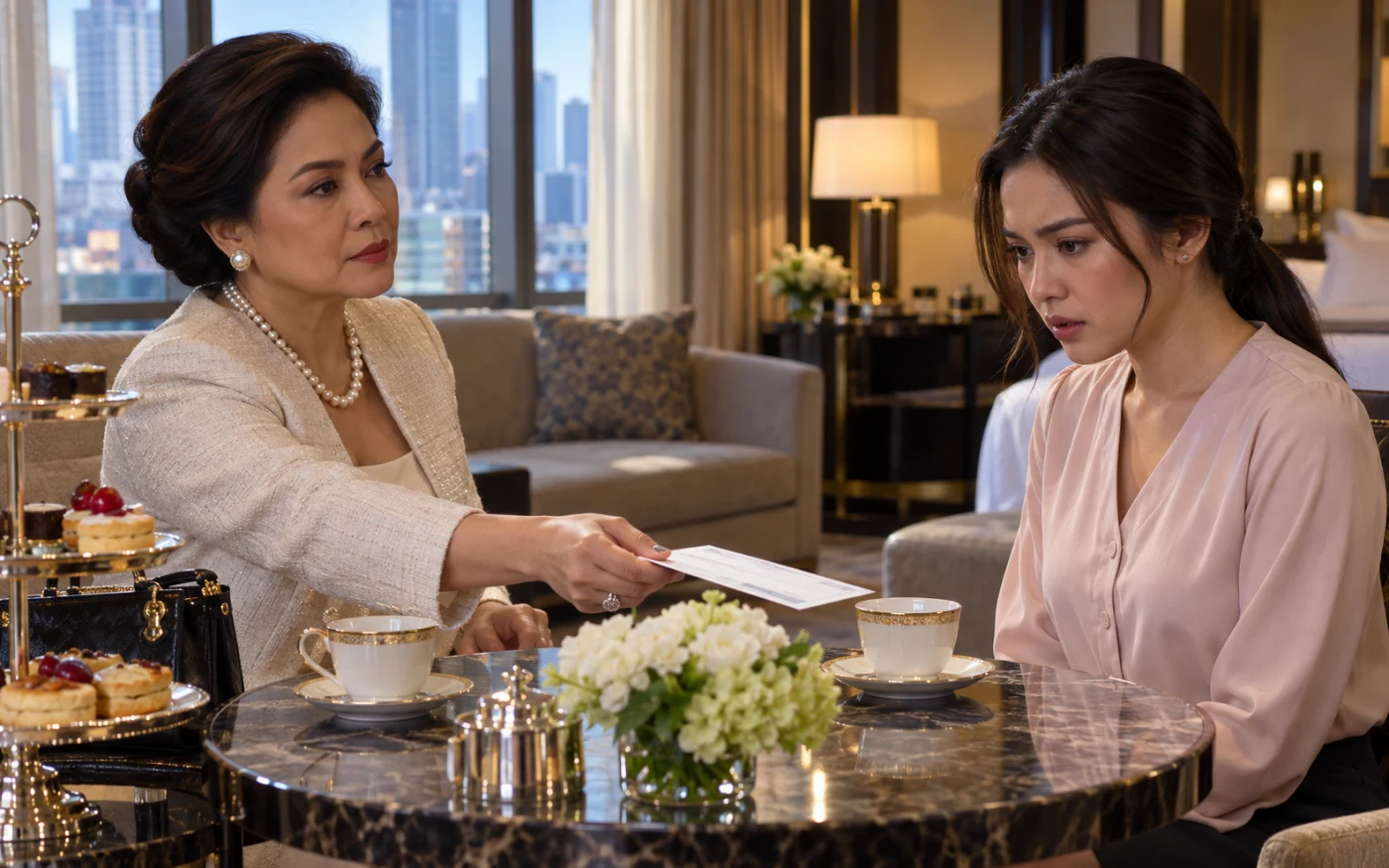
His mother slid the check across the table between two untouched cups of tea.
“One hundred thousand US dollars,” Regina Solano said. “You disappear from Gio’s life tonight.”
We were sitting in a private room at a hotel in Makati where the napkins were softer than my bedsheets.
Regina wore pearls at three in the afternoon.
I wore a blouse with a loose button that I kept hiding under my handbag strap.
“You think your son is worth only this much?” I asked.
Her mouth tightened.
“You misunderstand. This is not his value. It is yours.”
“Aray,” I muttered.
That woman could slap you without moving a finger.
Gio and I had been together for three years.
He was the only son of the woman who owned half the luxury condominiums rising across Metro Manila.
I ran a tiny catering business with my cousin Joy, drove a twelve-year-old Vios, and knew exactly how long fried chicken could sit under a fan before the skin became sad.
Regina had hated me since Gio brought her a box of my homemade ensaymada.
She took one bite and said, “Too much butter.”
Gio ate the remaining five in her car.
What Regina did not know was that I knew her son’s real dream.
It was not joining the family property empire.
It was not wearing Italian suits or building glass towers.
Gio wanted to bake bread.
Not as a hobby.
Not on Sundays.
He wanted to reopen Pan de Tomas, the old neighborhood bakery his father had started before marrying Regina.
His father had died when Gio was sixteen.
The bakery closed a year later, and the little building in Marikina had been rented to a motorcycle-parts shop.
But Gio kept his father’s battered recipe notebook in a kitchen drawer at my apartment.
At midnight, after twelve-hour days at Solano Properties, he made pandesal in my apartment.
He kneaded dough when he was angry.
He shaped Spanish bread when he was worried.
Once, after his mother announced his promotion without asking him, he baked ninety-four cheese rolls.
“Someday,” he whispered, dusted with flour, “I’ll buy Papa’s place back. I’ll put his old wooden sign above the door. And I’ll teach kids who can’t afford culinary school.”
Then he laughed like he had said something foolish.
“In another life, maybe.”
Two weeks before Regina summoned me, I learned that the old bakery building was for sale.
The owner, Mang Lito, needed money for his wife’s surgery.
His price was almost exactly what Regina was now offering me.
I stared at the check.
My heart started pounding so hard I could hear it.
“Why now?” I asked.
“Gio will be named chief operating officer next month. He needs a suitable wife.”
“And you already found one?”
“I found several.”
Of course she had.
Probably laminated their résumés too.
Regina pushed a one-page agreement toward me.
It said I would end the relationship and make no claim against Gio or the Solano family.
It said nothing about what I could do with the money.
I read it twice.
Then I signed.
That evening, Gio arrived at my apartment carrying fish balls and two bottles of soda.
He kissed my forehead and said, “Good news. Mama wants us at dinner on Sunday.”
I nearly collapsed against the refrigerator.
Instead, I made my face cold.
“I won’t be there.”
He smiled, waiting for the joke.
“Angela?”
I had practiced my speech all afternoon.
But when I saw his tired eyes and the tiny oven burn on his wrist, every prepared word vanished.
So I chose the cruelest truth I could bend into a lie.
“I’m tired of waiting for you to become brave,” I said.
His smile disappeared.
“What does that mean?”
“You hate your job. You obey your mother. You whisper about dreams at midnight, then wake up and forget them.”
He put the fish balls on the counter very carefully.
“If this is about the promotion, I can refuse it.”
“But you won’t.”
“For you, I will.”
I wanted to grab him.
I wanted to tell him about the check, the building, and the crazy plan already burning in my chest.
Instead, I said, “I don’t want a man who needs me to make him brave.”
His face broke.
There is no softer way to say it.
I watched the person I loved believe that I had finally become ashamed of him.
He picked up the fish balls and dropped them into my trash bin.
Then he took my spare key off his ring.
“I hope you find the brave man you deserve,” he said.
The door closed behind him.
I slid to the kitchen floor and cried beside our ruined dinner.
At eight the next morning, I deposited Regina’s check.
At ten, Mang Lito called me.
“Another buyer wants the bakery,” he said. “Cash offer. They’re coming tomorrow.”
“Who?”
He lowered his voice.
“Solano Properties.”
Regina was not only removing me from Gio’s life.
She was about to demolish his dream too.
PART 2: What the Oven Hid
I had one day to beat a billionaire’s company to a tiny broken bakery.
My check had not cleared.
The roof leaked.
The motorcycle-parts tenant had painted the walls orange and refused to leave before Friday.
And I had just destroyed the only relationship that made any of this worth doing.
“This is the worst romantic plan I have ever heard,” Joy said when I told her.
She was chopping onions for a baptism lunch.
She did not stop chopping.
She just cried harder and blamed the onions.
“Will you help me?” I asked.
“Oo naman. But if we go to jail, I’m telling everyone you kidnapped me.”
Mang Lito agreed to sign a conditional sale if I gave him my car as security until the check cleared.
I handed him my keys.
For the next week, Joy and I delivered catering trays by tricycle.
One driver strapped a pot of beef caldereta behind him and drove over three speed bumps like he was competing in motocross.
We arrived with more sauce on the lid than inside the pot.
Still, the check cleared.
The building became mine.
Or, more accurately, it became Gio’s dream with my name temporarily on the deed.
We peeled away the orange paint.
Under it, we found faded blue walls.
Behind a sheet of plywood, we found an old brick oven blackened by years of smoke.
And inside the cold oven, wrapped in plastic, was the original wooden sign.
PAN DE TOMAS.
The gold letters were chipped, but still visible.
Mang Lito covered his mouth.
“Tomas asked me to keep that,” he said. “He said Gio might come back for it one day.”
That was when I knew I could not wait for the perfect moment.
I had to bring Gio back before Regina found a way to stop us.
But he had blocked me.
He returned my letters unopened.
When I went to his office, security escorted me out before I reached the elevator.
Regina came down to the lobby herself.
“You signed an agreement,” she said.
“And I ended the relationship.”
“Then why are you here?”
“To invite him to a bakery.”
For the first time, her perfect face lost color.
She knew.
“What did you do?”
I smiled even though my knees were shaking.
“I spent my value.”
Her lawyer sent me a letter that afternoon.
Then suppliers began canceling.
The electrician suddenly became unavailable.
The city inspector received an anonymous complaint that our old oven was dangerous.
Regina never threatened me directly.
She did not need to.
Her fingerprints were invisible, but they were everywhere.
So Joy posted one photograph online.
It showed me sitting on the bakery floor, filthy and exhausted, holding the restored PAN DE TOMAS sign.
Her caption said: “My cousin accepted money to leave her boyfriend. Look what she bought him.”
By breakfast, twenty thousand people had shared it.
By lunch, former customers of Gio’s father were outside the bakery.
A retired electrician fixed our wiring for free because Tomas had once fed his children during a flood.
Three culinary students volunteered to scrub trays.
An old woman arrived carrying a jar of coins and demanded to buy the first pandesal.
“Your father gave me bread on credit for eleven years,” she told the photograph of Gio that Joy had printed. “Ngayon, ako naman.”
Only one person did not come.
Gio.
Our opening was Saturday at six in the morning.
At five forty-five, rain began pouring through a fresh leak above the counter.
At five fifty, the old mixer died.
At five fifty-five, a black Solano car stopped outside.
Regina stepped out under an umbrella.
Beside her was Gio.
He looked through the glass at his father’s sign.
Then he looked at me.
There was no joy on his face.
Only fury.
He walked inside and placed Regina’s check stub on the counter.
“You sold me,” he said. “Then you turned it into a publicity stunt.”
Behind him, his mother smiled.
PART 3: The Bread He Chose
Every person in the bakery went silent.
Even the broken mixer seemed embarrassed.
Gio held up the check stub.
“Mama showed me everything.”
“Not everything,” I said.
“You took her money.”
“Yes.”
“You told me I was a coward.”
My throat closed.
“Yes.”
“Was any part of us real?”
That question hurt more than all the others.
I reached beneath the counter and placed the deed in front of him.
Then I placed his father’s recipe notebook beside it.
I had repaired the loose cover, but I had not touched the floury fingerprints on the pages.
“Every part was real,” I said. “That is why this is yours.”
He did not touch the deed.
Regina did.
She snatched it up and scanned the page.
“The property is in her name,” she announced. “This proves nothing.”
“Page four,” Mang Lito said from the doorway.
Regina froze.
Page four contained my signed transfer of ownership to Gio, effective the moment he accepted it.
No payment.
No conditions.
No requirement that he forgive me.
“I could not put it in your name without telling you,” I said. “So I did the closest thing I could.”
Gio stared at the paper.
“You gave away your car.”
“Temporarily.”
“You spent all of it?”
“There are forty-three dollars left.”
Joy lifted a dripping bucket from beneath the leak.
“Thirty-eight after we buy roof sealant.”
Someone laughed.
Then everyone laughed.
Everyone except Regina.
“This fantasy ends today,” she said. “Gio, get in the car. The board is waiting to announce you as COO.”
Gio finally looked at his mother.
“Did you try to buy this building?”
“I was protecting your future.”
“Did you block Angela from seeing me?”
“She agreed to leave.”
“Did you cancel her suppliers?”
Regina’s silence answered him.
He took off his suit jacket.
Then he removed his silk tie and laid it on top of the check stub.
“Tell the board I resign.”
Regina actually laughed.
“To do what? Sell bread in the rain?”
Gio turned toward the dead mixer, the leaking roof, and the trays of dough waiting on the tables.
For one terrible second, I thought he would leave.
Then he rolled up his sleeves.
“Yes,” he said. “But first, I have to save the opening.”
He plunged both hands into the dough.
The bakery exploded into movement.
Gio taught the volunteers to knead by hand.
I lit the old brick oven.
Joy took orders while holding the bucket with one foot.
Mang Lito climbed onto the roof with the sealant.
Outside, the line stretched around the block under umbrellas.
Regina stood alone in the middle of us, perfectly dry and completely powerless.
At last, she picked up her bag.
“When this fails, do not come to me.”
Gio did not look up from the dough.
“When it succeeds, you may come for breakfast.”
She left without answering.
At seven twelve, the first batch came out.
The pandesal was uneven.
Some pieces were too big.
One looked exactly like a potato.
But when Gio opened the oven, the smell filled that little blue room.
He stopped breathing.
“Papa’s recipe,” he whispered.
The old woman with the jar of coins received the first piece.
She tore it open, spread butter inside, and took a bite.
Then she pointed at Gio.
“Needs more salt.”
Gio burst out laughing.
He laughed until he cried.
Then the whole room started crying with him, including the electrician, who claimed smoke had entered his eyes.
We sold every piece before nine.
When the last customer left, Gio and I stood beside the warm oven.
“What you said that night was cruel,” he told me.
“I know.”
“You should have trusted me with the plan.”
“I know.”
“I’m still angry.”
“You should be.”
He looked at the flour on his hands.
“But you were right about one thing. I kept waiting for courage to arrive like a delivery.”
I shook my head.
“You chose this today. That courage belongs to you.”
He finally looked at me.
“And us?”
“That choice belongs to you too.”
He made me wait three full seconds.
It felt like three years.
Then he pulled me against him and kissed me with flour on his face and tears still wet on mine.
Six months later, Pan de Tomas had twelve employees, including four young trainees who had never been able to afford culinary school.
My catering business moved into the kitchen next door.
And one rainy Tuesday, Regina walked in alone.
She placed exact change on the counter and asked for one ensaymada.
I gave her the biggest one.
She took a bite.
Gio and I waited.
His mother chewed slowly, swallowed, and sighed.
“Still too much butter.”
Then she took another bite.