
I Left 18,000 Pesos in a Stranger’s Tricycle. I Had No Name, No Plate Number, and No Way to Find Him — and the Money Wasn’t Even the Worst Part.
PART 1: The Bag Was Gone
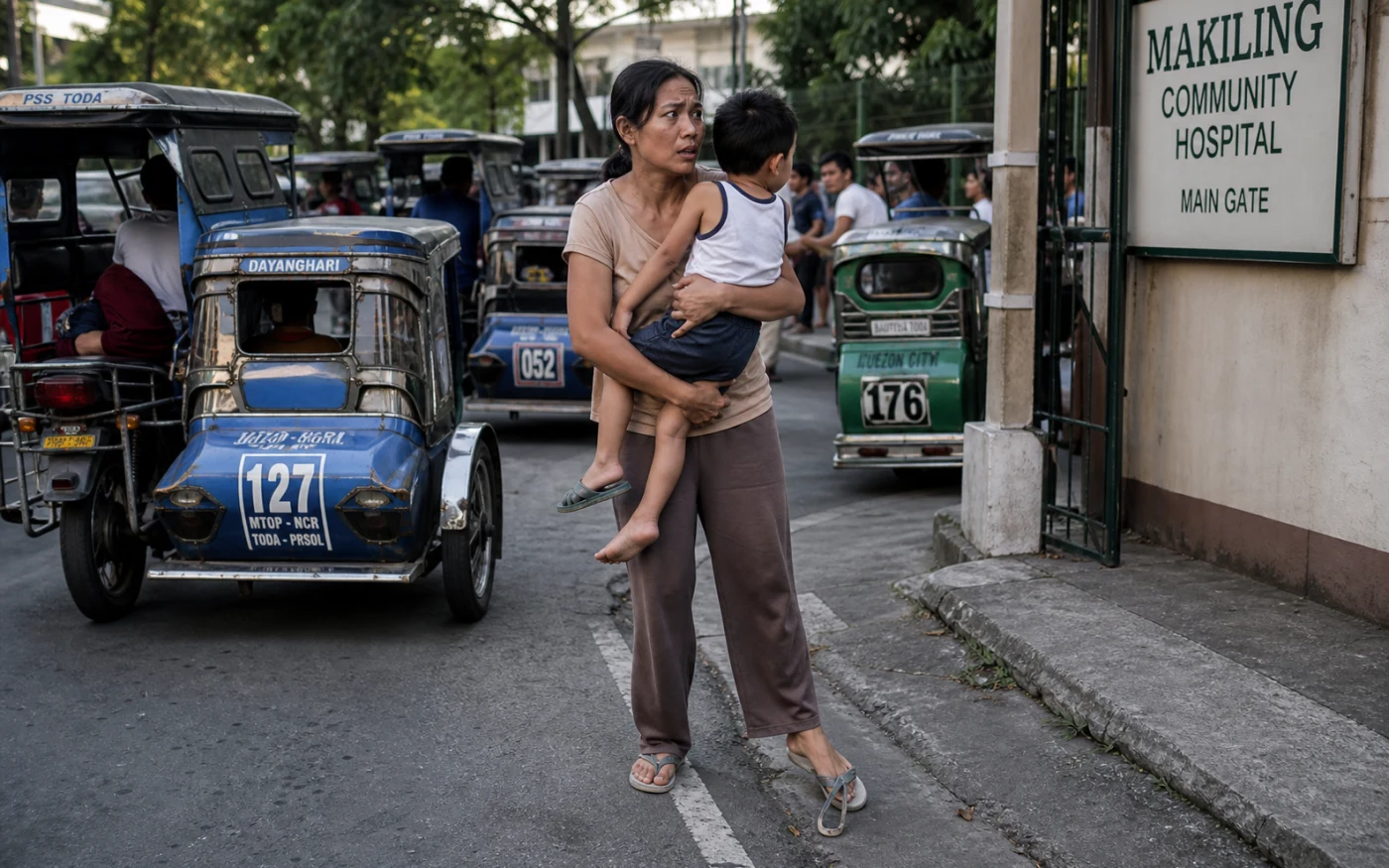
The moment I realized I had left everything we owned inside a stranger's tricycle, I was standing at the hospital gate with my half-blind son in my arms and one broken slipper hanging from my foot.
Inside that bag was eighteen thousand pesos.
Every single peso my husband had earned in seven months of construction work in Cavite.
But the money was not even the worst part.
The bag also held the down payment for my son Ken-Ken's eye operation, his birth certificate, our marriage certificate, the barangay clearance, every medical paper the surgeon had given me, and the old Nokia phone my husband used to call us.
It was our money, our names, and our son's chance to see clearly, all zipped inside one faded blue bag.
And I had left it on the floor of a tricycle.
My name is Gina. I wish I could tell you I was careless because I was chatting or daydreaming. The truth is more ordinary.
I was carrying Ken-Ken because the sunlight hurt his eyes. I had his medicine in one hand and the hospital folder under my arm. My slipper had snapped while I was getting down, so I was trying not to fall into the road.
I had four hands' worth of things and only two hands.
That is the whole reason.
There is never a better reason than that.
I set Ken-Ken beside the guard's chair and ran back toward the road with one bare foot slapping the pavement.
There were tricycles everywhere.
Green ones, blue ones, silver ones, drivers calling for passengers, engines coughing, people climbing in and out. Forty tricycles must have passed in front of me, and suddenly they all looked exactly the same.
I had not checked the number.
I had not noticed the driver's face.
I could not even remember the color of his shirt.
“Which tricycle, Ma’am?” the guard asked.
“I don’t know,” I said.
He asked where I had boarded. He asked what route we took. He asked if there was a sticker on the sidecar.
I kept saying, “I don’t know. I don’t know.”
Then Ken-Ken tugged my blouse and asked, “Mama, operation na?”
I sat down on the curb.
The sound that came out of me did not feel human. I pressed both hands over my mouth, but it kept coming. Ken-Ken climbed into my lap and started crying because I was crying, even though he did not understand what was gone.
The security guard brought me water. A woman selling boiled eggs rubbed my back. Another stranger pushed fifty pesos into my hand so I could get home.
At first I refused it.
Then I looked at my child, at my bare foot, and at the empty road.
I took it.
Pride is a thing for people who still have eighteen thousand pesos.
At home, my sister Dalisay knew as soon as she saw my face.
“Where’s the bag?” she asked.
I could not answer.
She searched the house anyway. Under the bamboo bed. Behind the rice sack. Inside the empty cabinet. She knew it was useless, but she searched because she loved me and there was nothing else to do.
That night I borrowed our neighbor's phone and called my husband, Dante.
He answered from the construction barracks. Behind him, men were talking and metal dishes were clattering.
“Are you at the doctor?” he asked immediately. “Do you have a schedule?”
I tried to speak, but my throat closed.
“Mahal?”
“I lost it,” I whispered.
“What?”
“Everything. The money, the papers, all of it. I left it in the tricycle.”
The noise behind him seemed to disappear.
He did not shout. Somehow that made it worse.
For a long time, I heard only his breathing.
I waited for him to ask how I could be so stupid. I was ready to agree with him. I wanted him to punish me because I was already punishing myself and I needed somebody to say the words out loud.
Instead, he said, “Okay lang, mahal. We’ll manage.”
“We can’t.”
“Seven months ulit.”
Seven more months.
Seven more months of him sleeping on plywood, mixing cement under the sun, eating sardines so he could send home almost everything.
He said it so gently that I had to walk out of the room.
I crouched behind Dalisay's outdoor kitchen and bit my own wrist to stop Ken-Ken from hearing me sob.
The surgeon had warned us not to delay too long.
Ken-Ken's world was already shrinking into shadows and blurred faces.
At school, he sat so close to the blackboard that his knees touched the teacher's table.
That night he lay beside me and touched my nose, my eyelids, my cheeks.
“Mama,” he said, “pag gumaling ako, makikita ko ba mukha mo?”
“Oo,” I told him.
Then I turned away because I had just promised something I could no longer give him.
I did not sleep.
The next morning Dalisay told me to report the bag.
“Report it to whom?” I snapped. “What would I even say? A driver I cannot describe took a road I cannot remember in a tricycle with no number?”
She went quiet.
I hated myself for speaking that way. I hugged her, and we cried over cold coffee while Ken-Ken played with bottle caps on the floor.
For two days, every engine made me run to the window.
Every time our gate rattled, my heart jumped.
But no one came.
On the second night, Dante called again. He said his foreman might lend him part of the money, but then he would be working only to pay a debt. He tried to sound hopeful.
“Get some sleep,” he told me.
“You first.”
Neither of us did.
At six the next morning, while the sky was still gray, somebody knocked on our metal gate.
Not a neighbor's little tap.
Three slow knocks.
When I opened it, a thin old man was standing outside with red eyes, sweat dried white on his shirt, and my blue bag locked against his chest with both arms.
PART 2: Who Found Our House?
For one terrible second, I thought I was imagining him.
Then he held the bag toward me and said, “Ma'am, pasensya na po. It took me two days to find you.”
I grabbed the gate because my knees gave way.
“Where did you find it?”
“Sa tricycle ko po.”
His name was Mang Emilio.
He was sixty-two and drove from before sunrise until the streets emptied at night. He said he found my bag only after his last passenger climbed out. It had slid beneath the sidecar seat.
He opened it to look for a name.
First he saw the cash.
Then the certificates.
Then he saw Ken-Ken's medical papers, the surgeon's schedule, and the words about his eyes.
“That’s when I understood,” he said. “Hindi puwedeng bukas na.”
But he had no phone of his own. The Nokia inside the bag was locked and already low on battery.
So he drove to the barangay hall printed on our clearance.
They sent him to the address listed there.
It was our old rented room. We had left it two years earlier after the roof began leaking onto Ken-Ken's bed.
Mang Emilio knocked anyway.
The new tenants did not know us, so he asked the woman next door. She remembered Dalisay's name but not where she lived. He drove to another street looking for Dalisay's former laundry customer, then waited outside a sari-sari store until someone recognized our family name.
That lead was wrong.
“You did all that with the money?” I asked.
He nodded like there was nothing unusual about it.
He had tucked the bag inside his shirt whenever he left the tricycle. He slept for less than an hour at the terminal with both arms around it, woke in fear, and started searching again.
On the second day, he went to the hospital named in the medical papers.
There he found the security guard who had given me water.
The guard remembered the woman with one slipper and the little boy who kept wiping her tears.
He remembered which road we had taken home.
Mang Emilio drove through three barangays, showing my name to storekeepers, street sweepers, and anyone old enough to know every family nearby.
At dawn, a taho vendor finally pointed to our gate.
Two days.
No sleep.
His own fuel.
Eighteen thousand pesos beside him the whole time.
“Bilangin niyo po,” he said.
I held the bag, but my fingers would not work.
“I can count it later—”
“Now, please, Ma’am. Sa harap ko.”
I understood then that he needed to see my face when I found it complete.
Dalisay came outside. We sat on the front step while Mang Emilio remained by the gate.
The papers were there.
The cracked Nokia was there.
I opened the envelope and counted the bills once. Then again because I could not believe my hands.
Eighteen thousand pesos.
All of it.
I pressed the envelope to my chest and screamed for Dalisay to call Dante.
Our neighbor ran over with her phone. When Dante answered, I could barely form the words.
“It’s here,” I cried. “Mahal, everything is here.”
He made one broken sound and then began thanking a man he could not see.
I pulled five thousand pesos from the envelope and held it out to Mang Emilio.
He stepped backward off our front step as if I had swung at him.
“Ma’am, no.”
“Please. For your fare, your fuel—kahit ito lang.”
“Hindi.”
His voice broke.
He looked past me at Ken-Ken, who had come outside and was squinting up at him in the morning light.
Then Mang Emilio lowered his eyes.
“May apo akong babae,” he said. “Six years old. Ganoon din po ang mata niya.”
PART 3: Why He Refused Everything
Mang Emilio's granddaughter was named Aira.
Her parents worked wherever they could, but they had stopped taking her for checkups because every appointment meant losing a day's wages.
Mang Emilio knew the way she held books against her nose. He knew how she stumbled when evening came.
That was why he had driven until his eyes burned.
“When I saw what you might lose,” he said, looking at our bag, “I thought of her.”
I tried once more to give him money.
He closed my fingers around the bills.
“Use it for your son.”
Then he climbed into his tricycle and drove away before I could even give him coffee.
Ken-Ken had his operation that November.
Dante came home from Cavite for it, thinner than I remembered and smelling of cement dust even after he bathed.
Mang Emilio insisted on driving us to the hospital.
When Dante tried to pay, they argued beside the tricycle until a nurse told them both to move away from the entrance.
The operation lasted three hours.
Those three hours felt longer than the seven months it had taken us to save the money.
When the surgeon finally came out, he lowered his mask and smiled.
“It went well,” he said. “We wait now.”
The next morning, Ken-Ken's eyes were still covered. Dante sat on one side of his bed, and I sat on the other. Mang Emilio had gone back to work, though he had called the ward twice from a borrowed phone.
When the doctor removed the bandages, Ken-Ken blinked at the ceiling.
Then he looked at Dante.
Then he turned to me.
His whole face changed.
“Mama,” he whispered. “May nunal ka pala.”
I touched the tiny mole beside my mouth and laughed while tears ran down my neck. Dante bent over the bed, crying into our son's blanket.
But that was not the last thing we did with the bag Mang Emilio returned.
Months later, when Dante had steadier work, we asked Aira's parents if we could help with her eyes. The doctor said her problem was milder than Ken-Ken's and could be managed with glasses and regular checkups. We paid for both, along with the small school fees that kept her in class.
Mang Emilio found out, of course. After that, he began appearing near our road more often and refusing our fare with the same offended face.
“Mang Emilio, bayad ito.”
“Hindi kita pasahero.”
“Ano ako?”
“Maingay.”
Ken-Ken laughed every time.
The real ending happened at our barangay fiesta.
Mang Emilio had parked near the covered court. Aira was beside him in a yellow dress and new glasses, holding a paper plate of pancit. Ken-Ken spotted her first.
By then he no longer sat at the teacher's table. He proudly sat in the middle row, where he could see every word on the board.
He ran to Aira carrying a book from the school reading booth.
“Let’s read,” he said.
They sat together on the low concrete wall. Aira leaned close to the page. Ken-Ken moved the book nearer to her without making a fuss, and they began reading aloud, taking one line each.
Mang Emilio watched them.
Ken-Ken and Aira had their heads bent over the same book. My son traced the words with one finger while Aira read them, slowly but correctly.
Mang Emilio's red, tired eyes filled again, just as they had at our gate.
Then Aira reached the bottom of the page, looked up at him, and shouted, “Lolo, nakita ko lahat!”
Mang Emilio crossed the court in three steps and lifted her into his arms.