
For Years the Neighbor Kid Knocked on Our Door Right at Dinnertime. We Always Set Him a Plate. Years Later, He Set One for Us.
PART 1: The Dinner Knock
The invitation said our whole family had a table at the hottest new restaurant in San Francisco.
There was only one problem.
We had never made a reservation.
My husband, Eddie, held the thick cream envelope under our kitchen light as if it might confess.
“Party of Everyone,” he read. “Ano 'to, joke?”
I took it from him.
Our name was embossed across the top.
THE ABAYA FAMILY.
Opening night. Saturday. Seven o'clock.
No price. No phone number to confirm. Just an address and one handwritten line.
Please come hungry.
We should have thrown it away.
Instead, it took me back twenty-two years, to a skinny boy who always arrived at our door when the rice cooker clicked off.
His name was Warren.
He lived with his mother in the apartment beside ours in Union City.
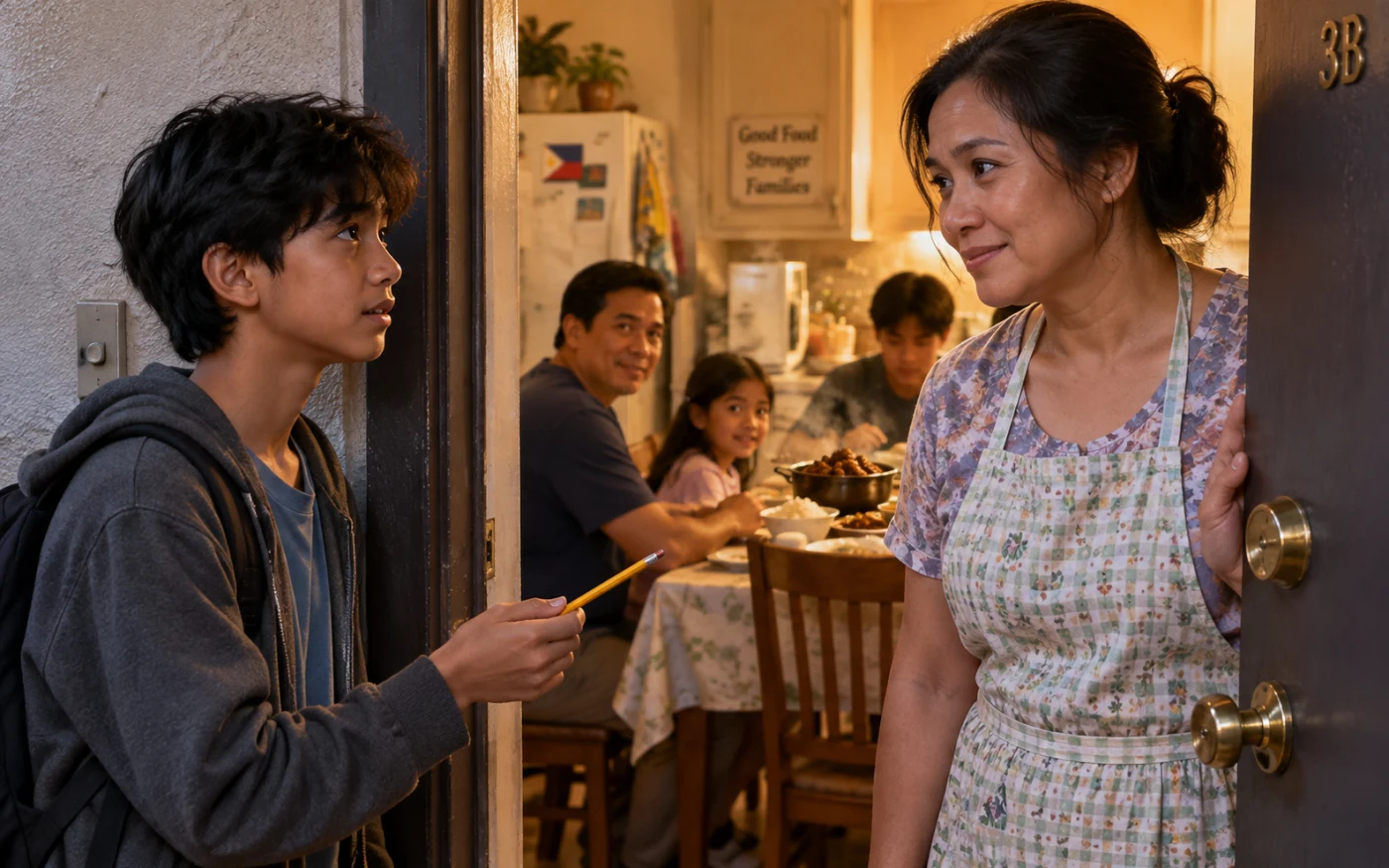
Every weekday, at exactly six-thirty, there would be three soft knocks.
When I opened the door, Warren would stand there with an empty backpack and the same serious face.
“Hi, Tita Gina. Can I borrow a pencil?”
The first time, I gave him two pencils.
Then I noticed him staring past me.
Eddie had just lifted the lid from a pot of chicken adobo.
The smell filled our tiny apartment.
Warren swallowed so hard I could see it.
“Have you eaten?” I asked.
“Yes, po.”
His stomach answered for him.
It growled loud enough for Eddie to hear from the kitchen.
Eddie looked at me.
I looked at Warren.
“Good,” I said. “Then you can eat again.”
I set another plate beside our daughter Tricia.
Warren finished the rice before touching the chicken.
He ate carefully at first, like someone might change their mind and take the plate away.
Then Eddie pushed the adobo bowl closer.
“Sige, iho. Kain pa.”
That boy cleaned his plate.
The next evening, he returned holding the two pencils.
“Can I borrow an eraser?”
I almost laughed.
He could have asked for food.
But pride is already alive in a child, especially one who has seen his mother work herself tired.
So I never embarrassed him.
“Of course,” I said. “Dinner first.”
After that, Warren borrowed something every night.
A ruler.
Tape.
Yellow paper.
Once, he asked for a green crayon even though he was already fourteen.
“Green talaga?” Eddie teased.
Warren turned red.
“For science, Tito.”
“Ah, scientific sinigang first.”
Soon we stopped pretending not to know.
But we let Warren keep pretending.
His mother, Carmen, cleaned hotel rooms before sunrise and worked at a laundry after lunch.
Some nights she came home after ten.
Whenever she found Warren at our table, she would grip my hands and say, “Gina, nakakahiya.”
“Hindi,” I would tell her. “He helps us finish the rice.”
That was not always true.
Money was tight for us too.
Eddie drove a delivery truck, and I altered dresses from our bedroom.
There were weeks when I stretched one chicken across three dinners.
But adding water to soup was easy.
Watching a child go hungry next door was not.
Warren became part of the noise of our home.
He argued with Tricia over the last lumpia.
He helped our younger son Eli with fractions.
He learned to chop onions beside me, though his pieces looked like broken furniture.
“Ay, grabe,” I said. “The onion did nothing to you.”
He laughed until tears ran down his face.
The first dish he learned properly was my chicken adobo.
Not from a recipe.
I did not own one.
I showed him how much vinegar to pour by listening to the bottle.
I taught him to wait before stirring, and to let the garlic darken just enough.
“How do you know it's ready?” he asked.
“The smell tells you.”
“What if I can't tell?”
“Then you keep cooking until you can.”
One night, he made the whole pot himself.
Eddie took one bite and frowned dramatically.
Warren froze.
Then Eddie reached for more rice.
“Naku,” he said. “Gina, you have competition.”
I had never seen Warren smile that wide.
Two months later, Carmen found cheaper rent with a cousin in Daly City.
Their move happened fast.
Warren came to our door one last time, holding the green crayon.
“I forgot to return this.”
His voice cracked.
I pulled him into my arms.
“Keep it.”
“I'll pay you back someday, Tita.”
“For a crayon?”
“For all of it.”
I touched his cheek.
“You owe us nothing.”
For a while, Carmen sent Christmas cards.
Then we moved, numbers changed, and life carried everyone in different directions.
Tricia became a nurse in Sacramento.
Eli found work in San Jose.
Our apartment grew quiet.
Eddie stayed with the same delivery company for twenty-seven years.
Then, four months before that invitation arrived, the company shut down.
He came home carrying his lunch bag at ten in the morning.
“Finished na,” he said.
At sixty-one, Eddie applied everywhere.
Warehouses said the work was too physical.
Offices wanted computer skills he did not have.
Restaurants wanted experience he could not prove.
We did not tell the children.
Tricia had two little girls and hospital bills from her husband's surgery.
Eli was saving for a home.
“We can manage,” Eddie insisted.
So I nodded, even as our savings shrank.
I watered the soup again.
We turned off lights in rooms we were using.
Eddie started pretending he had already eaten.
The night the invitation came, our dinner was rice, one fried egg each, and tomatoes with salt.
Eddie studied the gold lettering.
“Opening night means expensive.”
“It says we're invited.”
“It could still be a mistake.”
I read the handwritten line again.
Please come hungry.
Something about those words made my chest tighten.
We called Tricia and Eli.
Both said yes before we finished explaining.
“Free dinner in San Francisco?” Eli said. “Ma, kahit prank, pupunta ako.”
On Saturday, we put on our best clothes and drove across the Bay Bridge in Tricia's minivan.
The restaurant stood on a bright corner near the water.
People crowded outside beneath a sign that read PENCIL & PLATE.
I stopped walking.
Behind the glass doors, framed on a white wall, was a single green crayon.
PART 2: The Name Behind the Door
“Ma?” Tricia asked. “Are you okay?”
I could not answer.
Eddie stared at the crayon too.
“No way,” he whispered.
A hostess opened the door before we could turn around.
“The Abaya family?”
Every person in our group pointed at someone else.
The hostess smiled.
“We've been waiting for you.”
Inside, the restaurant glowed with warm light.
Copper pans hung above an open kitchen.
Every table was full.
Servers moved quickly through the room carrying plates that smelled strangely familiar.
Garlic.
Vinegar.
Ginger.
Charred eggplant.
My own memories seemed to be cooking behind the kitchen glass.
A server led us past people taking pictures of their food.
“Who invited us?” Eddie asked.
“Chef did.”
“What chef?”
She only smiled.
Our table was hidden behind a wooden screen near the open kitchen.
The moment we sat down, small bowls arrived.
Arroz caldo with crisp garlic.
The first spoonful stopped me.
It tasted like the arroz caldo I made whenever Warren had a cold.
Not similar.
The same.
Next came lumpia, rolled thin because Eli used to complain when the wrapper was too thick.
Then sour tamarind broth with salmon, the way Carmen liked it.
Tricia leaned toward me.
“Ma, these are your dishes.”
“Maybe common recipes,” I said, but my hands had started shaking.
The lights above the kitchen dimmed.
A man in a white chef's coat stepped through the swinging door.
He was tall now, with broad shoulders and a little gray near his temples.
But he had the same serious eyes.
And in his chest pocket was a green crayon.
“Hi, Tita Gina,” he said. “Can I borrow a pencil?”
I stood so fast my chair nearly fell.
“Warren?”
He opened his arms.
I crossed the space between us and held him.
For one second, he was fourteen again.
Skinny shoulders. Empty backpack. Hungry stomach.
Then Eddie wrapped both of us in his arms.
“Ikaw pala!” Eddie said, laughing and crying at once.
Warren hugged Tricia and Eli next.
He knew them immediately.
“You stole my lumpia,” he told Tricia.
“You ate everything else,” she shot back.
The nearby diners applauded, but I barely heard them.
I touched Warren's face like I had on the day he left.
“You became a chef.”
“Because you let me ruin your onions.”
He told us he had worked his way through restaurant kitchens.
Dishwasher first.
Then prep cook, line cook, sous-chef.
He studied at night, traveled when he could, and kept cooking the food he remembered from our table.
An investor finally tasted his adobo at a pop-up and backed this restaurant.
“Every dish started in your apartment,” he said.
“But you made them beautiful,” I told him.
Warren shook his head.
“You made them mean something.”
The last main dish arrived in a black clay pot.
Chicken adobo.
Eddie tasted it first.
He made the same dramatic frown from twenty-two years earlier.
Warren froze, then caught himself and laughed.
Eddie reached for more rice.
“Gina,” he said, “your competition got stronger.”
“Hoy,” I said. “Respect your wife.”
We laughed until my cheeks hurt.
For the first time in months, Eddie looked like himself.
Then the kitchen door opened again.
A silver-haired woman walked out.
I knew her before she called my name.
“Gina.”
Carmen gripped both my hands.
“I finally found you.”
She had tried to find us for years.
The old building manager had finally remembered the name of Eddie's delivery company.
From there, Warren tracked down an old coworker, then Tricia's public nursing profile, then our address.
He had planned the invitation for months.
Then she hugged me and whispered, “You fed my son when I couldn't.”
Her voice broke.
“You kept him from knowing how scared I was.”
I held her tighter.
“You were working for him. We only opened a door.”
Warren looked at Eddie.
His smile faded into something more serious.
“Tito, can we talk before dessert?”
Eddie glanced at me.
Warren led us around the wooden screen, toward the center of the dining room.
There, under a hanging brass lamp, stood one empty table.
And on its edge was a plaque with our name.
PART 3: What the Plaque Promised
Eddie reached the table first.
He bent close to read the small brass plaque.
RESERVED FOR THE ABAYAS.
He read it twice.
Then he looked around at the packed restaurant.
“Tonight?” he asked.
Warren shook his head.
“Always.”
I covered my mouth.
“Any night,” Warren continued. “Any one of you. If this place has a door, your family has a table.”
Eli ran his fingers over our last name.
Tricia began to cry.
“Warren, this is too much,” I said.
“No, Tita. Too much was working all day and still making room for one more plate.”
He pulled out a chair for Carmen.
“My mother sits here too.”
Carmen lowered herself into it and patted the chair beside her.
“Halika, Gina.”
I sat.
For a moment, nobody spoke.
Around us, forks touched plates and servers called orders.
The whole room felt alive.
Then a tray slipped near the kitchen.
Three glasses tipped toward the floor.
Eddie moved before anyone else.
He caught one glass, steadied the tray, and guided the young server away from a passing busser.
“Slow down,” he said kindly. “Look where the room is going, not where it was.”
The server exhaled.
“Thank you, sir.”
Warren watched him.
“You still do that.”
“Do what?” Eddie asked.
“See what people need before they ask.”
Eddie gave a small shrug.
“Years of deliveries.”
Warren rested both hands on the back of a chair.
“I heard the company closed.”
Eddie's face changed.
He looked at Tricia, then Eli, then me.
“How did you know?”
“Your old coworker told me.”
Our children stared at us.
“Dad?” Tricia said.
Eddie's shoulders sagged.
The secret we had protected for four months sat down at the table with us.
“I was going to tell you,” he said.
“When?” Eli asked. “When you’re ninety?”
“You both have your own problems.”
Tricia took his hand.
“You're not a problem.”
Eddie looked away quickly.
Warren did not offer pity.
He pointed around the dining room.
“Opening this place taught me something. I can cook, but I can't be everywhere.”
He nodded toward the entrance, where two waiting parties were crowding the host stand.
“I need someone who remembers faces. Someone who stays calm when things go wrong. Someone who can make a person feel welcome before they even sit down.”
Eddie blinked.
“You need a manager.”
“I need you.”
The words landed harder than any speech could have.
Eddie shook his head.
“Warren, I never ran a restaurant.”
“You ran a delivery route for twenty-seven years. You handled schedules, customers, drivers, missing orders, and bad days.”
Warren smiled.
“And you ran a dinner table where a scared kid never felt like charity.”
Eddie looked down at his old suit.
“I don't know fancy service.”
“Good. I want warm service.”
“Computers?”
“We'll teach you.”
“I'm not young.”
“Neither is adobo. People still love it.”
That made Eddie laugh.
But he still did not answer.
Warren reached into his apron and placed something on the plaque.
It was a small black name tag.
EDDIE ABAYA
GENERAL MANAGER
Eddie picked it up with both hands.
“You already made this?”
“I was hoping.”
“What if I said no?”
“Then I would keep asking at dinnertime.”
Eddie's chin trembled.
He turned the name tag over, then pressed it against his jacket.
“Do I get Sundays off?”
Warren grinned.
“Every Sunday.”
“Health insurance?” Tricia asked immediately.
“Yes.”
“Paid vacation?” Eli added.
“Yes.”
Eddie raised one hand.
“Sandali. I can negotiate for myself.”
He faced Warren.
“One condition.”
Warren straightened.
“Name it.”
Eddie pointed toward the front door.
Outside, a family with two small children was studying the menu posted in the window.
The father checked the prices and gently began guiding them away.
“Every night,” Eddie said, “we keep two seats open.”
Warren followed his gaze.
“For who?”
“For anyone who comes hungry and cannot ask.”
The room around us seemed to go quiet, though it had not.
Warren's eyes filled.
He held out his hand.
“Deal.”
Eddie ignored the hand and pulled him into a hug.
“Deal, anak.”
Warren closed his eyes.
Carmen started crying openly.
“Naku, mascara ko,” she said, wiping her cheeks.
Tricia laughed through her tears.
Then Eddie surprised all of us.
He pinned on the name tag, walked straight to the entrance, and opened the door.
The family outside turned in confusion.
Eddie smiled at the two children.
“Have you eaten?”
Their father hesitated.
“We were just looking.”
“Good,” Eddie said. “Then you can look from inside.”
He led them to the empty seats beside our table.
Warren hurried to the kitchen.
A few minutes later, he returned carrying a clay pot of chicken adobo himself.
He served the children first.
The youngest boy took one bite, looked up at Warren, and smiled.
Warren set one more plate at our table.