
I Took Care of an Old Man Who Claimed He Was a Deposed King. The Morning After He Died, Forty Royal Guards and Diplomats Sealed Off My Street.
PART 1: My Patient the King
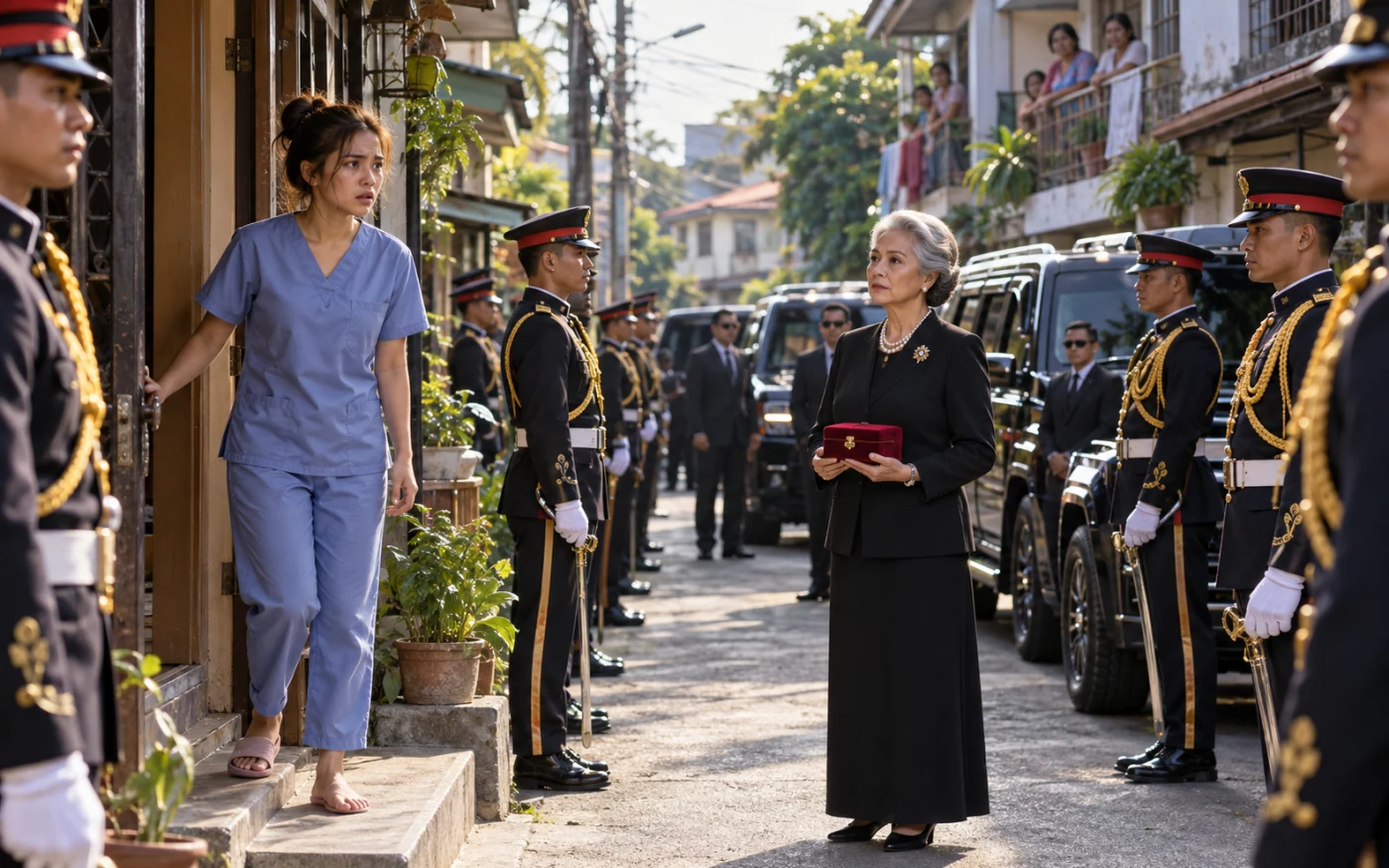
The morning after my patient died, forty royal guards surrounded my apartment building.
Not security guards.
Royal guards.
Gold cords. White gloves. Swords.
Behind them stood a line of black armored SUVs, three foreign diplomats, and one silver-haired woman holding a red velvet box.
My landlord pounded on my door and screamed, “Naku, Joanna! What did you do?”
Honestly?
I had no idea.
Twelve hours earlier, I had been sitting beside an old man in my apartment building while he wore a crown made of plastic sampaguita flowers.
His name was Mr. Alejandro Del Rosario.
Everyone in Building C called him the King of Room 609.
Not kindly.
He was eighty-seven, thin as a broom handle, and always dressed in a faded burgundy robe.
He claimed he had once ruled a tiny mountain kingdom called Monteluce.
He said enemies had stolen his throne, burned his summer palace, and forced him across the ocean under diplomatic protection.
The neighbors said he had watched too many old movies.
I never argued with him.
“Your Majesty,” I would say, bowing with his medicine cup, “oras na po. The royal blood-pressure tablet.”
He would lift his chin. “At last. A servant with proper manners.”
Then he would swallow the pill with mango juice because plain water, according to him, was “a beverage for defeated republics.”
I was a nursing assistant at St. Agnes Medical Center.
Most weeks, I worked two double shifts. I grabbed sleep wherever I could.
On the bus. In the laundry room.
Once, I fell asleep inside a supply closet, hugging a box of gloves.
My mother’s cancer had left me with bills that kept multiplying even after she was gone.
Every month, another envelope arrived with a new number and the same cold warning.
And that was only half my problem.
The little community clinic my mother had started in our neighborhood was about to be taken by Argent Health, a huge healthcare company that had bought its loans.
The clinic occupied an old yellow building between a bakery and a pawnshop.
Its ceiling leaked.
Its blood-pressure machine needed a slap before it worked.
But no one was turned away.
My mother had treated jeepney drivers, cleaners, grandmothers, babies, and men too proud to admit they were scared.
Before she died, she made me promise to keep its doors open.
Argent was coming Thursday to take the building.
So why was I caring for Mr. Del Rosario for free?
Because he was my neighbor, and I liked him.
He had lived two floors above my family for as long as I could remember. My mother used to bring him food and boss him around when I was a girl.
As he got older, I started checking on him too.
Then I found him one night trying to crawl across his kitchen floor after a fall.
After that, I began visiting after work.
I changed his sheets. Cleaned his wounds. Heated arroz caldo.
Listened to stories about royal hunts, winter balls, and a palace with two hundred windows.
His stories changed sometimes.
The palace had two towers on Monday and three on Thursday.
His royal horse was named Valentino one week and Napoleon the next.
But one detail never changed.
He had lost a daughter named Isadora.
“She had your stubborn eyes,” he told me.
“Pagod lang ang mata ko. Not stubborn.”
“Both can be true.”
On his final night, rain tapped against the window.
I had just finished sixteen hours at St. Agnes, and my feet felt full of broken glass.
I almost went straight home.
Then I remembered he was out of soup.
When I entered Room 609, he was awake but breathing badly.
His burgundy robe lay across his chest.
On the table beside him sat a cheap plastic crown decorated with white flowers.
I had bought it months earlier from a party shop after he complained that no monarch should celebrate a birthday bareheaded.
“Joanna,” he whispered. “The court is waiting.”
“The court can wait. Inhaler muna.”
He caught my wrist with surprising strength.
“Not tonight.”
I checked his pulse and called the hospice nurse.
Then I sat beside him, because I knew what was happening.
I had seen it with my mother.
He stared toward the rain-dark window. “They took everything from me.”
“I know.”
“No, child. You smiled because you thought I was confused.”
My face burned. “Minsan, I wasn’t sure.”
He laughed once. It became a cough.
I lifted the plastic crown. “Would Your Majesty like this?”
His eyes filled with tears.
I placed it gently on his silver hair.
Then I stood, bowed as low as my aching back allowed, and said, “Your Majesty, it has been my honor.”
He reached for my hand.
“No,” he whispered. “The honor was mine.”
Those were his last words.
He died before midnight, holding my fingers.
I stayed until the hospice nurse came.
I washed his face, straightened his robe, and left the plastic crown on his chest.
Then I walked home in the rain and cried inside a paper bag on the bus so nobody would notice.
At seven the next morning, engines shook my windows.
My whole street was blocked.
Neighbors leaned from balconies in pajamas.
Children pressed their faces against the glass.
Uniformed men formed two perfect lines from the curb to our entrance.
The silver-haired woman looked up.
Then she pointed directly at me.
“Joanna Navarro,” she called. “By order of the Crown of Monteluce, come downstairs.”
PART 2: Was He Telling the Truth
I went down wearing one slipper.
I had been so frightened that I forgot the other.
My landlord followed me, clutching a rosary and whispering, “If they arrest you, huwag mo akong idamay.”
Nobody arrested me.
The forty guards struck their heels together.
The sound cracked through the street like thunder.
Then every one of them bowed.
To me.
I turned around, certain someone important stood behind me.
Only my landlord was there. He bowed too, just in case.
The silver-haired woman approached. “I am Chancellor Sofia Varga of the Kingdom of Monteluce.”
She opened the velvet box.
Inside was a gold seal bearing the same mountain-and-lion symbol Mr. Del Rosario had drawn on napkins for years.
My knees weakened.
“Si Mr. Del Rosario?” I said.
Her formal face broke.
“His Majesty King Alejandro the Fourth died last night.”
The entire street went silent.
Even the bakery mixer seemed to stop.
Chancellor Varga explained that Monteluce was a wealthy little kingdom tucked between mountains in southern Europe.
Forty years earlier, a military council had removed King Alejandro.
Loyal officials smuggled him abroad.
Years later, the council fell and the royal government was restored—but Alejandro refused to return.
His wife and daughter had died during the uprising.
He never forgave the palace for surviving when they had not.
So he stayed in the same old apartment building he had called home for decades, rejecting estates, staff, and ceremonies.
Only a few officials knew his address. They honored his wish to be left alone.
“Then why did he stay here?” I asked.
“He refused to reclaim most of his restored estate for decades,” she said. “He was also extremely difficult.”
That part I believed immediately.
“Three weeks ago, he changed his mind.”
“Why?”
Her eyes moved toward the clinic. “Apparently, he finally found something he wanted it for.”
A diplomat handed me a cream envelope sealed with red wax.
My name was written across it in Mr. Del Rosario’s shaky handwriting.
Before I could open it, another black car stopped at the barricade.
Out stepped Leonard Pike, regional director of Argent Health.
I knew him from the foreclosure meeting.
Expensive gray suit. Pink face. Smile like a closed door.
“What is this circus?” he demanded. “I need access to the Navarro clinic.”
My stomach dropped.
Of course.
It was Thursday—the day Argent’s surveyors were coming to mark the building for seizure.
Pike saw me and lifted a folder. “Ms. Navarro, your final extension expired at nine this morning. The property now transfers to Argent Health.”
“It’s seven thirty,” I said.
He checked his watch and scowled.
“Then consider this professional courtesy. Sign now. Save everyone the embarrassment.”
Chancellor Varga looked at him. “You are attempting to take her medical clinic?”
“This is private business.”
“Not anymore.”
She nodded to the diplomat beside her. He opened a slim leather case and removed several documents.
Pike laughed. “Lady, unless your costume club can pay what this clinic owes—”
“It does.”
His smile vanished.
The chancellor took my sealed envelope and placed it back in my hands.
“His Majesty’s final testament contains instructions concerning you. We must read it inside the clinic, in the place he visited without your knowledge.”
I stared at her. “Pumunta siya sa clinic?”
“Many times.”
That made no sense. For his last year, Mr. Del Rosario rarely went anywhere without help.
Then I remembered the afternoons when he insisted on wearing polished shoes.
The black sedan I sometimes saw outside Building C.
The way he knew our clinic roof leaked over Examination Room Two.
He had told me a palace must always be inspected in secret.
I thought he was joking.
We walked two blocks with forty guards behind us.
Neighbors poured onto the sidewalk. Someone began livestreaming.
My landlord had found my missing slipper and carried it above his head like a sacred object.
At the clinic door, Leonard Pike pushed ahead of me.
“This performance changes nothing,” he said. “Argent owns the debt.”
Chancellor Varga’s lawyer handed him one page.
Pike read it.
His face turned from pink to gray.
“His Majesty ordered the purchase weeks ago,” the lawyer said. “As of six forty-two this morning, the Crown Treasury completed the transfer of every loan, lien, and claim Argent holds against this clinic.”
Pike looked ready to swallow his tie.
The chancellor held out her hand. “The keys.”
He slapped them into her palm.
She gave them to me.
I had dreamed about defeating Argent for months. In my dreams, I made a brilliant speech.
In real life, I burst into tears and dropped the keys.
Inside, the clinic smelled of rubbing alcohol, old paint, and the pandesal our receptionist, Tita Gloria, brought every morning.
Staff crowded into the waiting room. Patients stared at the guards through the windows.
Chancellor Varga placed a tablet on the reception desk.
The screen flickered.
Mr. Del Rosario appeared in his burgundy robe.
The plastic flower crown sat crooked on his head.
“If you are watching this,” he said, “then I am dead, and Joanna is probably angry that I did not tell her the truth.”
I covered my mouth.
He leaned toward the camera.
“Do not celebrate yet, child. First, open the envelope. There is something inside you must decide.”
PART 3: What He Asked of Me
My hands shook so badly that I tore the envelope down the middle.
Inside was a photograph and one handwritten page.
The photograph showed my mother twenty-five years earlier, standing outside the clinic beside a much healthier Mr. Del Rosario.
He wore work pants. She held a paint roller. Both were laughing.
On the back, my mother had written: Alejandro, stop calling my clinic a palace.
I sank into a waiting-room chair.
“Grabe,” I whispered. “Mama knew him from the beginning?”
The video continued.
“Your mother found me sleeping in a train station after I fled Monteluce,” he said.
“I had a crown waiting for me somewhere, yes. But grief had made me useless. Irene fed me, treated my infected foot, and ordered me to help paint these walls.”
Chancellor Varga said quietly, “He tried to repay her with what little he kept. Irene never took his money. Once she handed him a paint roller instead.”
Our receptionist laughed through her tears. That sounded exactly like Mama.
“She did not save a king,” he said. “She saved a stubborn old man. There is a difference.”
I read his letter aloud.
He wrote that he had watched me work at the clinic as a teenager, mop floors during nursing school, and return after every exhausting hospital shift.
His secret visits were not tests.
He came because the waiting room reminded him of the only years when he had felt useful again.
Then I reached the sentence that made everyone gasp.
I, Alejandro IV of Monteluce, recognize Joanna Irene Navarro as my honorary daughter and primary personal heir.
I stopped breathing.
The chancellor gently took the page and finished.
Mr. Del Rosario had left me more money than I could understand. Houses. Investments. Art. A vineyard I could not pronounce.
But his letter said I could refuse all of it.
His final request was not that I become royal, move away, or spend my life protecting his name.
It was one question.
What do you want to save?
Behind the chancellor, Pike cleared his throat.
“Before anybody gets emotional,” he said, “Argent would be willing to buy the clinic back at a very generous premium. Ms. Navarro could walk away today.”
For one ugly second, I imagined it.
No debt collectors. No double shifts.
No waking at three in the morning terrified that I had failed my mother.
I could buy a quiet house. Sleep for a year.
Then a little boy in the waiting room tugged my scrub top.
His name was Luis. His mother cleaned offices at night.
We had been treating his asthma for free since he was four.
“Ate Joanna,” he whispered, looking at the guards, “are they closing us?”
That was my answer.
I stood.
“No.”
Pike smiled. “Excellent. We can draw up—”
“I wasn’t talking to you.”
I knelt in front of Luis. “Nobody is closing us. Hindi ngayon.”
Then I faced Chancellor Varga.
“I want to save this place. Not just for another month. Forever.”
For the first time that morning, she smiled.
“Then His Majesty prepared wisely.”
She opened the red velvet box again. Beneath the gold seal was a folded deed.
The clinic property was mine, free of every lien.
Then her lawyer placed a second document beside it.
Mr. Del Rosario had created a permanent medical trust for the clinic.
The property could never be sold to a private company.
The trust would restore the building, expand its services, and keep its doors open so no patient would be turned away because they could not pay.
I was named lifetime Executive Director.
My mother’s medical debt—every last cruel peso of it—had also been paid in full before sunrise.
I pressed both hands against the desk because the room tilted.
Leonard Pike tried to slip out.
My eighty-year-old receptionist, Tita Gloria, blocked the door with her walker.
“Ay, sir,” she said sweetly, “you forgot your professional courtesy.”
She handed him his empty folder.
The waiting room erupted.
People laughed. Nurses clapped. My landlord waved my missing slipper. Even two royal guards lost their serious faces.
Pike squeezed past Tita Gloria and fled through a line of cheering patients.
Then Chancellor Varga returned to the video.
Mr. Del Rosario looked tired now. Not like a king. Just my difficult, lonely patient.
“Joanna,” he said, “I know you will try to give everything away. Do not. Keep enough to live. Rest sometimes. A person does not honor the dead by joining them from exhaustion.”
I laughed and cried at once.
“And one more thing,” he said. “The clinic must carry Irene’s name, not mine. I have had enough buildings named after me.”
The screen went dark.
Six months later, we reopened the Irene Navarro Community Clinic.
The old yellow building still formed its heart, freshly painted and strengthened.
Behind it stood a bright new wing with proper treatment rooms, modern equipment, and a pharmacy. No one was turned away because they could not pay.
At the opening, Chancellor Varga offered me a jeweled medal from Monteluce.
I wore it for exactly eleven minutes.
Then Luis asked why a queen was carrying boxes of gauze.
“Hindi ako queen,” I told him.
“Princess?”
“Executive Director.”
He considered this. “That sounds more scary.”
“It is.”
Near sunset, after the speeches ended, I went alone to the clinic garden.
We had placed a small bench there beneath a sampaguita trellis.
No statue. No royal title.
Only a brass plaque:
ALEJANDRO — A STUBBORN OLD MAN WHO HELPED.
I set his plastic flower crown on the bench.
The real royal crown of Monteluce was probably locked in some guarded palace across the ocean.
But this was the crown he had worn when he died holding my hand.
I bowed once.
“Your Majesty,” I whispered, “the palace is open.”