
My Entire Family Was Rushed to the ER After Grandma Served “Toxic” Black Sinigang — Then Our Blood Tests Exposed the Real Poison...
PART 1: Why Lola Made It Black
My Lola Nena made beautiful sinigang, the kind that fogged the capiz windows before noon and pulled cousins into the kitchen pretending they needed water while staring at the pork belly.
So when Sunday lunch smelled like burnt grass, bitter fruit skin, and wet river clay, I stopped halfway down the hallway.
“Lola? Ano ’yan?”
“No questions,” she called from the kitchen. “Set the table.”
I'm Hazel, twenty-four, and back then I still lived in our old family house in Malolos with Lola, my parents, two cousins, and whichever relative had decided our place was a free hotel that week.
For almost a month, all of us had been sick.
It started after Tita Brenda arranged to have several upstairs rooms “freshened up.” Lola objected because nobody had asked permission, but Brenda had already hired two men and bought cheap industrial paint and varnish from somebody she knew through somebody else.
“Same thing contractors use,” Brenda told us. “Mas mura lang.”
The house smelled strange for days. Lola opened windows. Brenda closed them.
“Sayang ang aircon,” she complained.
Then came the headaches, sour stomachs, dizziness, and heavy legs. My cousin Mark once fell asleep sitting upright with pandesal still pinched between his fingers.
“Baka haunted,” he muttered when he woke up.
“Mas mura ang multo kaysa doctor,” I told him.
Brenda blamed Lola.
“She’s eighty. Hindi na niya kaya ang bahay. We move her to a nice facility in Laguna, sell this place, everybody stops fighting.”
Everybody knew which part Brenda liked best.
Sell this place.
Our ancestral house sat on valuable land, and whenever Brenda discussed the sale price, her voice became soft and reverent.
I hated the plan. Still, after weeks of watching Lola roam around opening windows, sniffing doorframes, and muttering that something in the house was wrong, a shameful thought had started creeping into my head.
Maybe Brenda was right about one thing.
Maybe Lola really was getting too old.
That Sunday morning, I found Lola beside Chiquito’s cage near the back kitchen. Her yellow canary, six years old and personally offended by Brenda’s existence, was lying on the bottom.
“Lola…”
She touched him once, then grabbed my chin.
“Show me your tongue.”
“What?”
“Dila, Hazel.”
I obeyed. She stared at my tongue, then squeezed my fingernail and watched the color return.
Her face changed.
Not confused. Recognizing.
“Nasaan si Brenda?”
“Upstairs.”
A few minutes later I heard them shouting.
“Buksan mo ang bintana!” Lola yelled.
“Stop opening everything! The paint needs to dry!”
“May lason dito!”
“Oh, please. It is paint, Nena, not a curse.”
At lunch, Brenda arrived carrying a thick folder under one arm.
“What’s that?” I asked.
“Options. After lunch.”
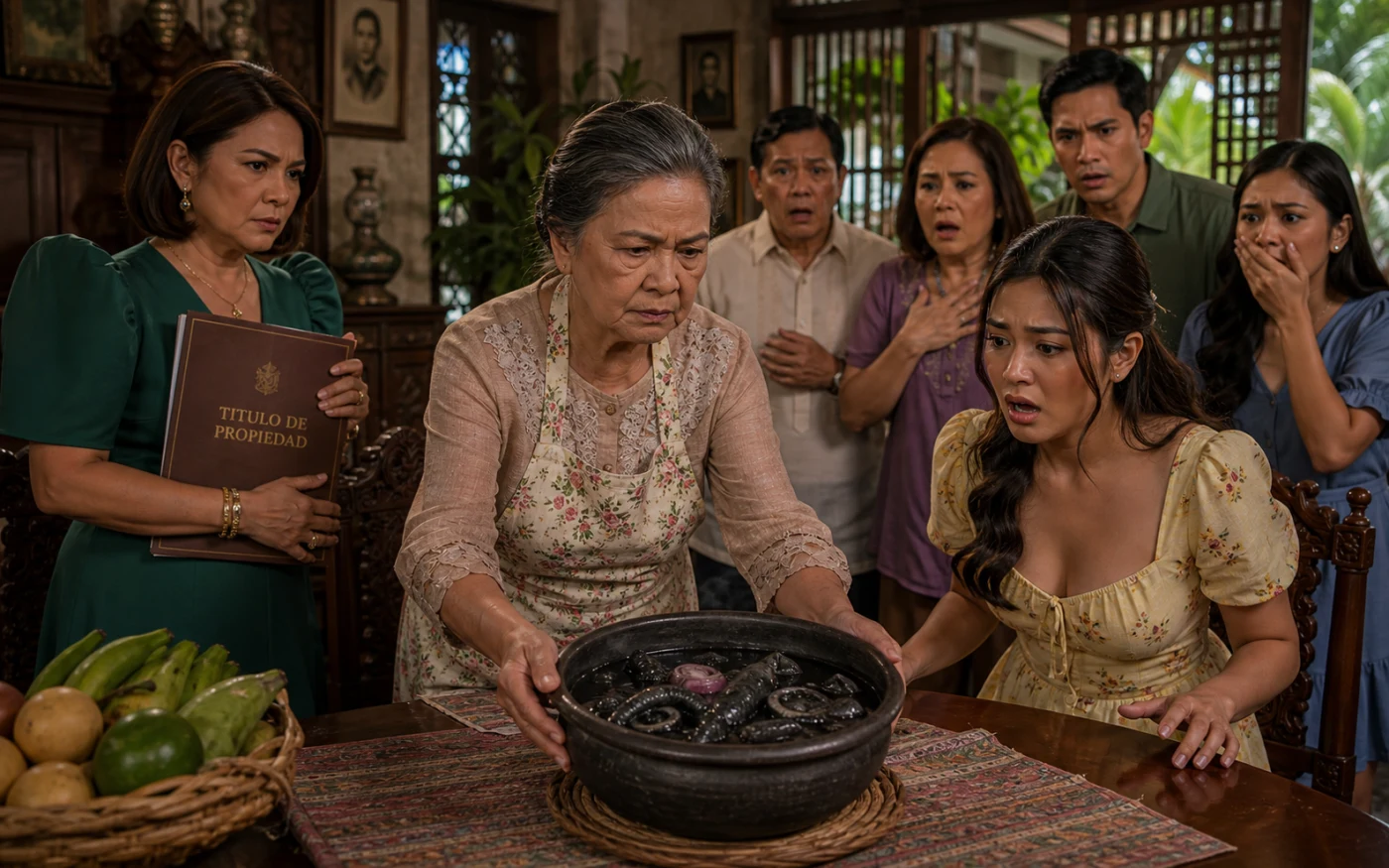
Then Lola came through the kitchen doors with her heavy black clay palayok. Her gray hair was pinned back, her floral apron stained down the front, and there was a dark smudge at the corner of her mouth that I thought was soot.
“Kain,” she said.
Brenda lifted the lid.
Then screamed.
“Diyos ko, Nena!”
The soup was black.
Not adobo black. Not squid-ink fancy black.
Funeral black.
Wilted kangkong floated beside unfamiliar leaves, dark bits of root, and oily swirls that made the whole pot look dredged from a swamp.
Mark pushed his chair backward.
“Lola, bakit mukhang galing sa tambutso?”
Brenda shot to her feet. “Ano ’to? Motor oil? Sinasabi ko sa inyo, hindi na normal ’to!”
“Sit down,” Lola said.
“Nena—”
“Brenda. Umupo ka.”
I had heard Lola angry before. This was different. There was fear underneath it.
She filled seven bowls herself and gripped the ladle.
“Inumin niyo ang sabaw. Lahat.”
Nobody moved.
“Lola,” I whispered, “ano bang nilagay mo dito?”
“Hazel. Trust me.”
Brenda laughed. “Trust you? Para sabay-sabay tayong ma-food poisoning?”
Lola slammed her palm on the table.
“INUMIN NIYO!”
So I drank.
It was intensely sour, violently bitter, smoky and herbal, with something sharp underneath that made my whole mouth pucker. I gagged.
Mark took one spoonful and stared at his bowl with genuine betrayal.
“Ate, my ancestors are rejecting this.”
“Drink,” Lola ordered.
Brenda snatched up her bowl. “Ayan! Kinain ko! Happy? Pag namatay ako, Nena, ikaw ang dahilan!”
Lola stared at her.
“More.”
Within minutes, Brenda’s bowl hit the floor.
Mark bent over and vomited black liquid onto the rug. Pia started crying. My mother stood too fast and fell against the wall. Then my own stomach rolled and the room tilted so badly I could barely stand.
“LASON!” Brenda screamed. “NILASON TAYO NG MATANDA!”
Black soup spread across the white tablecloth like ink while we staggered toward the veranda, vomiting, gasping, and trying to understand why our arms suddenly felt too heavy to lift.
Someone outside began shouting for help. Then came sirens.
The last thing I saw before blacking out was Lola Nena standing over us in her stained apron, watching us suffer without moving an inch.
PART 2: What the Relatives Demanded
When I woke up, fluorescent lights burned my eyes, and the smell of antiseptic filled my lungs.
There was oxygen in my nose and an IV taped to my hand. Mark lay two beds away looking pale green, Pia cried into a plastic basin, and Uncle Hector wore an oxygen mask.
And Tita Brenda was shouting at two police officers.
“Intentional poisoning! Isulat niyo! Seven victims!”
She had somehow acquired a foam neck brace nobody had prescribed and was holding the folder from lunch as though she had personally been appointed prosecutor of the Philippines.
Then I saw Lola.
She was sitting in a wheelchair near the wall.
Handcuffed.
“Lola?”
Brenda spun toward me. “Hazel, don’t defend her. You almost died.”
“Bakit naka-handcuff siya?”
“Because she poisoned us!”
“She ate none of it.”
“Exactly!” Brenda snapped.
At the time, I hated that this was a fair point.
Officer Cruz said they were waiting for the full blood work. Brenda shoved a form toward him.
“Waiting for what? She served black chemicals to her own family. She needs to be transferred tonight.”
That was when I noticed what else was inside Brenda’s folder: a brochure for a care facility in Laguna, a property valuation for Lola’s house, and a printed email from a real estate broker.
“You brought sale papers to lunch?”
Her expression flickered. “I brought options.”
“You were planning this before the soup.”
“We have been sick for weeks!”
“You were planning to move Lola today.”
“I am planning to keep everybody safe. She goes to Laguna, we lock the house, and tomorrow I call the broker.”
Lola finally raised her head.
“No.”
Brenda laughed. “No?”
“My house is not for sale.”
“You nearly killed everybody in it!”
Lola looked around at the hospital beds.
“Then why are they alive?”
That shut all of us up.
She looked exhausted, but confused? No. Not even slightly.
“Lola,” I said. “Please. Ano ’yung sabaw?”
“Nasa apron ko.”
Brenda groaned. “Of course. A clue.”
“And ask them about the paint,” Lola added.
Brenda’s eyes flicked toward her.
“What about the paint?” I asked.
“Nothing,” Brenda said too quickly.
Lola kept looking at me. “Ask who bought it.”
Brenda marched over and yanked Lola’s apron off the wheelchair.
From the big pocket she pulled a folded notebook page, little paper packets tied with string, dried leaves, a dark lump wrapped in cloth, and a tiny brass key.
“Ayan!” Brenda held up the black bundle. “Burnt powder! Wild leaves! She is playing witch doctor in the kitchen!”
Lola’s face went cold.
“My mother was a healer.”
“Oh, wonderful. So attempted murder is traditional medicine?”
“Brenda,” Uncle Hector rasped through his oxygen mask, “shut up.”
Her own husband had finally spoken against her.
Brenda uncapped a pen. “I am signing the transfer.”
“No,” I said.
“Hazel, nalason ang utak mo.”
“And you brought a realtor valuation to Sunday lunch.”
Just then the double doors opened and a doctor strode toward us carrying a red folder of laboratory results.
He looked at Brenda’s pen hovering over the transfer form, then at Lola’s apron spread across the tray.
“Don’t sign that,” he said.
Brenda froze.
Dr. Ramos dropped the folder onto the tray.
“You are accusing the wrong woman.”
PART 3: What the Blood Revealed
Dr. Ramos pulled out a lab sheet.
“Whatever was in that soup is not what made your family sick.”
Nobody spoke.
The doctor explained that our blood had not been carrying oxygen normally when we arrived. That explained the headaches, nausea, dizziness, and dark color around our lips and nails that Lola had noticed first.
“Something you have all been breathing for weeks did this,” he said.
Brenda went very still.
Uncle Hector saw it.
“What did you buy?”
“Nothing dangerous.”
“What did you buy, Brenda?”
She swallowed. “Leftover industrial coating from a warehouse. My friend said it was fine for wood.”
Dr. Ramos stared at her. “You used that inside an occupied house?”
“It was cheaper! And we needed the upstairs finished before—”
She stopped.
Before.
Nobody moved.
“Before what?” I asked.
Her eyes dropped to the real estate folder.
Before the listing photographs.
Before Lola agreed to leave.
Before any of us agreed to sell.
Uncle Hector slowly removed his oxygen mask.
“You were preparing Ma’s house for sale behind her back?”
“I was trying to help this family.”
“You poisoned this family.”
“I did not know!”
“No,” Lola said quietly. “You only knew better than everybody.”
That landed harder than shouting.
Dr. Ramos said the emergency crew had found the leftover coating and strong fumes trapped upstairs with terrible ventilation. Chiquito dying first made sense. So did Lola opening the windows while Brenda closed them.
“That was the poison,” he said.
Brenda pointed desperately at the black packets on the tray.
“Fine! The paint was bad. But what about that? She still gave us that horrible soup and then we all collapsed!”
Dr. Ramos turned to Lola.
“What did you give them?”
“My mother’s emergency recipe.”
“Who was your mother?”
“A healer.”
He pulled up a chair.
“What did she teach you it was for?”
“For bad blood from fumes,” Lola said. “When the lips turn dark and the head becomes heavy.”
“And you took it too?”
“Before lunch.”
I stared at her.
That dark smudge at the corner of her mouth.
“You already drank it?”
“I was sick first. I spend more time in that kitchen than you.”
Dr. Ramos checked Lola’s chart. Then mine. Then the others.
“And then you gave the same remedy to all of them?”
“Yes.”
He looked at the numbers again.
Brenda folded her arms. “Doctor, are you seriously saying that black soup helped them?”
Dr. Ramos looked straight at her.
“I’m saying the soup did not poison them. The fumes did.”
He tapped our first test results.
“And by the time the paramedics brought your family in, every one of them was already beginning to respond. Lola was further along because she took hers first.”
My throat tightened.
“You mean she knew what she was doing?”
“Yes.”
He picked up Lola’s old notebook.
“Your grandmother recognized what was happening, treated herself, then treated the rest of you.”
He looked around at all seven beds.
“And judging by these results, it was working.”
Nobody spoke.
Lola folded her arms.
“My mother was a healer.”
Dr. Ramos looked down at the notebook again.
“I would still like a copy of this.”
“No,” Lola said.
Mark started laughing into his oxygen mask.
Officer Cruz immediately unlocked Lola’s handcuffs.
“Pasensya na po, Lola.”
She rubbed her wrists. “Next time, Officer, ask the old woman one question before decorating her with jewelry.”
Even Dr. Ramos laughed.
Brenda did not.
She stood in the middle of the emergency ward wearing her unnecessary neck brace while Uncle Hector picked up the broker’s email.
He read one line twice.
Ready to list as soon as family confirms vacant possession.
“Vacant?” he asked.
“It is standard language,” Brenda whispered.
“You told them Ma would be gone?”
“I was exploring options.”
Lola stood, took her apron from the tray, and tied it around her waist.
Then she held out her hand to me.
“The key.”
I gave her the little brass key from the pocket.
“That opens my document cabinet,” she told Brenda. “My house papers are there. You will never touch them.”
“Nena—”
“No. Tapos na.”
Then Lola pointed at the property folder.
“Hazel.”
“Yes, Lo?”
“Basura.”
I tore the valuation, the care-home brochure, and the broker’s email straight down the middle.
Brenda gasped like I had ripped actual money.
So I tore them again.
Mark began clapping from his bed.
I dropped the pieces into the red biohazard bin.
Wrong bin? Probably.
Did I care? Absolutely not.
Lola looked at Brenda.
“Uuwi ka sa bahay mo.”
“Nena—”
“Hindi sa bahay ko. Sa bahay mo.”
That was it. No screaming. Just eviction by grammar.
Two weeks later, the upstairs rooms had been stripped back and properly refinished, every window was open to the afternoon breeze, and Brenda was no longer making decorating decisions for anybody.
Lunch returned.
Same table. Same capiz windows. Same black palayok.
When Lola carried it out, everybody went quiet.
Mark leaned toward me. “Should we be concerned?”
Lola gave him one look.
He sat up straight.
She lifted the lid.
Clear golden broth. Tomatoes. Gabi. Kangkong. Tender pork.
Beautiful sinigang.
I filled Lola’s bowl before my own and pushed it toward her.
She raised one eyebrow.
“Bakit ako muna?”
“Trust exercise.”
Her mouth twitched. She tasted the broth while everybody waited.
“Well?” I asked.
Lola took another spoonful.
“Needs salt.”
And for the first Sunday in weeks, our house sounded like home again.