
A Stranger Paid for My Mother's Medicine When We Were Twelve Pesos Short — Thirty Years Later, an Old Woman Walked Into My Clinic and I Finally Understood...
PART 1: Twelve Pesos Short
I was twelve years old when a stranger bought my mother's life for twelve pesos—and then disappeared before I could even learn her name.
Thirty years later, an old woman walked into my clinic, and the secret of that afternoon came walking in with her.
But first, you have to understand what twelve pesos meant to us back then.
It was 1996. My mother, Lorna, washed clothes for three families in our barangay, and I delivered pandesal before school. My father had been gone for years. Every coin in our house already had somewhere to go before it reached our hands.
That afternoon, Mama and I stood inside a tiny pharmacy near the public market. Rain hammered the metal awning. My slippers were soaked, and Mama kept one hand pressed against her chest.
The doctor at the health center had warned her not to miss her heart medicine again.
“It can become dangerous, Aling Lorna,” he had said.
She had nodded as if medicine could be bought with obedience.
At the counter, the pharmacist counted our coins twice.
Then he looked at Mama. “You're short by twelve pesos, po.”
Twelve pesos short.
I can still feel the heat that rushed into my face. There were people waiting behind us. I heard someone sigh. Mama opened her faded coin purse and searched every corner, although we both knew it was empty.
I checked my pockets.
Two marbles. A rubber band. Nothing else.
“Can we take fewer tablets?” Mama asked quietly.
The pharmacist shook his head. “It only comes by the full box, po.”
Mama looked at the medicine, then at the rain outside.
“Sige,” she whispered. “Return it.”
I grabbed her wrist. “Ma, the doctor said you need it.”
“We still need rice, anak.”
“I won't eat.”
She smiled at me, and that smile nearly broke me. “Kakain ka.”
The pharmacist began pulling the box back.
That was when a woman's hand appeared between us and placed a twenty-peso bill on the counter.
“Add it,” she said.
She was perhaps in her fifties, with silver beginning at her temples. Her dress was plain blue, damp at the shoulders. She carried a woven bayong full of vegetables, and there was mud on one sandal.
Mama immediately shook her head. “Naku, hindi po. Salamat, pero—”
“Gamot iyan. Hindi luho.”
The pharmacist took the bill and handed Mama the box.
I stared at the stranger. I wanted to thank her, but shame had closed my throat.
Mama took her name and address—or tried to.
“I'll pay you back, po,” Mama insisted. “Next week.”
The woman laughed softly, not because anything was funny, but because Mama was already searching her purse for a pencil she did not have.
“Huwag na,” she said.
Then she looked directly at me.
“Ikaw, iho. What's your name?”
“Danilo po.”
“Danilo, uwi na kayo. Take care of your mama.”
“Opo.”
Then she took her change, tucked it into her bayong, and stepped into the rain.
I ran after her.
Outside, jeepneys crowded the road. Umbrellas moved through the market like dark flowers. I saw her blue dress once near the fish stalls.
Then a truck passed.
She was gone.
Mama took the medicine that night. And the next night. She lived long enough to see me finish high school, then college, then medical school.
People like to say I became a doctor because I was intelligent.
The truth is simpler.
I became a doctor because, at twelve years old, I watched my mother place her life back on a pharmacy counter over twelve pesos.
And I watched a stranger refuse to let her.
I studied under a leaking roof. I borrowed textbooks. Mama sold puto before sunrise and pretended not to be tired. When I wanted to quit, she would tap the medicine box she had kept all those years.
“Remember her, anak,” she would say.
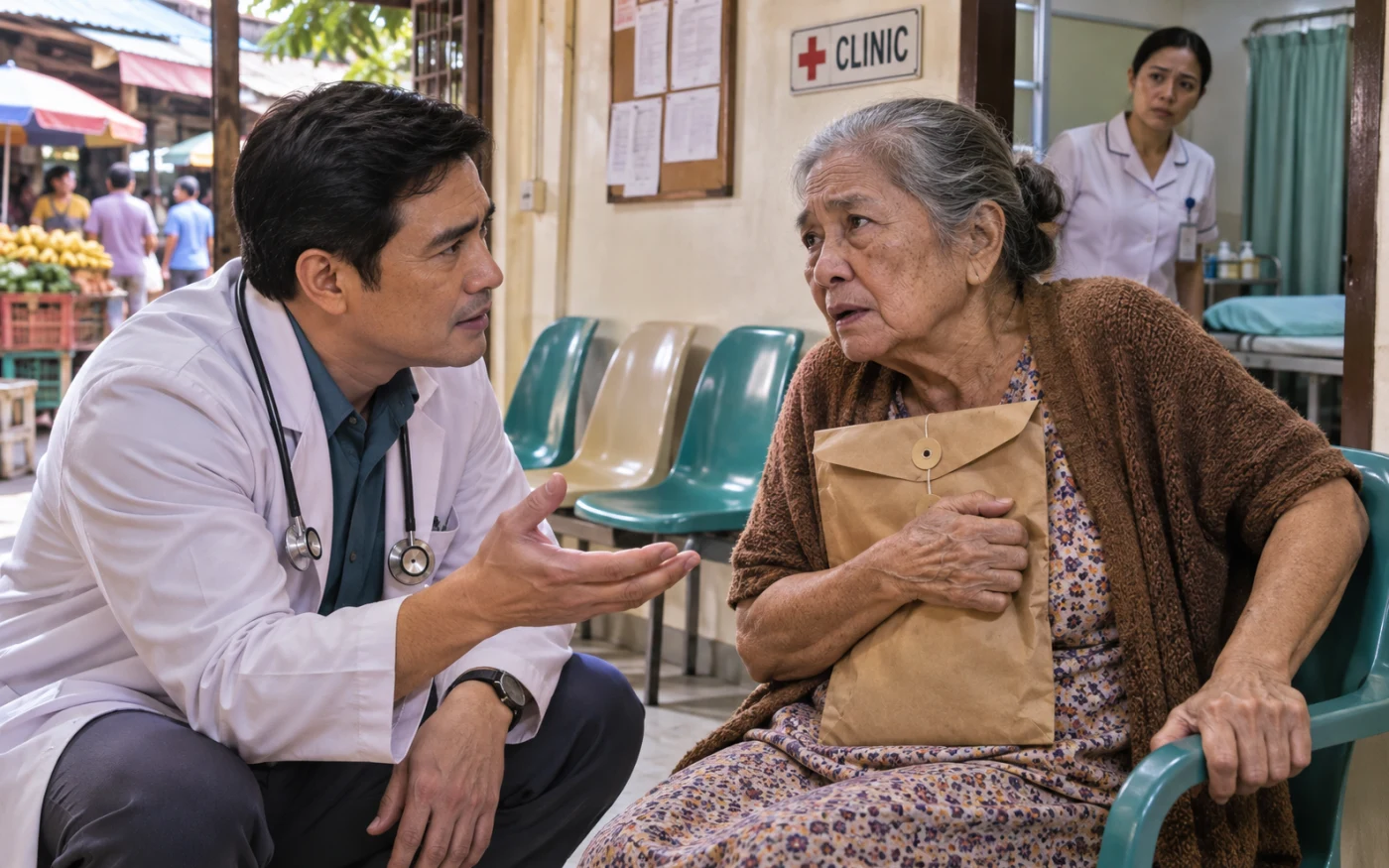
After residency in Manila, I returned home and opened a small clinic beside the same public market. The paint peeled every rainy season. Our waiting room had eight plastic chairs, only six of them matching.
My nurse, Maribel, kept a biscuit tin beneath the front desk.
Patients who could pay placed money inside. Patients who could not took what they needed for medicine, laboratory fees, or fare home.
On the lid, I had written three words: PARA SA SUSUNOD.
For years, I tried to make sure nobody at my counter felt as helpless as Mama had that day.
Then, one Tuesday morning, Maribel pushed open my office door and whispered, “Doc, there's an old woman outside. She can barely breathe, pero ayaw magpatingin.”
“Why?”
Maribel glanced toward the waiting room.
“She says she can't afford the consultation.”
PART 2: Why She Came Alone
Her name was Rosario de la Cruz, seventy-eight years old, with swollen ankles and lips turning pale.
She sat rigidly in the last plastic chair, clutching a brown envelope against her chest.
“Aling Rosario,” I said, crouching before her. “Come inside.”
She shook her head. “Tanong lang sana, Doc. How much?”
“We can discuss that later.”
“No. Sabihin mo muna.”
Her breathing rattled. Every doctor learns to recognize the moment when politeness becomes dangerous.
“Maribel, wheelchair.”
Rosario gripped the chair. “Ayoko. I can't afford this.”
For one strange second, I was back in that pharmacy, wet and ashamed, while my mother surrendered her medicine.
“We'll take care of it,” I told her.
She glared at me. “Huwag mo akong kaawaan.”
“Hindi awa. Clinic rule.”
Maribel looked at me because this was not technically a clinic rule.
I looked back at her.
“New rule,” I said.
We brought Rosario into the examination room. Her blood pressure was dangerously high. Fluid had gathered in her lungs, and her heart was struggling.
I gave her emergency medicine, called the district hospital, and arranged an ambulance.
When I told her she needed admission, she tried to sit up.
“Hindi puwede. My grandson will come home from school. Walang susi.”
“Where are his parents?”
Her eyes dropped to the brown envelope.
“My daughter died last year. His father left before that.”
Inside the envelope were school notices, an unpaid electric bill, and a pawn ticket for a small gold ring. Rosario had walked nearly two kilometers to our clinic because she had spent her last fare money buying rice for her grandson.
She had come alone because there was nobody else to come with her.
Maribel found the boy's teacher and arranged for a neighbor to take him home. I rode in the ambulance with Rosario because she still looked ready to escape.
At the hospital, she kept asking the cost of every needle.
“How much is the oxygen?”
“And every test?”
“Doc, tama na. Nakakahiya.”
Finally, I pulled a chair beside her bed.
“Do you want to know why my clinic has that biscuit tin?” I asked.
“What biscuit tin?”
“The one you pretended not to see because you didn't want help.”
She frowned at me, but she stopped tugging at the oxygen tube.
So I told her.
I told her about Mama's heart medicine. The crowded pharmacy. The twelve missing pesos. The woman in the blue dress who had stepped out of line.
I told her about the promise.
“I never found her,” I said. “Maybe she forgot us the next day. But I didn't forget. The way she helped Mama without making us feel small stayed with me.”
Rosario had gone completely still.
Then she asked, “What year?”
“Nineteen ninety-six.”
“Which pharmacy?”
I told her.
Her hand flew to her mouth.
“What did she look like?”
“Medium height. Blue dress. Gray in her hair. She carried a bayong.”
Rosario began to cry.
Not quietly. Her whole chest shook beneath the hospital blanket.
I thought the strain was hurting her heart, so I reached for the call button.
She caught my hand.
“Sandali,” she gasped. “The woman—did she have a scar here?”
She touched the edge of her left eyebrow.
My breath stopped.
I had forgotten that scar for thirty years.
But the moment she touched her brow, I saw it.
A small white line, bright against rain-dark skin.
“Yes,” I whispered.
Rosario squeezed my fingers.
“Doc,” she said, “that woman was my mother.”
PART 3: What Was in the Envelope
Her name was Pilar Villanueva.
The name struck me harder than I expected. For thirty years, the stranger had lived in my mind without one.
Now she had a name.
Pilar.
Rosario wiped her eyes with the corner of the blanket.
“Mama went to that market every Tuesday,” she said. “Blue was her favorite. And that scar—she got it falling from a mango tree when she was nine.”
I laughed once through my tears. “She never let me repay her.”
“Ganyan siya.”
Rosario opened the brown envelope again. Beneath the bills and school papers was an old photograph.
In it, two young women stood beside a wooden table covered with bananas and eggplants. One was Rosario. The other was the stranger from the pharmacy, younger but unmistakable, with that small scar beside her eyebrow.
I touched the edge of the picture.
“That's her.”
Rosario closed her eyes.
For a moment, neither of us spoke.
Then she told me Pilar had died eleven years earlier.
“She did small things,” Rosario said. “Never grand. She carried groceries for an old neighbor. Shared food with street children. Paid jeepney fare when somebody had no coins. Ganoon lang siya. If she could help, she did.”
“Did she ever mention us?”
Rosario shook her head.
The answer hurt, but only for a second.
Of course Pilar had not mentioned us. To me, that afternoon had changed everything. To her, it had been Tuesday.
Before Rosario left the hospital four days later, I returned the photograph.
She pushed it back toward me.
“Keep it.”
“I can't take your mother's picture.”
“I have others. You waited thirty years.”
I placed Pilar's photograph inside my wallet.
Rosario recovered slowly. Each week, she came to my clinic for a checkup, usually with her grandson, Paolo. Each week, she argued about the bill.
“You cannot keep refusing my money,” she complained.
“Clinic rule.”
“Bad rule.”
“Ako ang doctor.”
“And I'm older.”
One Friday afternoon, six weeks after we met, Rosario arrived without an appointment. She wore a clean yellow blouse and came with Paolo beside her.
The waiting room was full, but she did not sit down.
Instead, she walked straight to the biscuit tin beneath Maribel's desk.
“Nay Rosario, what are you doing?” I asked.
“Sandali lang, Doc.”
She opened her coin purse and counted onto her palm.
Twelve pesos.
Then she lifted the lid marked PARA SA SUSUNOD and dropped the coins inside.
“For the next person,” she said.
The coins struck the tin softly.
I looked at Pilar's photograph, which I had framed and placed on the wall above it.
Rosario followed my eyes.
“Now you know her name,” she said.
I nodded.
“And I know what one small kindness became.”
For thirty years, I had remembered a blue dress, a woven bayong, and a hand reaching across a pharmacy counter.
Now I knew Pilar.
She had given Mama twelve pesos and let us leave with our dignity.
I had carried both with me ever since.
Rosario took Paolo's hand and headed for the door.
Before she left, she touched two fingers to her mother's photograph.
Then she smiled at me.
“Para sa susunod, Doc.”
The twelve pesos stayed in the tin, waiting for whoever came next.