
My Wife Wrote Birthday Letters for Our Daughter Before She Died. This Year an Envelope Appeared in the Box That I Did Not Put There.
PART 1: The Lie in the Box
Three weeks before my daughter turned fourteen, I opened a box of letters from my dead wife—and found one addressed to me that I had never seen before.
I almost dropped it.
But before I tell you why, I need to confess the ugly thing first.
For two years, I had been forging my dead wife’s handwriting.
My name is Miguel Navarro. I install air conditioners around Vallejo, and I can tell you exactly when a compressor is about to die by the sound it makes.
But when my wife, Nerissa, was dying, I couldn’t tell when hope had stopped being hope and become pretending.
Our daughter Dani was five then.
During Neri’s last months, she wrote birthday letters for her.
She used cream stationery, blue gel pens, and a shoebox from Rite Aid that still had a faded price sticker underneath.
Each envelope had a number on it in Neri’s beautiful handwriting.
Six. Seven. Eight.
Up to eleven.
At every family reunion, someone told the story.
“Grabe, Miguel,” my sister Julie would say, pressing a hand to her chest. “Neri thought of everything.”
I always smiled. “Oo. Gano’n talaga siya.”
But Neri had not thought of everything.
She had been exhausted, in pain, and trying to fit a lifetime into afternoons when she could barely hold a pen.
The box had a bottom.
I found it after Dani’s ninth birthday, when I lifted the remaining envelopes and saw only two.
I sat on our closet floor until my legs went numb.
Two years later, on Dani’s eleventh birthday, she read the last real letter at the kitchen table.
Neri told her not to pluck her eyebrows too thin and reminded her that courage didn’t always feel brave.
Dani laughed, then cried into my shirt.
That night, after she slept, I took out tracing paper.
For six months I practiced Neri’s sharp little r’s, her ridiculous loopy g’s, and the way she pressed harder on the last word of every sentence.
I bought the same blue pens online.
I copied old grocery lists until “eggs” looked like she had written it.
On Dani’s twelfth birthday, I handed her my first lie.
She opened it beside a plate of ube pancakes.
“Dad,” she whispered, touching the page. “Parang nandito si Mom.”
Then she hugged me so tightly I could feel her tears through my shirt.
“Happy birthday, anak,” I said.
I told myself it was kindness. I told myself grief was already cruel enough. I told myself I would stop next year.
Then thirteen came, and I did it again.
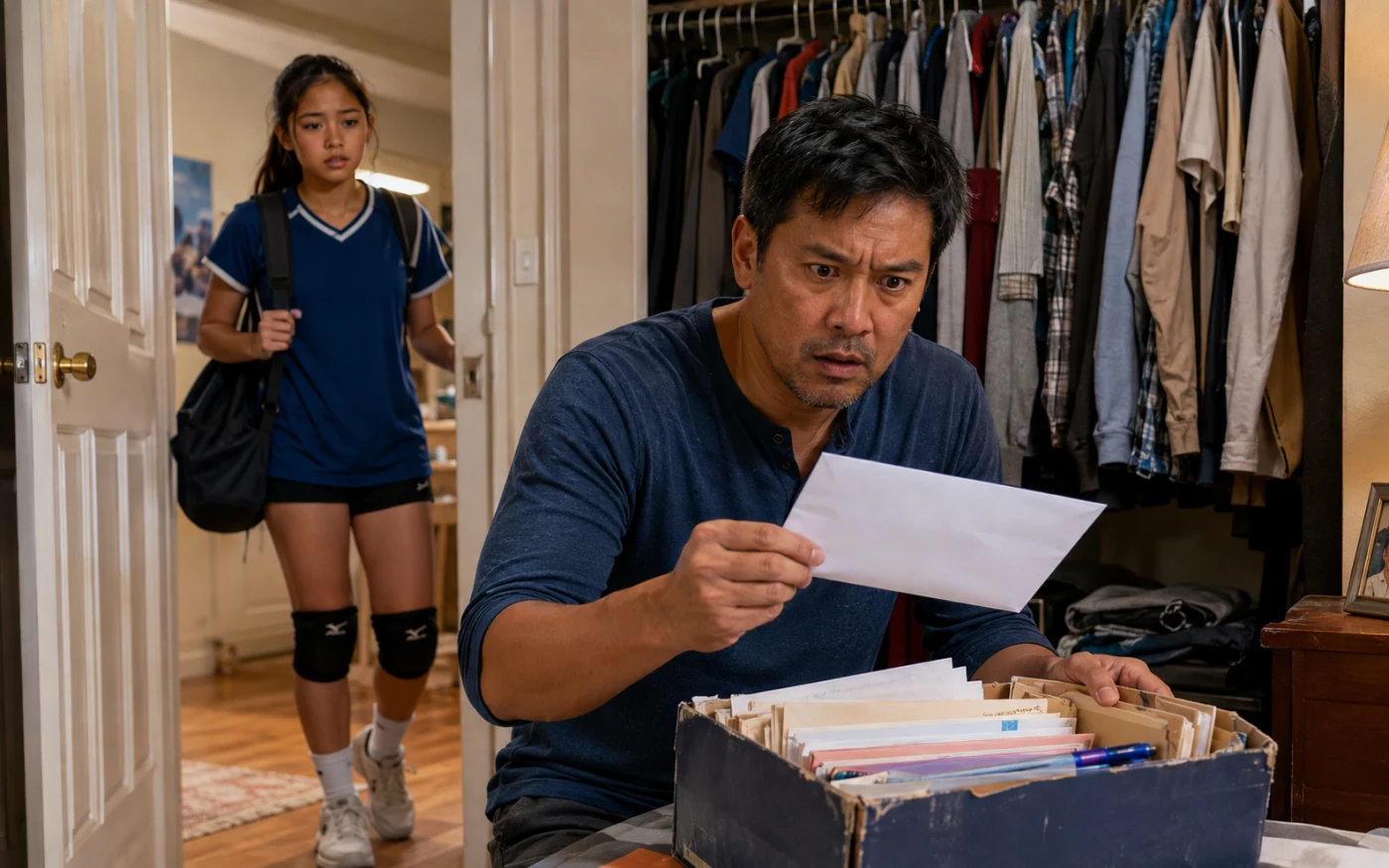
So there I was one month ago, home late from a rooftop job, kneeling in the closet to begin the letter for fourteen.
Dani was at volleyball practice. The house smelled like the sinigang my mother had dropped off and the menthol ointment she put on everything.
I reached behind Neri’s old winter coat and pulled down the Rite Aid box.
The lid felt wrong.
Something inside slid.
I opened it.
There was one envelope resting on top of my pens and practice pages.
Not cream like the birthday letters. White.
On the front, in the handwriting I had studied until I dreamed in it, was one word:
Miguel.
I heard the front door unlock.
“Dad?” Dani called. “Nandito ka?”
And before I could hide the envelope, her footsteps stopped directly behind me.
PART 2: Who Wrote My Name
For a few seconds, neither of us moved.
Dani was still wearing her knee pads. Her ponytail had fallen sideways, and one shoelace was untied. She looked from the box to the envelope in my hand.
Then she said, “You found it.”
My fear changed shape.
“Ikaw ang gumawa nito?”
She nodded.
I should have felt relieved.
Instead, I felt exposed, as if she had opened a door I had kept locked for years.
“Why are you copying your mother’s handwriting?” I asked.
Her face hardened. “Seriously, Dad?”
I looked down at the box.
The practice pages were gone.
“How long?” I asked.
“Since I was eleven.”
The closet seemed to tilt.
“Hindi. That’s impossible.”
“You left the worksheets under the printer.” She crossed her arms. “You wrote ‘Happy birthday, my brave girl’ like twenty times. Medyo obvious.”
I sat on the floor.
Three years.
For three years, she had known.
“Why didn’t you say anything?”
She slid down against the opposite wall, our knees almost touching between hanging clothes.
“Because you looked scared every birthday.” Her voice softened. “And because the letters were good.”
That hurt more than anger would have.
“Dani, I’m sorry. Sobrang sorry.”
“I know.”
“I shouldn’t have lied.”
“I know.”
“Your mom wrote six letters. I gave you two fake ones. I kept thinking, one more year lang. Then I’d tell you.”
“I know, Dad.”
“Stop saying you know.”
“Then stop explaining everything I know.”
That was so exactly Neri that I laughed once, a broken sound I didn’t mean to make.
Dani’s mouth twitched.
I held up the white envelope. “You learned all this just to scare ten years off my life?”
“Hindi naman.” She picked at the loose tape on the box. “I wrote because Mom left six letters for me and zero for you.”
I stared at her.
“Zero,” she repeated. “Wala kahit isa.”
“She didn’t have time.”
“Exactly. So I thought somebody should.”
My daughter had copied her mother’s handwriting for the same reason I had: because love had left a blank space, and we were both ridiculous enough to believe ink could fill it.
I opened the envelope.
Inside was one sheet of notebook paper.
Miguel,
You need to stop making Mom sound perfect. She was funny and impatient and she hated when you chewed ice. You always write that she’s proud of me. I think she is. But I think she’d also tell you she’s proud of you.
You learned her handwriting for me. So I learned it for you.
Love, Dani
P.S. Your g’s are better. My r’s win.
I pressed the page against my mouth.
“Dad?”
“Sandali lang.”
“Are you crying?”
“No.”
“You’re doing the face.”
“Anong face?”
“The ugly one.”
I laughed into the letter, and then I was crying for real. Dani moved across the small space and put her arms around my shoulders.
For years, I had imagined the day she discovered my lie. In every version, she screamed. She threw the box away. She told me I had stolen her mother’s voice.
Instead, she had spent weeks learning the loops of an old alphabet just to give something back to me.
When I could speak again, I said, “Your r’s are terrible.”
“Sinungaling ka talaga.”
She pulled away and wiped her cheeks with the heel of her hand. Then her expression changed.
“There’s something else.”
“What?”
She reached into the deep pocket of Neri’s winter coat—the gray one I had refused to donate, even after Julie said moths would eat it.
From inside, she took out a second envelope.
This one was cream.
The edges were bent. There was no name, no age, no date. But I knew the handwriting before she placed it in my hands.
This time, neither of us had copied it.
PART 3: What Her Last Letter Said
“Where did you get this?” I whispered.
“That pocket. Two weeks ago.” Dani hugged her knees. “I was looking for one of Mom’s scarves for my birthday picture.”
“You waited two weeks?”
“Hindi ko alam.” She stared at the envelope. “What if it was private? What if it was goodbye? Baka hindi ko dapat nakita.”
My hands began to shake.
The flap had never been sealed.
Inside was a single unfinished page. The first line made me sit back against the closet wall.
Miguel,
You will run out.
You will get to eleven or twelve and you will run out, and then you will do something ridiculous, because you cannot leave a thing unfinished. It is your worst quality and I married it.
Write them yourself.
Make her laugh. Tell her the truth when you’re ready. And do not let me become a saint in that box. Tell her I threw the remote at you during Survivor and it left a mark on the wall by the switch.
The final sentence stopped halfway across the page.
I read it twice. Then a third time.
Dani leaned over. “She knew?”
I started laughing. Not a polite laugh. Not a brave one. The kind that takes over your whole body until grief has to loosen its grip just to make room.
“She knew,” I said.
“You’re so predictable.”
“Apparently.”
“Wait.” Dani grabbed my arm. “Mom threw a remote at you?”
I looked toward the hallway.
“Halika.”
We went to the living room.
Near the light switch was a small crescent-shaped dent, painted over once but never filled. I had stopped seeing it years ago.
Dani touched it with one finger. “Mom did that?”
It wasn’t the question of a child hearing a cute story. Her eyes were wide, almost delighted, like a young woman meeting her mother for the first time—not Saint Nerissa of the Birthday Box, but Neri, who yelled at reality shows and had terrible aim.
“Your mom thought I changed the channel,” I said.
“Did you?”
“Hindi importante.”
“You did!”
“The remote slipped.”
“From her hand?”
“Very fast.”
Dani laughed so hard she had to lean against the wall.
That Saturday, her fourteenth birthday arrived.
I made ube pancakes, burned the first batch, and placed the Rite Aid box on the kitchen table. Dani sat across from me in pajamas, her hair piled on top of her head.
There was no forged envelope inside.
Instead, I set down three blank sheets, two blue pens, and Neri’s unfinished letter between us.
“So,” I said, “what would your mother tell you at fourteen?”
Dani picked up a pen. “That I can date when I’m thirty.”
“Good. Write that.”
“Dad.”
“Twenty-eight?”
“She’d tell me not to listen to you.”
“Your mother loved listening to me.”
Dani pointed toward the dent by the switch.
“Fine,” I said. “She had mixed feelings.”
We wrote the letter together.
We argued over every other sentence.
Dani said Neri would never call her “hon.” I said Neri called everybody “hon,” including telemarketers she was about to insult.
Dani wanted to include advice about volleyball. I told her Neri couldn’t serve a ball over a laundry basket.
“That’s mean,” Dani said.
“Your mom said no saints.”
So we wrote about courage. We wrote about eyebrows. We wrote that grief could sit at the table, but it did not get the last pancake.
Then Dani added, Your dad is trying his best, kahit makulit siya.
I pretended not to see her wipe her eyes.
At the bottom, we signed in two different handwritings.
Love, Mom and Dad.
The first honest letter that box had held in three years.
Dani read it aloud. When she reached the end, she didn’t cry the way she had at twelve.
She stood, came around the table, and wrapped both arms around me.
“Next year,” she said against my shoulder, “we make it funnier.”
“Next year, we start earlier.”
“You’ll wait until midnight.”
“Mana ka sa akin.”
She pulled back. “Fifteen through eighteen. Today.”
So we cleared the breakfast plates and kept writing.
Four envelopes spread across the table, full of crossed-out words, bad jokes, and arguments over what Neri would say.
By afternoon, the shoebox was full again.
Before Dani carried it back to the closet, she stopped beside the light switch and touched the little crescent in the wall.
“We’re never painting this, okay?”
I handed her the box.
“Never, anak.”