
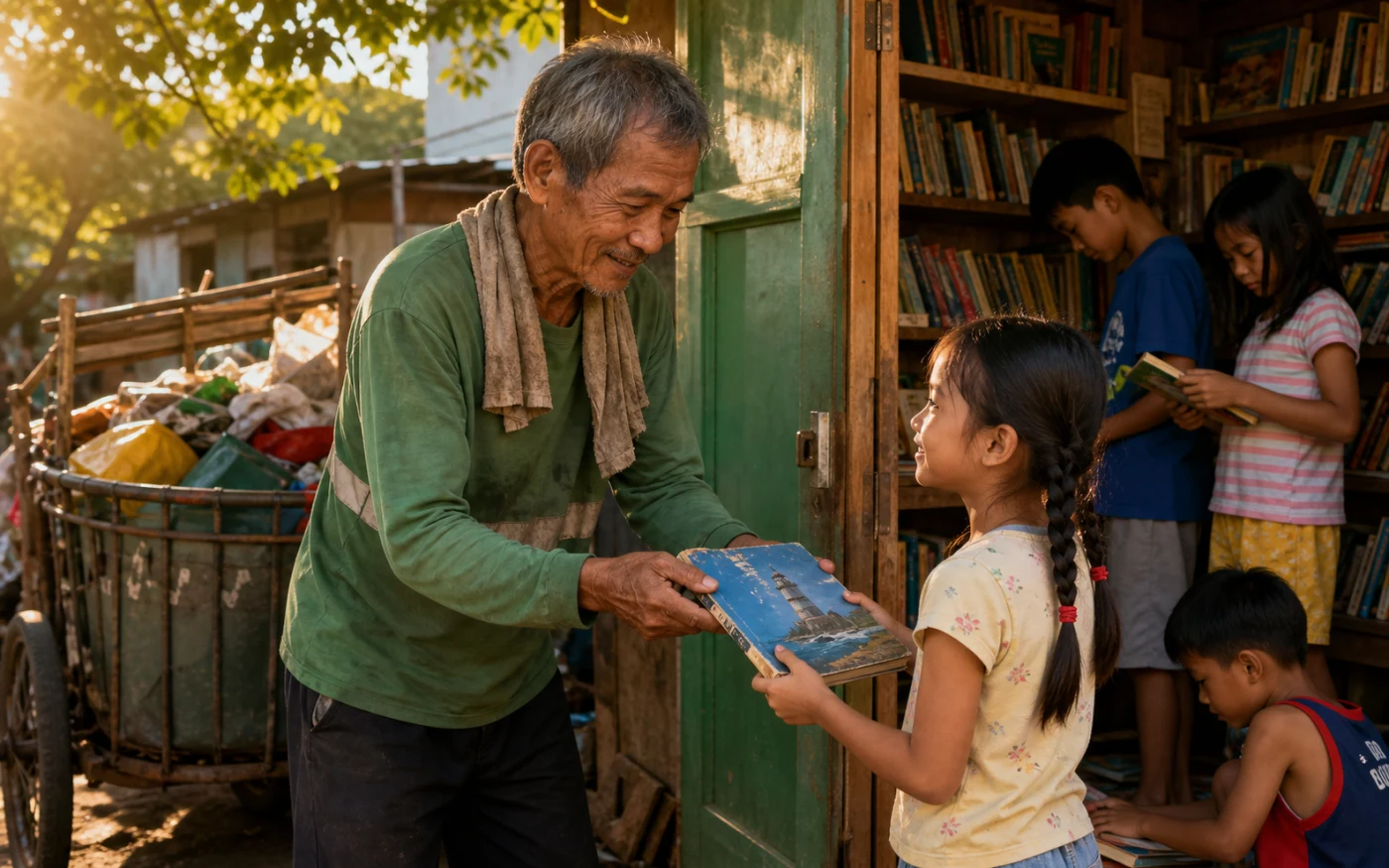
For Thirty-One Years I Pulled Books Out of the Garbage and Gave Them to the Children of Our Barangay — Last Month, One of Those Children Came Back and Discovered My Secret...
PART 1: The Woman at My Gate
The woman crying outside my gate knew that I had given away ten thousand books, but she did not know I could not read a single one of them.
My name is Faustino Mendoza. Everyone in Barangay San Roque calls me Mang Tino. I am sixty-four years old, and for thirty-one years I have collected other people's garbage before sunrise.
Six days a week, I pushed my cart through streets that still smelled of last night's rain, calling softly, “Basura po,” so I would not wake the babies.
People left me rice gone sour, broken chairs, empty bottles, fish bones wrapped in old newspapers. Sometimes they handed me their bags without looking at my face.
I never minded the work. It was honest work. My hands fed my wife, Belen, and our two sons until they had families of their own.
But books were different.
The first one was lying on top of a garbage bag outside a large house on Mabini Street in 1994. It had a torn blue cover and a picture of a small boat beneath a yellow moon.
Coffee grounds had spilled across one corner.
I wiped it against my shirt. I told myself I would put it back down after I looked at the pictures.
Instead, I hid it under the seat of my cart.
“Ano 'yan?” Belen asked when I brought it home.
“Sayang,” I said. “A child might want it.”
She stared at the book, then at our leaking roof.
“A child might want dry socks too.”
Still, she cleaned the cover with a damp cloth and left it beside our window.
By Christmas, I had eleven books.
By the end of the decade, I had so many that Belen could no longer reach the sewing machine. She stood in our room with both hands on her hips and said, “Tino, either I sleep outside or the books do.”
So I built a shed from scrap plywood behind our house.
The roof was old galvanized metal. The shelves came from a bakery that had closed. I painted the door green because that was the only paint someone had thrown away.
Then I told the children on our street, “Libre ang libro. Take one, take five, keep them if you love them. But you must come back and tell me what happened.”
That was my only price.
Come back and tell me.
At first, only little Michelle de Vera came. She was nine, with two braids tied by red rubber bands. Her mother, Aling Mercy, sold banana cue at the corner.
Michelle chose a thick book with a girl standing beside a lighthouse.
“Maganda ba?” she asked.
I looked at the waves painted on the cover and said, “You tell me.”
Three days later, she returned breathless.
“Mang Tino, the light went out during the storm!”
I stopped sorting bottles.
“Then what happened?”
She sat on an upturned crate and told me everything. Her eyes grew wide. Her hands became the waves, the rain, the little girl climbing the tower.
When she finished, I said, “Ang galing. Again. Slower this time.”
Soon she brought friends.
Every afternoon, children filled my little shed. They sat on the floor with their legs stretched between towers of books. They argued over picture books, mysteries, school atlases, and stories about faraway places.
“Mang Tino, listen to this part po.”
I always listened.
When they asked what a word meant, I would call to an older child. When they asked which book they should choose, I would put three in their hands and say, “The book will know.”
They thought I was being wise.
The truth was burning inside my chest.
My father died when I was seven. After that, I worked wherever someone would pay a small boy—at the market, beside jeepneys, carrying sacks heavier than my body.
I never returned to school.
I knew numbers. I could sign Faustino Mendoza carefully on a form. I knew each street in San Roque even in darkness.
But the words inside my rescued books were closed doors.
I sorted the books by their pictures, size, weight, and smell. I remembered where I had found each one. I knew which stories were beloved because children came back clutching them to their chests.
Not one child ever asked me to prove I could read.
Thirty-one years passed.
The first shed became two sheds. The children became nurses, mechanics, vendors, mothers, seafarers, teachers. New children arrived and sat in the same places.
Then, last month, someone knocked on my gate at three in the afternoon.
A woman stood there in polished shoes and a cream blouse, holding a brown paper bag. She was already crying.
“Mang Tino,” she said. “Ako si Michelle.”
I saw the nine-year-old at once.
“Michelle with the two braids,” I said. “Naku. You got tall.”
She laughed through her tears and pressed my hand to her forehead.
“I teach high school English now,” she said. “I came home because Mama told me you still have the library. I brought something for you.”
I smiled, nodded, and looked away from the paper bag.
That was what I always did when someone handed me anything with words.
Michelle reached inside and held up one of the books. “I thought you might like this one.”
I looked at the picture on the cover. “Looks interesting.”
Her smile disappeared.
She looked at me the way a teacher looks at a student who has hidden an empty test paper.
Then she asked the question I had escaped for thirty-one years.
“Mang Tino po, what was the last book you read?”
PART 2: What Had I Hidden
For one foolish second, I considered naming the book about the lighthouse.
I knew it better than any other. Michelle had told it to me so many times that I could see the storm, the black water, and the girl racing up the tower stairs.
But Michelle was standing at my gate as a teacher now.
I could not lie to that little girl with two braids.
“Hija,” I said, “I don't know how to read.”
The paper bag slipped from her hand.
Three new books fell onto the ground.
She did not pick them up. She only stared at me.
“Hindi maaari,” she whispered.
“I know my name. Numbers too.” I tried to smile. “Useful things.”
“But all those books—”
“I never read them.”
“You told us which shelves.”
“I remembered the covers.”
“You knew which stories we loved.”
“Because you came back.”
Her face changed then. The shock became something softer and more painful.
“That was why,” she said. “That was why you always made us tell you.”
I bent down and placed the fallen books back inside the bag.
“You children were my books,” I said. “Kayo ang nagbasa. I only listened.”
Michelle covered her mouth.
Then she began to cry so hard that Belen came running from the kitchen with a wooden spoon raised like a weapon.
“Ano'ng ginawa mo?” Belen demanded of me.
“Nothing!”
Michelle hugged her.
“Aling Belen, did you know?”
Belen looked at me. In thirty-eight years of marriage, she had never spoken of my secret to anyone.
“Of course,” she said. “I married him, not his report card.”
Then she wiped Michelle's face with the bottom of her apron and fed her pancit until she could speak again.
At the table, Michelle asked me why I had never tried to learn.
I wanted to say I was too busy. I wanted to say my eyes were weak, my hands were tired, and an old man did not need children's lessons.
The honest answer was smaller.
“Nahihiya ako.”
Michelle reached across the table.
“You were never ashamed to pick our books out of garbage.”
“That was different.”
“You washed coffee and ulam off them. You dried pages one by one. You built shelves.” Her voice shook. “You saved the book that made me a teacher.”
I looked down at my thick, scarred fingers.
“What if I cannot do it?”
She squeezed my hand.
“Then you come back and tell me what happened.”
The next Saturday, she arrived at seven in the morning with a lined notebook, two pencils, and the serious expression she used on naughty students.
I made coffee. Belen made enough pandesal for a fiesta, though there were only three of us.
My first lesson lasted twenty minutes.
I hated every minute.
The letters moved. Some looked almost the same. My hand cramped around the pencil, and the page showed the trembling work of a child.
“Again,” Michelle said gently.
“My garbage route is easier.”
“Again, Mang Tino.”
Belen stood behind her, mouthing, “Again.”
So I tried again.
On the third Saturday, I read the label on a can of condensed milk in our kitchen.
Belen made a sound as if I had returned from the dead.
She took the can from me, kissed it, then kissed me.
“Read the sardines,” she ordered.
“Bukas na.”
“Now.”
Michelle laughed into her notebook while I struggled through every letter.
Word spread without my knowing. Children began leaving notes on the shed door. I could not read most of them yet, but Michelle saved them in a box.
One said, “You waited for us. We can wait for you.”
Another said, “Go, Mang Tino!” with three crooked stars.
I was furious when I learned Michelle had told people.
“My secret is now barangay news?” I asked.
“I told no one,” she said. “One child saw us practicing through the window.”
Of course. In San Roque, a curtain moving can become a witness.
The following Saturday, Michelle came without her notebook.
She carried one old book against her chest.
Its cover was torn. A girl stood beside a lighthouse beneath a gray sky.
“You kept it?” I asked.
“For twenty-six years.”
She placed it in my hands.
My thumbs knew the worn edges. I remembered finding it beneath a sack of wilted vegetables. I remembered Michelle racing back to tell me about the storm.
“I can't read this yet,” I said.
“Not alone,” she answered.
Then she opened to the first page and pointed at the first line.
“Ikaw naman, Mang Tino.”
PART 3: Who Came to Listen
It took me four Saturdays to read that book.
Not four Saturdays to finish it.
Four Saturdays to reach the last page.
Michelle sat beside me on the shed floor. When I stumbled, she waited. When I guessed a word from the picture, she tapped the letters and made me face them.
Sometimes Belen listened from the doorway while pretending to dust shelves.
The old story was exactly as Michelle had told it. A girl lived with her father in a lighthouse. One terrible night, he was injured, the lamp went dark, and she climbed through the storm to light it herself.
I had carried that story in my heart for twenty-six years without ever seeing its words.
On the last Saturday, I had only five pages left.
I arrived from my route, washed carefully, combed my hair, and put on the blue collared shirt Belen saved for Mass.
“Why are you dressed like the mayor?” she asked.
“Today I finish.”
But when I opened the shed, there was no room to step inside.
Eleven children sat on the floor with their feet stretched in front of them.
Behind them stood their parents.
Behind the parents were adults I had not seen in years.
There was Noli, who used to hide comic books inside his shirt. Liza, who had read aloud while her little brother slept on her lap. Benjie, home from a ship in Singapore. Aling Mercy leaned on Michelle's arm, crying before anything had even happened.
They crowded the doorway and spilled into our yard.
Each person held a book.
“Ano ito?” I asked.
Michelle touched the lighthouse book in my hands.
“You listened to all of us,” she said. “Kami naman.”
My knees became weak.
I sat in my usual place on an upturned crate. The smallest children gathered close. Belen stood behind me with both hands on my shoulders.
I opened to the page where I had stopped.
The first sentence was long.
Halfway through, I lost the word.
Silence filled the shed. Not impatient silence. Waiting silence.
I heard a tricycle pass outside. I heard someone sniff. I heard the old roof ticking under the sun.
Then a little boy named Carlo whispered, “Kaya mo 'yan, Mang Tino.”
I looked at the word again.
I sounded out the first piece, then the next.
The word opened.
I kept going.
Page by page, the storm grew. The lighthouse girl climbed higher. My voice shook when the wind struck her, and the children leaned toward me as if they could hold her on the stairs.
When she finally reached the lamp, I had to stop because I could no longer see the letters.
Michelle wiped my eyes with the same red handkerchief she used to tie around one braid when she was nine.
“Last page,” she whispered.
I read it slowly.
The girl lit the great lamp. Far out on the black water, the ships saw the beam and turned safely toward home.
Then I read the final sentence.
For a heartbeat, nobody moved.
I closed the book.
The shed exploded with applause.
Children shouted. Grown men wiped their faces. Aling Mercy kissed my forehead. Belen pushed through everyone, held my face in both hands, and said, “Marunong ka na, Tino.”
Michelle knelt in front of me.
“Mang Tino,” she said, “tell us what happened.”
I looked at the torn blue book, at the rescued shelves, and at all the children who had come home carrying stories.
“The light came back,” I said.
Carlo climbed into my lap and opened another book.
“Again,” he said. “Slower this time.”