
I Dug Up a Karaoke Machine Under My Late Mother’s Mango Tree. The Woman on the Last Recording Sang Exactly Like Me.
PART 1: The Voice Underground
The first time I heard my birth mother’s voice, it came from under a mango tree—and she was singing so badly I thought the dead had risen to punish me.
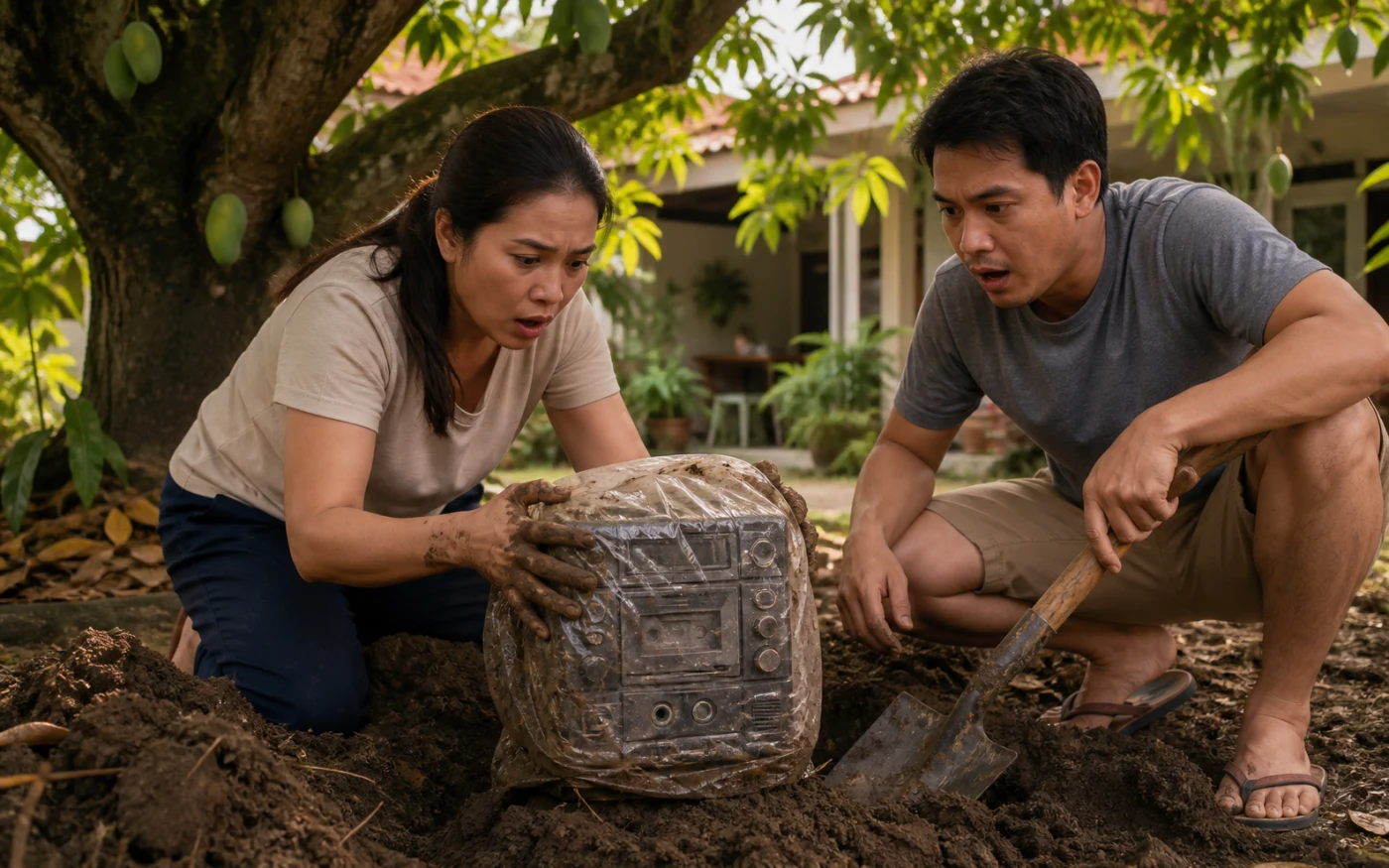
I had been digging beside Mama’s old tree because our backyard flooded every time it rained.
My brother Jun had promised to help, which meant he arrived two hours late carrying iced coffee and advice.
“Your trench is crooked,” he said.
“Your face is crooked. Pick up the shovel.”
Six years had passed since Mama died, but the tree still belonged to her.
She had planted it when I was a baby.
Every summer, she would stand beneath it with a basket, shouting, “Ana, bilisan mo! Before the birds take everything!”
I could still see her there—small, fierce, one hand on her hip, singing while she worked.
Mama had a beautiful voice. Our whole family did.
Except me.
In our house, karaoke was not entertainment. It was a blood sport.
Auntie Cora performed power ballads with one hand pressed to her chest.
Jun closed his eyes like a recording contract depended on him.
Even our youngest cousin could find harmony.
I sounded like a motorcycle refusing to start.
But Mama never allowed me to hide.
“Anak, singing is not only for beautiful voices,” she would say, pushing the microphone into my hand. “Sometimes it is for brave people.”
Then everyone would cover their ears while I bravely destroyed another song.
That afternoon, my shovel hit something hard.
Jun leaned over the hole. “Treasure?”
We scraped away the dirt and found a bundle wrapped in three layers of cloudy plastic. Inside was an old portable karaoke machine, the kind with a cassette deck and two microphone sockets.
It had been buried directly beneath Mama’s tree.
My hands began to shake.
“Kuya,” I whispered. “Why would Mama bury this?”
Jun stopped smiling.
We carried it to the patio and wiped off the mud. The plastic had kept it surprisingly dry.
Inside the cassette deck was one tape with handwriting across the label.
For my brave girl.
I knew Mama’s handwriting.
Jun found an old power cord in the garage. The machine coughed, hummed, and somehow came alive.
The tape turned.
At first there was only static. Then music burst from the speaker—an old love song Mama used to sing while washing dishes.
And there she was.
Mama’s voice.
Young, clear, and bright.
My knees gave way. I sat on the patio step with both hands over my mouth.
She sounded exactly as I remembered, but happier than I had heard her near the end.
She laughed between lines. Someone beside her laughed too.
Then a second woman started singing.
Ay, Diyos ko.
She was terrible.
Not ordinary terrible. Not shy-auntie-after-two-drinks terrible.
This woman attacked every note from the wrong direction.
She came in late, rushed the chorus, and sang with the confidence of somebody who had never once been corrected.
Jun slowly turned toward me.
I stared back at him.
The woman sounded like me.
Not merely bad like me. Exactly bad like me.
The same flat ending. The same stubborn pause before a high note.
The same strange habit of getting louder whenever the melody became uncertain.
On the recording, Mama dissolved into laughter.
“Rosario, grabe ka! The song did nothing to you.”
“Sus, keep singing,” the woman said. “We are almost good.”
Almost good.
That was what I always said.
The song stumbled to an end.
Mama and Rosario were still laughing, breathless and helpless.
I pressed my fingers against the speaker as if I could touch them through it.
Then a man’s voice sounded faintly in the background.
Rosario stopped laughing.
“Did you hear that?”
“Huwag kang matakot,” Mama said quickly.
“He knows I came here. Ernesto said he’ll take the baby if I leave him. He said I’ll never see her again.”
The patio seemed to tilt beneath me.
Mama’s voice lowered. “Then you have to go tonight. I’ll keep Ana safe.”
My name struck like a hand across my face.
Rosario began to cry. “She’ll think I abandoned her.”
“No,” Mama said. “Someday she will know you loved her enough to disappear.”
The tape clicked off.
Jun and I sat without moving.
Somewhere above us, a ripe mango dropped from the tree and hit the ground with a soft, terrible thud.
I stared at the machine.
Then I whispered, “Kuya… who is Rosario?”
Jun’s face had gone pale.
He looked toward Mama’s tree, then back at me.
“Ana,” he said, “I think she’s your mother.”
PART 2: Where Did Rosario Go
I wanted to throw the machine back into the hole.
I wanted to dig up the whole yard.
Instead, I carried it into Mama’s bedroom, shut the door, and played the recording again.
Then again.
By midnight, I knew every breath.
Rosario had cried when she talked about me. Mama had promised to keep me safe. Ernesto had threatened to take “the baby.”
Me.
But none of it could fit inside the life I remembered.
Mama teaching me to fry lumpia without tearing the wrappers.
Mama waiting outside my classroom when I had a fever.
Mama screaming louder than anyone when I graduated.
Mama in the hospital, squeezing my hand and saying, “Anak, you have always been the best thing in my life.”
She was my mother. Walang duda.
So who was the woman on the tape?
The next morning, Jun brought Auntie Cora over.
She saw the karaoke machine and sat down hard on Mama’s bed.
“Ate buried it?” she asked.
“You knew.”
Her eyes filled immediately.
“You knew,” I said again.
“Ana, makinig ka—”
“No. Tell me everything.”
Auntie Cora held my hands even when I tried to pull away.
Rosario had been Mama’s closest friend.
She had married Ernesto when she was very young.
At first he apologized after frightening her. Then he stopped apologizing.
When Rosario became pregnant, he watched her constantly. If she spoke of leaving, he promised to take the baby and make her disappear.
One night she ran to Mama.
Mama hid her for three days.
When Ernesto started searching nearby, Rosario made a choice: she left town alone, making sure he followed her trail.
Mama took me home and told everyone I was hers.
“And my papers?” I asked.
“Fixed later,” Auntie Cora said. “Not easily. Not perfectly. But enough.”
“Why didn’t Rosario come back?”
“She tried. Ernesto kept looking. Even after she escaped him, he sent people asking questions. Your mama told her, ‘Stay away until it is safe.’ They wrote. They called from different numbers. Rosario knew when you started school. She knew when you broke your arm. She knew you hated math.”
“I still hate math.”
“I know, anak.”
“Why didn’t Mama tell me?”
“She planned to.” Auntie Cora’s mouth trembled. “Then she got sick. She thought she had more time.”
“And Ernesto?”
“He died not long before your mama did. After Mila was gone, I kept waiting for the right time to tell you. Then I had waited so long I didn’t know how.”
Anger rose so fast it made me dizzy.
At Mama for waiting.
At Rosario for vanishing.
At Ernesto for turning love into a hiding place.
I started crying.
Jun started crying because I was crying. Auntie Cora told him to get tissues, then cried while scolding him for bringing toilet paper.
We searched Mama’s room.
Inside an old sewing tin, beneath buttons and broken rosary beads, we found photographs.
Mama and Rosario as young women, leaning against each other at fiestas, at the beach, beside the mango tree when it was only waist-high.
In one picture, Rosario was pregnant.
On the back Mama had written: Our brave girls.
There were letters too. Most had no return address. The last one was dated seven years earlier.
Ernesto is very sick. When he is gone, please tell Ana. I will wait for your word. I have already waited this long.
At the bottom was a phone number.
My fingers hovered over it for three days.
Every time I tried to call, I saw Mama’s face.
What if Rosario wanted me to call her Nanay?
What if she expected twenty-nine years of love to appear instantly?
What if I liked her?
That frightened me most.
On the fourth night, Jun put the phone in my hand.
“Call,” he said.
“You call.”
“She didn’t give birth to me.”
“Coward.”
“Yes. But today, ikaw muna.”
The number was disconnected.
I almost felt relieved.
Then Auntie Cora remembered that Rosario had a cousin named Lita in Dumaguete.
Lita knew somebody who knew Rosario’s old landlady.
The search moved through women who called each other “Mare” and remembered everything except exact addresses.
Two weeks later, my phone rang.
“Hello?” I said.
There was silence.
Then a woman asked, “Is this Ana?”
Her voice was older than the one on the tape, but I knew it.
My chest tightened.
“Yes.”
She inhaled sharply.
“Ana,” she said, and began to sob.
I cried too, but no words came. We stayed on the line listening to each other fall apart.
Finally she whispered, “I’m sorry.”
I closed my eyes.
“Please don’t start there,” I said. “If you start there, baka hindi tayo matapos.”
So she told me where she lived.
For a month, we spoke every Sunday.
We stayed with safe things. Food. Weather. Work.
She knew I was married. She knew my daughter Sofia was nine.
I learned Rosario sold cakes from her kitchen and still hated having her picture taken.
Neither of us said Mama’s name often.
It felt too dangerous.
Then Sofia’s birthday came.
Our family filled the house.
Auntie Cora brought pancit. Jun arrived with balloons large enough to block the hallway.
The karaoke machine waited in the living room, because in our family no celebration was complete until someone attempted a key change they had no business attempting.
The doorbell rang.
I thought it was the lechon delivery.
I opened the door.
A small woman stood on the porch holding a cake box with both hands.
Her hair was silver at the temples. Her eyes were mine.
“Hi,” Rosario said. “Pasensya na. I came early.”
PART 3: What Happened with the Microphone
For one horrible second, I could not move.
Rosario looked ready to run.
Then Sofia appeared beside me and stared at the cake.
“Is that for me?”
Rosario blinked. “If you like mango.”
“I love mango.”
“Then yes.”
Sofia took her hand and pulled her inside before either of us could decide how mothers and daughters were supposed to meet after twenty-nine years.
The room went silent.
Auntie Cora covered her mouth. Jun dropped three paper plates.
My husband, Luis, hurried forward, then stopped because he clearly had no idea whether to shake Rosario’s hand or hug her.
Rosario stood beneath the birthday banner clutching the cake.
“Hello,” she said. “Ako si Rosario.”
Auntie Cora crossed the room and embraced her.
There was crying. So much crying.
Rosario cried into Auntie Cora’s shoulder.
Jun hugged both of them and crushed the cake box slightly.
Sofia shouted, “Careful!”
Luis found napkins. Cousins stared at me, waiting.
I stepped closer.
Rosario looked at me with naked fear.
I wanted to call her something. Tita felt cruel. Nanay felt impossible.
So I said, “You came.”
She nodded. “I was afraid if I waited again, I would lose another year.”
I hugged her.
She was smaller than Mama had been. She smelled like baby powder and mango frosting.
Her arms locked around me with a force that made me gasp.
Then she let go too quickly.
“Sorry,” she said.
“Stop saying sorry.”
“Sorry.”
We both laughed once, nervously, and immediately started crying again.
Dinner was painful.
Everyone tried to behave normally, which made nobody normal.
Auntie Cora asked Rosario if she wanted rice four times.
Jun knocked over his drink. Luis praised the cake before we had opened the box.
Rosario and I kept looking at each other.
I could see questions lining up behind her eyes.
Did I have a happy childhood?
Had Mama been gentle?
Did I hate Rosario?
I had questions too.
Had she held me?
Did I look like Ernesto?
Had she ever stood outside our house without coming in?
But Sofia was opening presents, cousins were fighting over chicken skin, and Mama’s framed photograph watched from the shelf.
Rosario saw it.
Her face folded.
She walked over and touched the frame with one finger.
“Salamat, Mila,” she whispered.
Something inside me settled.
She had not come to take Mama’s place.
She had come carrying her own empty place.
After cake, Jun announced karaoke.
Rosario nearly dropped her fork.
“Ay, no,” she said. “I don’t sing.”
I stared at her.
Across the room, Jun stared at me.
Auntie Cora’s eyes widened.
I stood and picked up the second microphone.
“You sing.”
“Hindi talaga.”
“I heard the tape.”
Rosario froze.
I held out the microphone.
“The one under the mango tree.”
Her eyes filled. “Mila kept it?”
“She buried it.”
Rosario laughed through her tears. “Of course she did. Your mama never threw anything away.”
The words your mama landed softly.
I chose the same old love song from the recording.
The opening music began.
Rosario shook her head. “Ana, kawawa naman sila.”
“Let them suffer.”
Sofia cheered.
I placed the microphone in Rosario’s hand.
The first line appeared on the screen.
I sang it badly.
Everyone winced.
Then Rosario opened her mouth.
The note came out flat, late, and spectacularly wrong.
My whole body recognized her.
Not from her eyes.
Not from photographs.
From that hopeless note.
She rushed the next line exactly as I did. She frowned at the screen with the same stubborn concentration. When the melody rose, she simply became louder.
I burst out laughing in the middle of the chorus.
Rosario laughed too, but neither of us stopped singing.
“Mercy!” Jun shouted.
Auntie Cora covered both ears with napkins.
Luis reached for the remote. Sofia slapped his hand away.
“No! Let them finish!”
Rosario moved closer to me.
We shared the wrong rhythm. We missed the same entrance.
When the high note came, we faced each other and attacked it with complete confidence.
It was awful.
It was ours.
On the shelf behind us, Mama smiled from her photograph.
The song ended, but Rosario kept singing one extra word.
I did too.
For one second, the room was quiet.
Then Sofia screamed, “Again!”
Everyone else shouted, “No!”
Rosario looked at me, breathless and glowing.
“Isa pa?” she asked.
I selected another duet.
Around us, the family groaned, complained, laughed, and stayed exactly where they were.
Rosario lifted her microphone.
I lifted mine.
And beneath Mama’s smiling picture, we began ruining another song together.